It’s 85 years since Brian O’Nolan, better known as Flann O’Brien and Myles na gCopaleen, proposed a Book Handling Agency in The Irish Times.
On Sunday evening, Flann’s idea became reality. In a Berlin bar’s back room, Cabinet Magazine, a literary quarterly, assembled a crack team of white-coated literary experts to make your unread books look well-read – at moderate prices.
For €5 you could get an “essential” handling package including a “professional” spine-break for your book, “two commonplace page markers, 2 scholastic dog-ears; 4 underlined passages; 1 arbitrary yet discerning piece of marginalia; and 1 contextually appropriate piece of marginalia”.
The premier package added “mauling the edges” of the book with a drill and sand paper, thanks to the “vice-chiefs of abrasion (light, heavy)” as well as “one stain using cheap wine, coffee etc”, hand-applied by a “fluid dynamics specialist”.
READ MORE


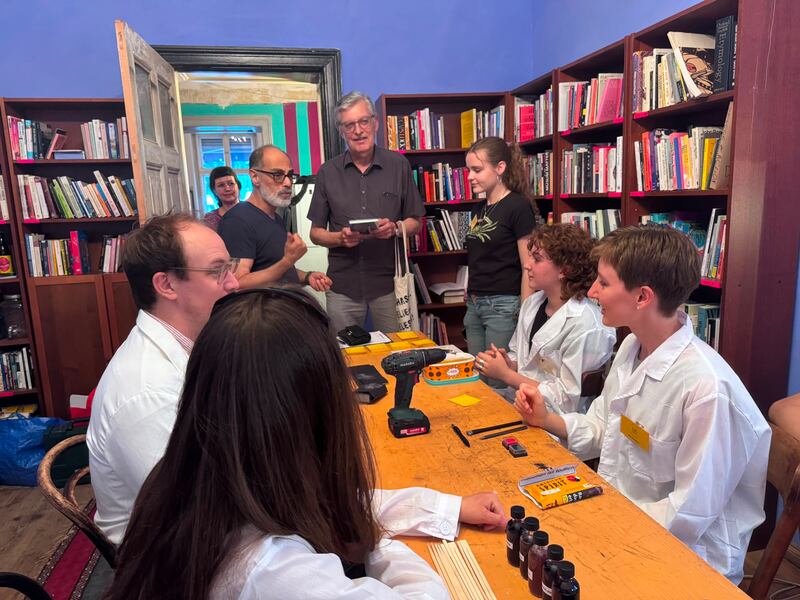
“We learned that, to look authentic, coffee needs to be dropped at a different height than wine,” said Sina Najafi, editor-in-chief of Cabinet magazine, who organised the evening and took on the professional spine-breaking.
He got the idea during a conversation with his friend Michel Chaouli, a US academic, who is working on an essay about underlining in books.
That made Chaouli recall reading, decades earlier, the literary handling agency column in a Flann O’Brien collection.
Chaouli, on Sunday the underlinings and marginalia expert, found it more time-consuming than he expected to give his additions some logic.
“But it was great fun,” he said, “a mix of Flann O’Brien and Monty Python to have normally serious scholars doing this absurd work.”
Among the 40 books handled on Sunday evening were an unread volume gifted to a woman by her mother a year ago – three days before the mother’s next visit.
Another visitor wanted their new copy of the 1,000-page Arcades Project by Walter Benjamin to look as well-read as the lost copy it was replacing.
The book handling agency will pop up again for an autumn fundraiser in New York.
For Najafi, the agency’s Berlin debut was an exhilarating and moving experience.
“We all have unread books,” he said, “but the history of why those books are unread is more fascinating than any of us knew.”


