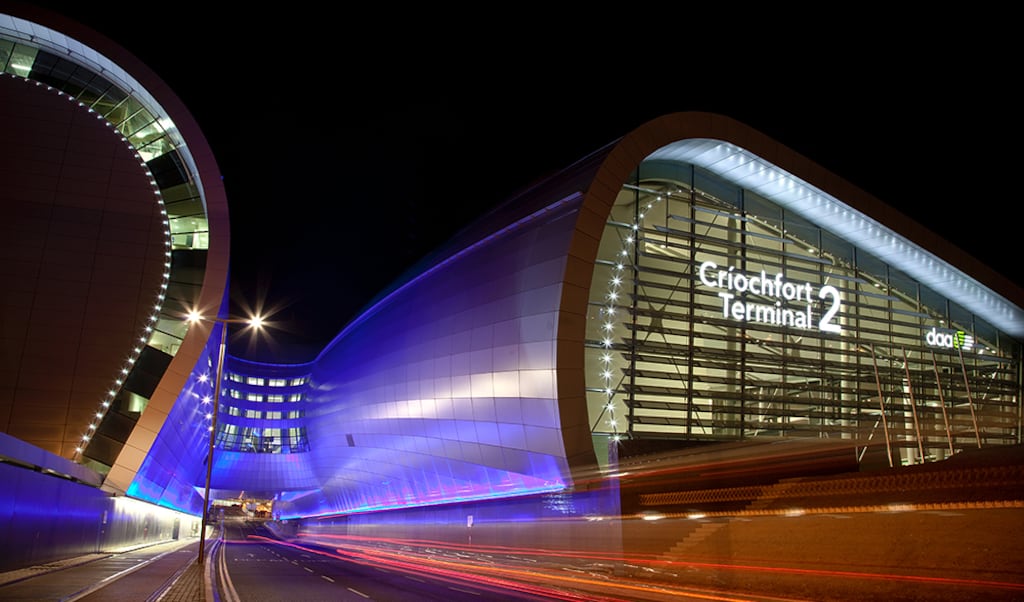
Planners never intended to halt Dublin Airport’s growth when they capped passenger numbers in its two terminals at 32 million a-year, it has emerged.
The limit stems from a 2006 Fingal County Council local area plan calculating that the airport would handle 38 million travellers annually by 2025 and providing for a third terminal, according to Declan Fitzpatrick, chief executive of the Irish Aviation Authority (IAA).
“The 32 million is not a cap on the whole airport, rather on terminal one and terminal two,” he told the Joint Oireachtas Committee on Transport on Tuesday.
Fitzpatrick explained that the Fingal plan provided for a third terminal on the airport’s western side to allow continued growth.
READ MORE


The limit on terminals one and two was to ensure the airport’s “balanced development”, not from a need to ease road traffic or other such concerns, he added.
While the council surveyed the roads around the airport at the time, there was no direct connection between that exercise and the passenger cap, Fitzpatrick explained.
The Oireachtas committee is hearing views on the Dublin Airport (Passenger Capacity) Bill 2026, allowing Minister for Transport, Darragh O’Brien, axe or amend the controversial limit if it is passed.

The difficult choices that could dramatically increase housing supply in Dublin
The 32 million cap has angered airlines, Aer Lingus and Ryanair, along with a group of US carriers, which have taken legal action to halt efforts to implement the limit.
Fingal County Council originally intended that terminals one and two would handle 30 million passengers a-year between them.
When An Bord Pleanála gave Dublin Airport permission to build its second terminal, it allowed for a further two million passengers as a “contingency” in case the third facility was not built once numbers reached 30 million, according to Fitzpatrick.
Subsequent developments at the airport and in air travel mean a third terminal is not now needed, but the planning conditions meant to facilitate its development remain, the IAA chief noted.
He said that if the authority had to take the cap into account when deciding terms for allocating take-off and landing slots at the airport, this would prevent airlines from launching new routes from Dublin.
It would also hinder efforts to boost flights to deal with peak travel, Christmas, Easter and sports events.
Those “unintended consequences” are probably why no comparable European airport has a passenger limit similar to Dublin’s, Fitzpatrick told the committee.
The IAA welcomes the proposed law allowing the minister to end the cap.
Fingal council and An Bord Pleanála told State airports company, DAA, in 2018 that they could not handle an application to increase the passenger limit, Vincent Harrison, its chief commercial and development officer, told the committee.
DAA was seeking permission to build its north runway at the time. The two planning authorities told the company that they would not be able to process both applications, he confirmed.
Earlier, the airports company said air fares rose 13 per cent while flights dipped 3 per cent when the cap was applied in winter 2024/25.
That trend reversed when the High Court stalled the limit’s implementation, DAA deputy chief executive, Nick Cole added.
Airlines Aer Lingus and Ryanair will on Wednesday press their case for the Oireachtas to pass the bill allowing the minister to scrap the limit quickly.
They will warn that without it, the airport could be forced to impose the cap this year, slashing passenger numbers from 36.4 million in 2025, a 12 per cent reduction.
Between them the two carriers account for more than 70 per cent of passengers flying in and out of Dublin Airport.
Ryanair will point out that Dublin could grow to 45 million by 2035 without the passenger cap and subject to what DAA charges airlines.
That will create 10,500 new jobs at the airport and 10,000 in tourist businesses around the State, the airline calculates.


