It is that time already. The summer is fading to memory and hundreds of thousands of children are happily getting ready to go back to school with all the joy that entails.
August:
The month is slipping away into a moment in time, to borrow from Taylor Swift, and parents up and down the country will spend much of this week racing around trying to sort out uniforms, shoes, lunch boxes, school paraphernalia and all the other things that they and their offspring will need before they start school later this week. It could be our fading memory but did schools not used to start back in September?
Back to school allowances:
One of the first ports of call for more than 100,000 families, this means-tested, one-off payment helps cover some of the costs of school clothing and shoes. You qualify if you are in receipt of certain social welfare payment or taking part in approved employment, education or training support schemes.
Household income must fall within set limits and any children you’re claiming for must be aged between two and 17, or 18 to 22 and returning to second-level education this autumn. The payment is €160 for children aged two to 11, and €285 for those aged 12 to 22. Applications can be submitted online using a MyGovID account, and the deadline to apply is September 30th.
READ MORE


The allowance is better than nothing but, as Barnardos highlighted earlier this month, “more and more” parents have raised frustration about receiving “little to no support” when meeting back-to-school costs. The children’s charity said parents’ most frequent complaint was “not being beneficiaries of the back-to-school allowance because they don’t quite meet thresholds”.
Credit unions:
According to the Irish League of Credit Unions, the majority of parents say covering back-to-school costs is a financial burden, with more than one in four getting into debt because of it. The organisation’s annual Back to School survey, published last month, found 59 per cent of parents reckoned back-to-school costs were a financial burden, with 27 per cent getting into debt to cover the costs.
It found that parents of primary-school-going children expect to spend a total of €1,607 across the school year, made up of €623 in upfront back-to-school costs and a further €984 in running costs over the year. Secondary-school parents expect to spend €2,142 this school year, made up of €1,115 in upfront back-to-school costs and €1,027 in running costs.
Back-to-school special: starting age, PE problems, school refusal and teenage vapes
Driving:
Within days our morning and evening roads will become clogged again as children are ferried to and from their places of learning. While driving children some distance to school in the dead of winter when the weather is miserable is probably unavoidable, maybe we could spend the less terrible months walking, scooting or cycling to school instead? It would be better for us, them, the environment and our wallets.
E-learning:
Over recent years many schools have started relying more and more on technology during the school day. The benefits are as yet unproven but what is clear is the financial burden it places on many parents. After decades of campaigning, free book schemes are now the norm in all schools and that is great news, but expecting parents to spend 500 quid on tech sort of defeats the purpose of the free book scheme, doesn’t it?
If there is to be tech used in our schools we need to know that it is better than books and we need parents to be financially supported when it comes to buying it.
Fee-paying schools:
In an ideal world parents would not feel the need to pay thousands of euro each year for their children’s education. And if they did make the decision to have their children educated in a private system, then they would send them to schools that would not require the same level of State funding as schools that don’t charge huge sums.
Government:
The Department of Education tends to have a very hands-off approach to education, despite the fact that it funds the system to the tune of hundreds of millions of euro every year. It is very reluctant to impose rules and instead issues so-called circulars telling schools what it would like them to do.
Rather than mandating an end to expensive bespoke uniforms, for instance, it calls on schools to be mindful of the costs parents face and maybe consider facilitating the use of generic uniforms instead. That is just one example and there are many others. While no one wants to see rigid rules imposed from on high all the time, it would be nice if the department was more proactive when it comes to supporting parents.

Hours:
We were interested to learn of a review of a circular that offers advice on how much time children spend in class and in school. The current advice dates back to 1995 and details how many days each year schools must be open and how many hours children must attend each day.
As it stands, a full school day can be no less than five hours and 40 minutes in duration, 30 minutes of which are set aside for breaks, with a further two five-minute breaks allowed. Schools can cut the school day by one hour for junior and senior infant classes, and that is likely to be a focus of the review. In advance of the review an Oireachtas education committee delegation travelled to Finland and saw how pupils are given 15-minute breaks between lessons and shorter school days.
Inter Cert:
Remember that? If you do you also probably remember when prices were affixed to bags of Tayto and you could buy a packet for 3p, and points were a whole lot different and you could get into arts in UCD with just six of the things.
Jumpers:
We know a lot of schools want to have clothes that carry their own crests, something their students can wear as a badge of pride. But do those crest really need to be embroidered on to high-priced jumpers, coats and tracksuits that can only be found in specialist shops? Could it not be mandatory for all schools with a crest to rely on patches that could be sewn or ironed on? The impact would be exactly the same yet the cost to parents would fall dramatically. A jumper with a bespoke crest can cost as much as €40. A generic one can be bought for less than a tenner.
Kudos:
School is hard. It is hard for children, teachers and parents and kudos to everyone who manages it.
Leaving Certificate:
The exam that has given generations of Irish people PTSD is still going strong and while it is has changed a fair bit since the dark days of the 1980s it remains one of the toughest experiences a young person has to endure. Everything about it is horrendous. The endless hours of studying, the pressure of the exams, the waiting for the results, the actual results, the waiting for the CAO offers to come around and then the elation or, perhaps more frequently, the disappointment if things don’t go our way on the score. It is intense but on balance it seems better than other systems we have come across.
Monday mornings:
Say what you like about the summer months, but they take a whole lot of the stress out of Mondays. For two or three months, we don’t have to start the week by hauling children out of bed, ensuring they are dressed, washed, fed and sent out the door with homework, a packed lunch, a recorder, a hurl and gym gear. We might complain about lazy summer days but we’ll miss them when they are gone.
Nature:
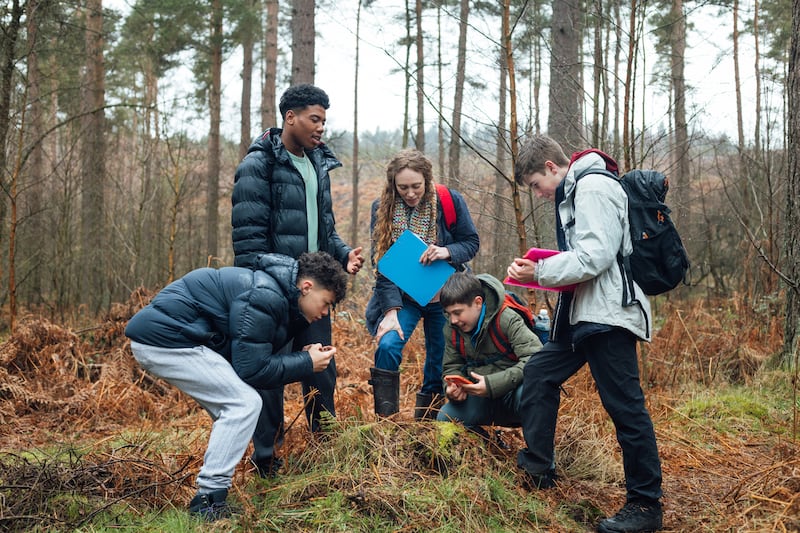
Children spend too much time inside over the course of the school day. There should be more nature walks, more nature tables and – generally speaking – more nature in all our schools.
Outside interests:
Extracurricular activities are vital for young people but they also come at a cost. Make sure you don’t overspend by sourcing what you can on one of the many second-hand platforms that are readily accessible online and only invest in expensive kit when you are pretty sure your child is in it for the long haul. There are few things more aggravating than spending money on a guitar, keyboard of full American Football kit, only to find your child’s interest was as painfully fleeting as an episode of Bluey.
Points:
This is going to be the focus for many young people – and their parents – this week. The system we have for allocating college places can be cruel and heartless, particularly for those who miss out by the narrowest of margins, but we struggle to think of a more impartial and egalitarian way of allocating college places.
[ It’s time to get rid of the damaging Leaving Cert points raceOpens in new window ]
Quality:
When buying uniforms, schoolbags and all the rest, it is always worth remembering that the very cheapest options on offer sometimes do not last as long as you might want them to last. The temptation always exists to buy the cheapest schoolbag or lunch box or water bottle – and in many cases it is unavoidable – but it can be a false economy. A bag that costs €20 but falls apart by Christmas and needs to be replaced is terrible value when compared with one that costs a tenner more but lasts the full year.
Refurbs:
When it comes to buying electronics for kids, look for refurbished rather than new. A refurbed iPad bought directly from the Apple store can save you hundreds of euro and Apple promise that all such models come with a new battery, and new outer shell, are backed by a one-year warranty, have free delivery and returns and are repackaged in a brand-new box with all accessories and cables.
There is also the likes of refurbed.ie, which sells second-hand electronics – including phones – for a lot less than they cost new. The site has a range of protections for consumers such as 30-day trial periods and a bespoke repair and exchange service.
While you can also buy them on online classified sites for cheap, you are taking a risk and have little by way of a comeback should things go wrong. When it comes to phones, look at SIM-only plans. They can offer really good value, with some packages costing less than €15 a month.
Schoolbags:
Do they really have to be as heavy as they are? We have sent children of all ages to school with bags on their back that a 1930s Sherpa would have struggled with.

Teacher:
Teaching is as hard as it is important, or at least it is when it is done well. Good teachers – and there are a great many of them out there – are one of our most precious resources as a society and we should treasure them and reward them properly. It is not without its flaws but our education system is still good, and the hundreds of thousands of children who are starting back will have a more rounded education than many of their peers around the world – and teachers play a large part in that.
Unnecessary:
Now, we recognise the prevalence of homework in the Irish education system but does there have to be so much of it? Some countries – we’re looking at you, Finland – manage just fine giving their children no or virtually no homework at all.
[ Do students really need homework? A new study has come up with the answerOpens in new window ]
Maybe we could learn something from the Finns and hold off on burdening our young folk with work they are expected to do when they could be playing or reading books. Lord knows they will be taking home work for long enough when they are adults.
Voluntary contributions:
We do have sympathy for some schools that have to ask for money as a result of a chronic lack of funding from the State. To many schools have no choice but to chase parents for money just to heat and light their schools and cover the cost of repairs during the year. That is on the State, and now the schools. But parents can still be put under pressure. If you can’t afford it you can’t afford it and that should be the end of the matter. There is no shame attached to that and any school that questions parents in this regard needs to take a long hard look at themselves.
WhatsApp:
WhatsApp can be a bit of a minefield but it can also be very useful in sourcing stuff second-hand. Most parents love getting rid of stuff their children have outgrown so don’t feel any shame in asking if anyone on your WhatsApp group has any uniforms or extracurricular stuff their child has outgrown up for grabs.
Xeroxing:
If workbooks were abolished in favour of old-school copybooks or photocopied sheets we’d all probably be better off.
Yikes:
There are 280 days until Ireland’s primary schools close for the summer, which means your next extended break somewhere lovely might be a long, long way away.
Zeds:
Bedtimes are returning to normal and the grand stretches in the evening that we love so much will soon be replaced by nights drawing in.