
A speck in the Pacific about 1,500km from Tokyo, the Japanese island of Okinawa bears the weight of Japan’s military alliance with the United States.
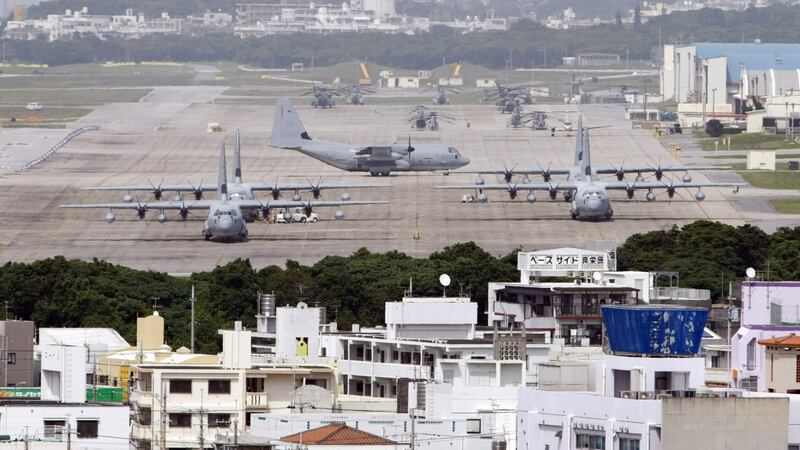
The islanders live uneasily with about 30,000 US troops and dozens of military installations, including the US Marine Corps’ only jungle warfare training unit.
Okinawans have long resented the burden of hosting 70 per cent of all US military facilities in Japan. The facilities include the Futenma airbase, which occupies about 4.8sq km of crowded Ginowan city, bringing noise, pollution and crime.
So locals have reacted with predictable fury to the weekend murder of a local woman. Devin Jacob Ballard, a 20-year-old lance corporal, has been arrested on suspicion of strangling local woman, Anna Yagi (39) in a hotel room. Ballard, who denies the charges, also allegedly stole his dead victim’s wallet.
READ MORE


Security camera footage showed Ballard entering the hotel with Yagi and fleeing alone, according to the Japanese media.
The behaviour of the US guests on Okinawa is closely watched, and politically sensitive. Last year, local police recorded more than 100 crimes by US military personnel and their families.
In 2024, the Tokyo government admitted that it had concealed a string of sex crime cases involving US servicemen in Okinawa, presumably because of their political sensitivity.
Anger at the US presence climaxed in 1995 with mass protests following the kidnapping and rape of a 12-year-old schoolgirl by three US servicemen.
Under pressure, Tokyo and Washington agreed the following year to close Futenma and build a replacement in Okinawa’s north.
But the plan to replace the base with a 1,800m runway off the coast of a quiet fishing village is bitterly controversial: 72 per cent of Okinawans opposed it in a 2019 prefecture-wide referendum.
The proposed new base, rising on reclaimed land out of Oura bay, is supposed to check China’s maritime expansion and maintain US military primacy in Asia.
The marines waded ashore in 1945. The battle to take the island left up to 100,000 civilians dead along with 100,000 Japanese soldiers and more than 12,000 Americans. Many Okinawans have grown up believing they were sacrificed as a buffer between the invading Americans and the Japanese mainland. Okinawa was under US occupation until 1972 when it reverted to Japan.
Yagi’s murder is the first big political test for Okinawa’s new governor Genta Koja, who is backed by prime minister Sanae Takaichi. Koja ejected his anti-base predecessor, Danny Tamaki, in an election last month and is under pressure to dampen down public anger about the murder amid protests on Okinawa.
“The case deals a major shock and adds fear to the Okinawans who have already been forced to live next to US bases,” Koja said after news of the murder broke. “It is absolutely unforgivable and we are outraged,” he said, adding that US military discipline was “not working”. On Wednesday US forces imposed a month-long curfew on soldiers based in Okinawa. They were banned from drinking alcohol while they undergo disciplinary training.
Prime minister Sanae Takaichi has condemned what she called a “brutal” crime, which raises the stakes for the drive to make Okinawa a linchpin in Japan’s strategy to contain China.
A succession of Japanese governments has passed record military budgets and is beefing up defences across roughly 200 islands in the Ryukyu chain that includes Okinawa, which is close to China, Taiwan and the Korean Peninsula.
Japan is training an amphibious assault force, modelled on the US marines, all part of a strategic shift to the south and southwest.
This strategy would crumble if Okinawa were to eject the US military guests, which is why Tokyo and Washington will be carefully monitoring the reactions of Okinawans over the coming days and weeks.