New York mayor Zohran Mamdani and his allies swept a series of congressional primaries in New York City on Tuesday in a remarkable show of strength for the insurgent left that sent shock waves through the Democratic Party.
Mamdani’s candidates toppled a pair of incumbents backed by the city’s political establishment, including influential labour unions and the House Democratic leader. Another candidate backed by the mayor won an open House seat, and a handful of democratic socialist challengers he supported were winning down the ballot.
For months, Mamdani threw himself and his energised political organisation into the three marquee congressional contests, campaigning late into the night in the race’s final days and calling the election a referendum on the direction of the party.
All the winning candidates share Mamdani’s progressive economic platform, and they each ran campaigns that focused intently on ending US support for Israel, a sign of how far public opinion has shifted on the issue, even in New York.
READ MORE


Late on Tuesday night, the mayor stood beaming at a victory party in Brooklyn, where supporters chanted “Free, free Palestine” and “DSA”. Surrounded by many of the same advisers who led his own successful campaign last year, he declared “a new chapter in our party’s history.”
“A year ago, it was not the end of a political movement,” he said. “It was the beginning.”
Mamdani’s deep involvement amounted to an audacious gamble for a brand-new mayor trying to lead an already fractious city. He alienated key allies along the way, but the pay-offs were far-reaching.
At home, the outcome will now cement him as the unquestioned political kingmaker of the nation’s cultural and financial capital and the Democratic Socialists of America as a formidable force.
The results also shook the foundations of the Democratic Party far beyond the five boroughs. When they are certified, Mamdani (34) and his movement will be on track to double the number of socialists in Congress from two to four. The outcome will also force a Democratic Party, already searching for its identity, to reckon with its ascendant, unapologetic left.
“It’s seismic,” said Jon Paul Lupo, a Democratic consultant who was a top adviser to the city’s last progressive mayor, Bill de Blasio.

The races do not necessarily suggest Mamdani has expanded his appeal. Each of the contests in which he endorsed took place in areas where the mayor won comfortably in last year’s election and remains deeply popular.
But Tuesday’s results showed two things about his young mayoralty. Mamdani has a high tolerance for political risk-taking, well beyond that of any of his modern predecessors. And, at least for now, he has the ability to transfer his high-wattage political brand on to other candidates in a way that only a few politicians in any office have been able to.
Brad Lander (56), a close ally whom Mamdani recruited to run for Congress, ran up a staggering 30-point margin in an affluent Brooklyn and lower Manhattan district. He defeated Daniel Goldman, a wealthy Levi Strauss heir who had opposed the mayor in last year’s elections and had close ties to the American Israel Public Affairs Committee, the pro-Israel lobby.

Claire Valdez (36), a little-known member of the state assembly also recruited by Mamdani to run, ran up larger than expected margins for an open seat in a gentrifying swath of Brooklyn and Queens so far left it has been nicknamed the “Commie Corridor”.
She defeated Antonio Reynoso, the Brooklyn borough president, who had far deeper roots in the district and the support of the popular Nydia Velázquez, who is retiring; the left-leaning Working Families Party; and nearly every influential labour union in the city.
And Mamdani’s allies even won in a predominantly black and Dominican district in upper Manhattan and the Bronx. In perhaps the night’s most surprising victory, Darializa Avila Chevalier (32), another democratic socialist who entered the race as a political unknown, narrowly knocked off Adriano Espaillat, the influential chair of the Congressional Hispanic Caucus.
“This is a wake-up call,” said Letitia James, the state’s progressive attorney general, who supported Mamdani’s mayoral campaign but ended up opposed to him on Tuesday.
“Obviously, there’s some hurt feelings tonight, particularly in communities of colour,” she said, adding, “What we have to do is sit down and work with the left-leaning part of the party and see if we can come to some sort of understanding going forward.”
Where previous mayors have taken a wide berth around intraparty primaries, Mamdani dove in. Before he even clinched his own mayoral win, he began recruiting candidates to run for seats he felt were ripe for leftist wins. He headlined fundraisers, appeared in ads and dispatched his top political advisers to run two of the campaigns.
In the race’s final days, Mamdani exhausted himself shuttling between events with Valdez and Avila Chevalier, who were in the closest races. Wherever the mayor went, large crowds seemed to materialise.
Mamdani’s aggressive interventions were not without collateral damage. His positions on some of the races put him at odds with the Working Families Party, prominent black and Latino Democrats, influential labour unions and members of the City Council, all of whom had supported his campaign for mayor and are now involved in his governing agenda.
He infuriated Velázquez, Mamdani’s first supporter in Congress, who believed the mayor should have deferred to her wishes about a successor. She came to accuse the DSA in particular of trying to erase the contributions she and other progressives had made to pushing the city leftward for decades.
Others, including Hakeem Jeffries, the House Democratic leader, were even more upset when Mamdani decided in May to endorse Avila Chevalier, a democratic socialist activist and doctoral student, and break with Espaillat.
Espaillat did not back Mamdani in last year’s primary, but afterward, he quickly endorsed him and brought along Latino support. Mamdani had privately assured Espaillat at the time that he would reciprocate if he ever needed it.
The mayor never explained his change of heart in detail, but his advisers said he watched Avila Chevalier’s momentum and believed he could make a difference in the race. Supporters of Espaillat were furious, and said they could no longer trust Mamdani’s word.
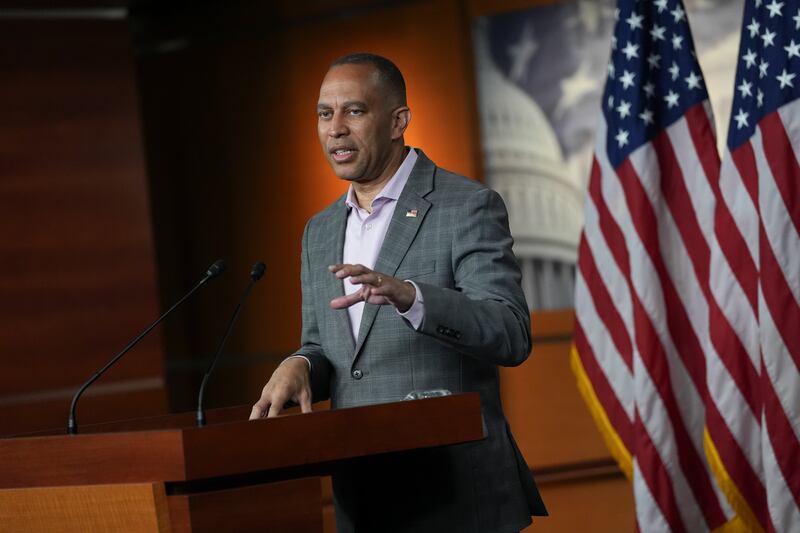
The outcome on Tuesday could pose particular problems for Jeffries, the New Yorker in line to become speaker if Democrats reclaim control of the House this year. Valdez and Avila Chevalier have not committed to supporting Jeffries’ leadership bid and could become persistent thorns in his side.
Democrats aligned with Jeffries, who fought hard to defeat Avila Chevalier, have privately raised concerns about her victory in particular. They fear that Republicans will weaponise a trove of her inflammatory old social media posts, including saying that “all deportations are wrong” and using crude language about Kamala Harris, against more moderate Democrats running in swing districts that will decide the fate of the House this fall.
Jeffries repeatedly sidestepped the issue during an interview on NY1 Tuesday night as the results came in. Others were less reticent to register concerns.
“Republicans will very quickly seek to elevate, as they always do, the most radical voices in the Democratic Party,” said Howard Wolfson, a former head of the House Democrats’ campaign arm and a top adviser to Michael Bloomberg. “And after tonight, they will have more radical Democrats to choose from.”
Mamdani and his allies saw it very differently.
Gustavo Gordillo, a DSA co-chair in New York, said that his organisation was already casting its attention to next year’s budget fight in Albany and beyond.
“We’re going to start thinking about 2028 and what comes next,” he said.
This article originally appeared in The New York Times.
2026 The New York Times Company