On Sunday night, US president Donald Trump attended the Washington Commanders-Detroit Lions football game in Maryland and was roundly booed as he read aloud a pledge for new military members to recite.
It was, for the president, a disagreeable close to a thoroughly miserable week defined by worsening shutdown frustrations and a mini-election trouncing by the Democrats.
There was no surprise that a predominantly middle-class crowd from a Democratic stronghold would boo the president but the sustained venom appeared to catch Trump off guard. He smiled tightly and ploughed on with the recitation. But if the darkest hour is just before dawn, then the sun was about to appear again for Trump.
As it turned out, the pressure valve was already releasing thanks to the machinations of the eight breakaway Democrat senators who decided to make a deal with the Republican majority to reopen federal government and keep it funded until the end of January.
READ MORE


On Tuesday, one of their number, Angus King – an independent who caucuses with the Democrats – explained the rationale behind his decision to end a shutdown that originated in a Democratic attempt to pressurise the Trump administration to extend healthcare credits to the most vulnerable citizens.
“The problem was: the shutdown wasn’t achieving that goal,” King said.
“So, the question was: was there any point in continuing with the shutdown that wasn’t accomplishing anything and at the same time was harming a lot of people.”

There may been a validity in the answer that King was pointing to, but the vast majority of Democrats believe that he was no longer asking a relevant question. If it was true that the Republicans had no intention of acquiescing to Democratic resistance, it is also true that they were beginning to feel the pain of the lockdown.
Trump said so himself last week when he addressed those significant election defeats for the roles of governor in New Jersey and Virginia in addition to New York’s adventurous turn in electing left-wing socialist Democrat Zohran Mamdani as mayor of the city.
“The shutdown was a big factor – negative for the Republicans. That was a big factor,” Trump said after the results.
“And they say I wasn’t on the ballot, was the biggest factor. I don’t know about that but I’m honoured they said that.”
If the Democrats needed proof that their strategy was working, here it was, from the least likely and most relevant source of all.
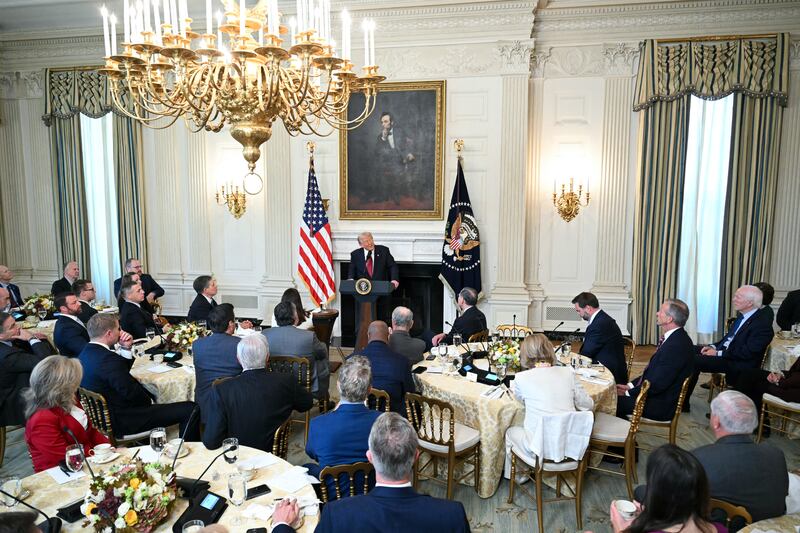
In addition, Republican cohesion had begun to show signs of weakening as Trump gathered Republican senators for a breakfast meeting last week. His express intent was to lobby them to end the filibuster rule, which would enable the Senate majority to simply vote through its preferred legislation without the requisite Democratic support.
A previous attempt to end the filibuster – which requires agreement by 60 of the Senate’s 100 members to pass most legislation – was introduced by the Democrats in January 2022. It was defeated when two Democratic senators, Joe Manchin and Kyrsten Sinema, voted against their party to preserve the tool of obstruction.
Trump referenced that failed vote when he predicted that the Democrats would themselves end the filibuster if and when they return to power.
“The biggest thing is the filibuster. When they do the filibuster, they are gonna pack the [Supreme] court [with judges],” he told the senators.
“I hear it’s up to seven and up to nine [judges]. They will do it in the first week. They’ll vote on this. And I have friends over there who are Democrats. I’m close to a lot of people. And I ask them about that because some people say they won’t do that. I mean, they destroyed the careers of Manchin and Sinema. They are gonna make DC a state and Puerto Rico a state, so now they pick up two states. They pick up four senators.
“You think you have problems? They are going to pick up electoral votes. It’s gonna be a very, very bad situation. And it’s done as soon as they attain power.
“Now if you do what I’m saying [end the filibuster], they’ll most likely never attain power because we will have passed every single thing that you can imagine that is good. And it’s all for the good of the country. If we don’t do that people will say: they are not doing much. And they’re in power.”
This was the first time since returning to office that Trump had betrayed any concerns about the Democratic Party as a future election threat. Both Mike Johnson, the House speaker and John Thune, the Senate leader, had politely but firmly dismissed the idea of terminating the filibuster throughout the week. It was a rare point of dissent.
In addition, Trump had to contend with the sharp and vocal criticisms of Georgia congresswoman Marjorie Taylor-Greene, who called the extended shutdown “an embarrassment” for the government.
A series of polls indicated the majority of respondents primarily blamed the Republicans, as the party in power, for the shutdown. With traffic chaos worsening and food shortages for the most vulnerable threatening to become acute, that disapproval seemed likely to skyrocket.
The Trump administration’s response to the shutdown was one of brutal non-compromise, framed by the cutting of those food stamps, wholesale federal lay-offs and the withholding of federal funding for Democratic states.
All of that ended with the breakaway Democrat votes.

So, when Trump spoke at Arlington cemetery on Tuesday morning to mark Veteran’s Day, he was keen to scan the crowd for Johnson and Thune.
It was wintry, suddenly, in Washington but the president’s mood was bright as he name-checked the Republican congressional leaders from the podium. “Congratulations to you and to everybody on a very big victory,” he said.
“We’re opening up our country. It should never have been closed.”
There it was.
The Commanders lost the football game 22-44 but by Tuesday, Trump was back to declaring wins again.