
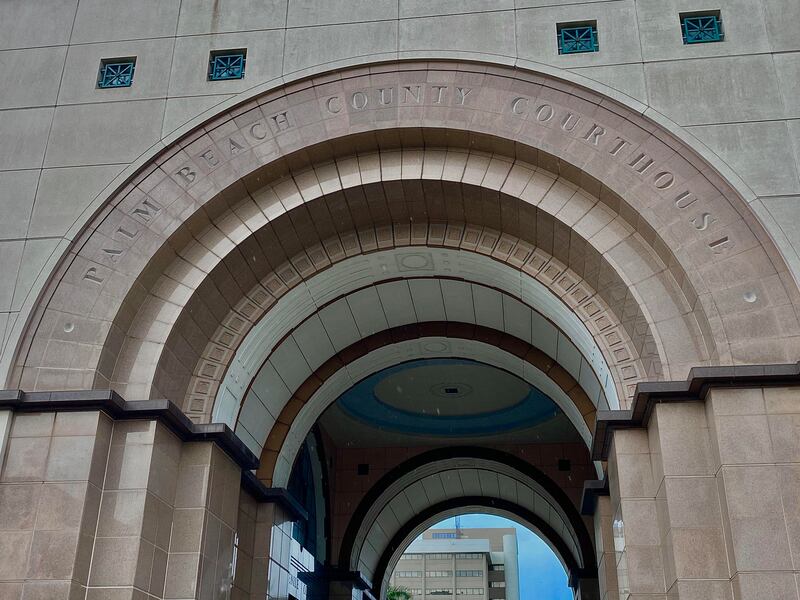
Irish showjumper Bertram Allen, who was arrested in Florida in January on charges of driving under the influence (DUI), appeared virtually via Zoom at a court hearing in West Palm Beach on Friday afternoon.
His attorney argued that Allen’s waiver of his Miranda rights, which allow him to remain silent, should not be admissible evidence because of his high level of intoxication at the time of questioning.
The hearing focused on this motion to suppress any statements Allen made to police following a January 13th car crash. Miranda rights, which protect suspects from self-incrimination under the fifth amendment of the US constitution, must be read to the suspect once they are in custody and subject to interrogation.
Allen (30) represented Ireland at the 2020 Tokyo Olympics and was on the Irish team that finished second in a five-star Nations League showjumping competition in March in Florida.
READ MORE


He is the son of Bert Allen, the multimillionaire whose family formerly owned Slaney Foods.
In the official motion, Allen’s attorney, Julian Kessel, wrote that the defendant must confirm they fully understand the rights being read to them or the consequences of waiving them. He cited multiple cases in which courts found the defendant could not validly waive their rights because they could not do so knowingly, voluntarily and intelligently.
“Because the crime the defendant was being questioned about is a DUI crash, it is to be expected that he was intoxicated at the time of his questioning,” wrote state attorney Savana Scarborough in her response.
Scarborough cited a 1913 Florida case holding that intoxication does not invalidate a confession unless “the confessor is intoxicated to the degree of mania or is unable to understand the meaning of his statements”.
Judge August Bonavita noted during the hearing that the case was more than a century old and was issued in a significantly different legal and social context.
Still, Scarborough held that Allen “was not in a state of mania and was coherent enough to participate with deputies and investigator Escaran throughout all points of the DUI investigation”.
Kessel emphasised Allen’s lack of knowledge about US law and the American criminal justice system.
Allen testified that he was unfamiliar with US constitutional protections and the criminal justice system. He said he has lived half his life in Ireland, the other half in Germany, and has only lived in the US for six to eight months.
The judge questioned the relevance of Allen’s legal knowledge, as his level of intoxication – a physical factor – is at the forefront of the motion, rather than a language or knowledge barrier, an intellectual factor.
“It’s pretty standard,” he said of questioning suspects who may be intoxicated. He indicated that, by Kessel’s logic, evidence could be subject to suppression in many DUI cases.
Scarborough then called the arresting officer, identified as investigator Escaran, to the witness stand. He confirmed that Allen submitted to the roadside sobriety tests, including the horizontal gaze nystagmus test, walk-and-turn, one-leg stand, and finger-to-nose test.
“He advised that he understood what was being asked of him,” Escaran said.
After he arrested Allen and transported him to the Breath Alcohol Test Centre at the local police station, Escaran read him his Miranda rights. Scarborough played video footage from this portion of the interrogation, showing the interaction.
According to Escaran’s testimony and the recording, Allen responded, “Yeah, no problem,” when asked whether he understood his rights.
Allen then testified that while he remembers Escaran, he does not remember being in the room where he was questioned, did not understand what he was being told, and did not understand the consequences of waiving his Miranda rights.
The judge did not rule on the motion to suppress at Friday’s hearing. A pretrial hearing is scheduled for the morning of August 9th.


