The father of a university student killed while trying to protect her friend from Valdo Calocane in Nottingham, UK, told an inquiry it is “disgusting” the stabbing victims were tested for drugs and alcohol but their killer was not.
Dr Sanjoy Kumar, Grace O’Malley-Kumar’s father, said he could not understand why the diagnosed paranoid schizophrenic had not been tested for drugs while in custody after the attacks.
O’Malley-Kumar (19) and her friend Barnaby Webber were both stabbed to death in the early hours of June 13th, 2023, in Ilkeston Road after going on a night out.
She was the daughter of Irish-born, London-based consultant anaesthetist Dr Sinead O’Malley and Kumar.
READ MORE


Calocane then killed caretaker Ian Coates (65) before running over three pedestrians with a stolen van.
Kumar said he and O’Malley had to sign human tissue forms he had never encountered during his work as a GP and a forensic medical examiner with London’s Metropolitan Police, or their daughter’s body would not be released to them.
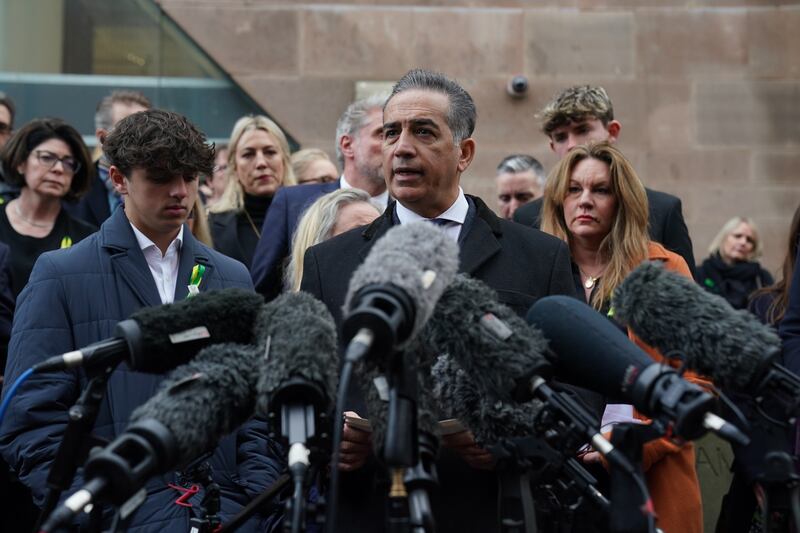
He told the judge-led Nottingham inquiry on Wednesday: “You had to sign them, but what was not highlighted was that this is a point in time where you are also signing to say that samples could be taken. That was absolutely not pointed out.
“They took samples from our children to test for drugs and alcohol. I was really struck by that being really quite disgusting.
“Our children were tested, but the culprit wasn’t and, from there on in, in terms of previous interactions and mental health, that was not made into a big thing at all, that was a flyaway comment.”
Kumar added he “just couldn’t understand” that a hair sample was not taken while Calocane was in custody, adding, “It may have proved nothing but it may have proved everything.”
The father said from his experience, he knew a hair sample to test for drugs did not require Calocane’s consent.
Retired Nottinghamshire police Det Sgt Leigh Sanders previously apologised to bereaved families during the inquiry for a decision not to take a hair sample to test the perpetrator for possible drug use.
But the ex-officer said a sample of hair “would not be able to provide analysis that showed drugs or alcohol in the system at a specific time or date”.
Kumar said: “If you’re a detective of any description at all, and I think every detective watching this is going to agree, if you are here to detect crime, that means forensics is really important.
“And a basic part of that forensics is head hair.”
Kumar said it is “obvious” that if Calocane, who was the subject of a warrant after assaulting a police officer, had been arrested before the attacks, there would have been a different outcome.
He said: “The analogy I use with VC [Valdo Calocane] is that VC was like an oil tanker who crashed into our children and Ian. A one-degree change in his course, he could have ended up in a different continent.”
He added: “If he’d missed our children, he would’ve hit someone else’s.”
Webber’s parents told the inquiry in central London they will “never forgive” the police after officers accessed footage from the attacks and sent WhatsApp messages about their son’s injuries.
His mother, Emma Webber, described one message as “disgusting and grotesque”.
David Webber, the student’s father, said: “And it does seem to me that, again, in this case, my son, who was the victim here, his privacy was not taken into consideration.”
Calocane, who admitted to manslaughter and attempted murder, is detained indefinitely in a high-security hospital after prosecutors accepted his not guilty pleas to murder on the grounds of diminished responsibility in January 2024.
The inquiry, chaired by retired senior judge Deborah Taylor, continues. – The Guardian