

A steady stream of visitors usually tends to wander down the Mall towards Buckingham Palace, even on the blustery damp days that have typified this dullest of Februarys in London.
Thursday’s crowd was hugely swollen, however, as Britain grappled with a sense of national disbelief over the arrest of Andrew Mountbatten-Windsor, Britain’s former prince detained for almost 12 hours on suspicion of misconduct in public office.
Crowds of curious tourists and giddy locals descended on the palace gates to gawp through the bars, and also to act as an impromptu live audience to the phalanx of broadcasters on the lawn nearby: the unprepared trying to explain the unbelievable.
For hours on Thursday morning and throughout the afternoon, the hunger for royal gossip seemed to permeate almost every conversation. One English hotel worker, after clocking The Irish Times email address on a business card, leant in to ask in a conspiratorial whisper: “If you find out anything, will you let me know? I have loved watching the royals all my life, but never, ever has there been anything like this.”
READ MORE


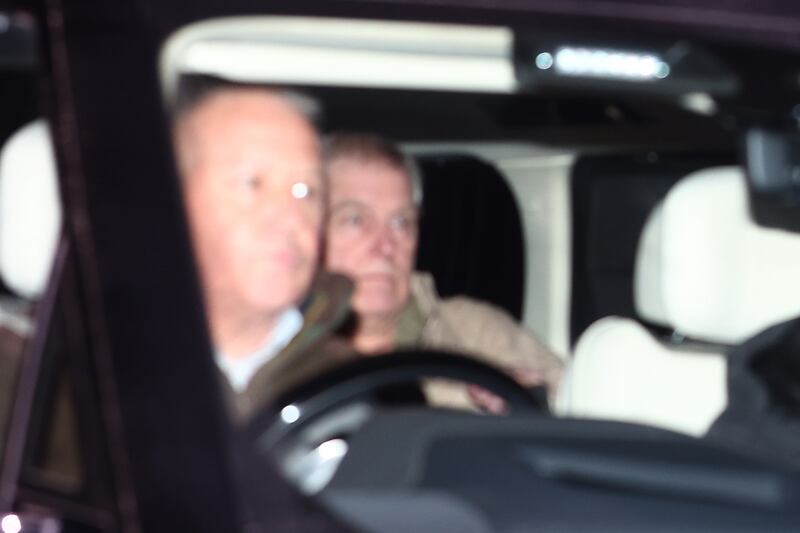
As Mountbatten-Windsor contemplated the non-celebration of his 66th birthday on Thursday from his police holding cell in Aylsham in Norfolk, many Britons might have looked at the man who is still eighth in line to the UK throne, and been inclined to agree.
The former prince was released without charge but Thames Valley Police, who drove three hours northeast to arrest him at Sandringham estate, made it clear he remains under criminal investigation over his links to Jeffrey Epstein, to whom he is accused of leaking sensitive government information while he was a trade envoy.
By Thursday evening police had concluded their search of his relatively modest current abode, Wood Farm on the Sandringham estate, north of Norwich. The more lavish 30-bedroom Royal Lodge from which he was recently evicted, on the grounds of Windsor Castle in Berkshire, was still being combed through by officers.
The tornado of revelations around the late US sex offender Epstein continues to wreak havoc in the British establishment, and there is no sign of where or when it might stop.
Apart from the former prince’s fate, there are at least three further known unknowns.
[ Police continue search of Andrew Mountbatten-Windsor’s former homeOpens in new window ]
[ The Irish Times view: Law must take its courseOpens in new window ]
The first is what this week’s events may mean for Peter Mandelson, the UK’s former ambassador to Washington who is also under police investigation after Epstein’s files released in the US seemed to suggest he had also leaked confidential government information. Mandelson, like Mountbatten-Windsor, has denied any wrongdoing.
While the former prince was in police custody, the lobbying firm that Mandelson cofounded after he left politics, Global Counsel, announced it would enter administration due to its inability to escape the damaging “maelstrom” of the Epstein revelations.
The firm’s blue-chip former clients such as Tesco and Barclays deserted it after the Epstein storm engulfed Mandelson. With the world media’s gaze monopolised by Mountbatten-Windsor on Thursday afternoon, Global Counsel confirmed it had basically reached the end of the road: “This will no longer be business as usual, as the administrators-in-waiting have already indicated that, in the unlikely event that any ongoing servicing of clients is viable, this will be on a limited basis only.”
The Irish Times understands that it had been in merger talks with another big firm but these broke down, putting its 100 jobs at risk. Entering the weekend, its rivals were circling as they prepared to pick off its most senior staff and fleeing clients.
In the meantime, things may get even worse for Mandelson. The UK government is working on a law to strip his peerage – he has already quit the House of Lords. But Mountbatten-Windsor’s arrest also showed the determination of UK police to pursue misconduct allegations against public figures whom the Epstein files suggest had leaked files to the US financier.
Mandelson falls firmly into this category and may fear the risk of ending up at the centre of a similar spectacle to the one that blew up around the former prince on Thursday. He has denied any criminal behaviour.

A second unknown is whether the various UK police forces examining issues around possible misconduct in public office expand their investigations to include allegations of the trafficking of women and girls into the UK on Epstein’s behalf. Former UK prime minister Gordon Brown has this week urged police to do so.
Brown seems to have waded through the Epstein files himself to find what he says is evidence that women were trafficked by Epstein through British airports.
“I have submitted a five-page memorandum to the Metropolitan, Surrey, Sussex, Thames Valley and other relevant UK police constabularies,” said Brown.
“This memorandum provides new and additional information to that which I submitted last week to the Met, Essex and Thames Valley police forces where I expressed my concern that we secure justice for trafficked girls and women.”
Brown was among the first to call a week ago for Mountbatten-Windsor to be interviewed by police.
A third unknown exists around the extent of the lasting damage that the Epstein revelations may inflict upon the British monarchy itself.
The group Republic, whose chief executive Graham Smith was arrested before he could protest on British king Charles’s coronation day in 2023, made the original complaint to Thames Valley Police that sparked this week’s investigation into Mountbatten-Windsor.
Broadcaster Jonathan Dimbleby, a close friend of Charles who occasionally acts in the media as a sort of non-official king whisperer, argued on Thursday that the monarchy wasn’t weakened by what happened, but the institution of the royal family may have been actually strengthened by it. His justification was that, as he saw it, the British king behaved “impeccably” by effectively washing his hands in public of his brother and insisting that the “law must take its course”.
Smith and Republic, however, saw things differently and argued that the former prince’s arrest proved the monarchy had no future.
“Make no mistake, this is a result of Republic’s action,” said the group, which claimed it had been prepared to pursue a private prosecution against Mountbatten-Windsor if the police had not pursued the former prince.
Thursday’s statement by Charles in which he effectively abandoned him to his fate with police was notable because it was also issued in the monarch’s own words, as opposed to a palace spokesperson.
He also referred to his brother as Andrew Mountbatten-Windsor, coolly underlining how the former prince has been catapulted from the royal family. There is a sense that the British monarch grasps that the future of the institution rests on its ability to handle crises such as the one engulfing the former Duke of York.
The most recent Ipsos polling of British public attitudes towards the monarchy, conducted this month in the week before the arrest, showed that although the popularity of the royal family had fallen, most Britons still believed the institutions would endure.
“The public are less likely to think the royals are handling the issue well and less likely to think it would be a bad thing if the institution was abolished,” said Keiran Pedley, the Ipsos director of UK politics.
“However, it is unclear how lasting any damage will be. Only one in four think it would be better if the monarchy was abolished and eight in 10 still think it will exist in 10 years time.”
The era of the royal mantra of “never explain” appears to be in the past. For Mountbatten-Windsor, however, the future remains unclear.


