

As Britain remains mired in acrimony over migration, its parliament in Westminster often discusses refugees. Rarely does it hear from one, except when Alf Dubs speaks.
The Labour peer, who turned 93 this month, escaped the Nazi takeover of Czechoslovakia in 1939 on a Kindertransport journey via train and ferry to England, where he was met by his Jewish father. His non-Jewish mother followed later.
Along with his fellow member of the House of Lords, the Anglican bishop Guli Francis-Dehqani who fled Iran in 1980, they are the only members of the UK’s houses of parliament who arrived in Britain as refugees.
In a country riven with division over the issues of asylum and migration, Dubs is an eloquent voice on the side of new arrivals from abroad who he feels can be traduced.
READ MORE


“The argument on behalf of human rights and asylum seekers should not depend on the personal background of the person making the argument,” says Dubs, as we sit in his Millbank office across the street from the House of lords.
“But, clearly I was more emotionally involved. It meant I had more empathy when I met refugees in Britain. So, yes, it does make a difference.”
Dubs, a former MP, says he can’t remember how he felt as a child, when the Nazi threat arrived in Czechoslovakia. But he can remember specific incidents.
“I remember having to tear out a picture of the Czech president from my schoolbook, and put in a picture of Adolf Hitler in its place.”
He also remembers the cheering when his Kindertransport train crossed the Dutch border: “But at the time, I didn’t know what it meant.”

The Kindertransport effort to save hundreds of mostly-Jewish children from the Nazis was spearheaded by London-born stockbroker Nicholas Winton, who arranged the journeys and paid families in Britain to take in the children.
“My Jewish father had always said he would leave if the Germans came to Prague. His cousins said they would take their chances, but they were sent to Auschwitz by the Nazis in 1942. My father left the city within 24 of the German occupation,” says Dubs.
“My mother was refused permission to leave. They threw her down the stairs when she went to ask, but they threw her passport after her, which meant she still had hope.”
With Dubs’s father already waiting in London, his mother put him on the Kindertransport in June 1939.
“She gave me some Czech sausages and rolls. It took two days to reach England, by train to the Hook of Holland and a ferry to Essex. When I arrived in London, my father wondered why I hadn’t touched any of my food.”

Dubs’s mother, still in possession of her passport, eventually managed to escape Czechoslovakia on August 31st, 1939. The next day, the war started when the Nazis invaded Poland. “That was her last chance,” he says.
Another central European man had promised Dubs’s father a job in a textile factory, should he ever make it to England. He had permission from the British government to open a factory, but only in Scotland or Northern Ireland, where unemployment was highest. He found a disused factory in Cookstown.
“So off we toddled to County Tyrone, where my father worked in the factory. Shortly after he had a heart attack and died. That left my mother and me in Cookstown. We were there for two years, but she couldn’t make ends meet. We left for Manchester where she got a job.”
Years later, after former UK prime minister Tony Blair appointed Dubs as a minister in the Northern Ireland office, an SDLP councillor in Cookstown announced that the new minister had lived in the town.
Dubs says some of the staff in his Belfast offices were surprised to learn he had once lived in the North, and asked him: “Why didn’t you say?”
“I told them it was only for two years aged seven to nine, and that doesn’t really qualify you to say you had lived in Northern Ireland. On the other hand, it’s too long to deny.”
It is painful that our traditional values are going by the board
— Alf Dubs
Years before, Dubs had been a Labour MP for Battersea in London and had always been involved in Anglo-Irish affairs. Then he lost his seat in 1987 and went to run the Refugee Council. He was also appointed to the Lords.
In 1997, Blair came calling to appoint him to “Mo’s team” – Mo Mowlam, then the UK government’s Northern Ireland secretary. He served as a minister for 2½ years, until New Year’s Eve 1999.
Since then, Dubs has been an active voice for refugees and migrants. He says he finds the current febrile debate in Britain on these topics “very depressing”.
“I thought we were doing better on this a few years ago. It pains me – one political party is pushing it, and that’s Reform. I think it is painful that our traditional values are going by the board. Not enough strong voices are speaking out against it.”
Dubs is particularly upset by the occasional loose talk of an “invasion” of migrants.
“When you call people invaders, you are calling them the enemy. That sets a tone. Language can have a very damaging effect on relations in the community.”
I don’t think we will weaken the position of Reform by doing a ‘me too’ on their approach. It is not very helpful.
— Alf Dubs
What about the language and policies of his own Labour Party in government? Home secretary Shabana Mahmood recently announced a crackdown on asylum seekers and those who are granted refugee status: she has proposed making it harder under British law for them to bring their families, while their status has to be regularly reviewed even after a successful claim. As he speaks about it, it is clear Dubs is disappointed in her.
“I think she is being unnecessarily hardline. I don’t think we will weaken the position of Reform by doing a ‘me too’ on their approach. It is not very helpful. I think we need to indicate that we are different.”

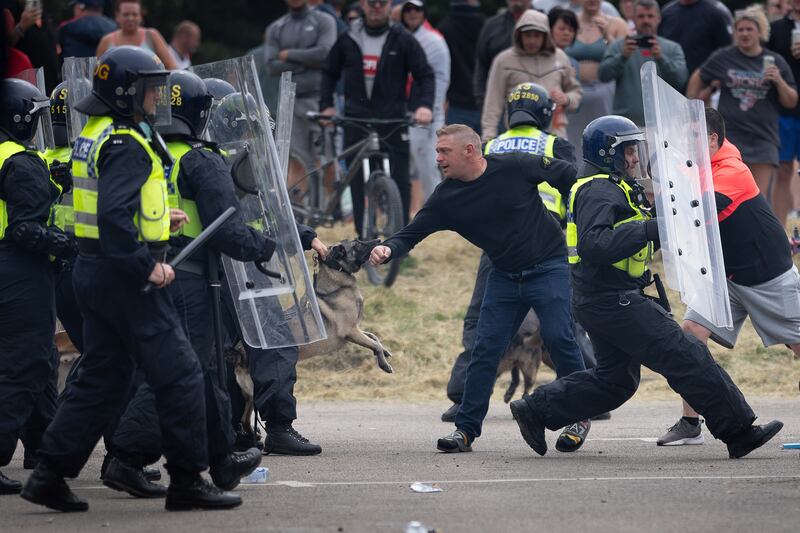
Dubs is harshly critical of some of the protests seen this year outside asylum hotels in Britain, in places such as Epping, as well as the attempted burning of an asylum hotel near Rotherham in the riots of 2024.
“That shamed us. It shames us a country. I think those people outside those hotels don’t represent what this country is really like.”
He is also frustrated by the tendency in the debate to confuse asylum with migration.
“Asylum is based on protection of human rights. Immigration is not unworthy, by the way. Governments can pick and choose which immigrants they want to stay,” he says.
“There is a question around how you decide whether an individual is an asylum seeker or an immigrant. You need a proper system for it that doesn’t take years to come to a conclusion for that individual.”
Dubs says he would like Britain to be more generous about child refugees.
I don’t denigrate the people who vote for Reform. We’ve got to educate them and help them see things differently
— Alf Dubs
But what about the concerns of some people in Britain, who may hold worries about the impact on their communities from an influx of immigrants of different backgrounds, faiths and cultures? Does he understand their concerns?
“I do understand. People are quite conventional, especially seriously older people. I understand that. I think we have to expect that. I don’t denigrate the people who vote for Reform. We’ve got to educate them and help them see things differently,” he says.
“There are people who’ve got their lives and they’ve got their concerns. Our job is to make them realise that [immigration] is not a threat and to make them realise that this is something which our local communities have enough strength to absorb.”
[ Inside Tommy Robinson’s world: Leader of Britain’s right-wing nationalist upsurgeOpens in new window ]
On the separate issue of asylum, Britain and Ireland were recently among 27 signatories to the European Convention on Human Rights (ECHR) to sign a statement calling for reforms to the convention’s Article 8, to make it easier to deport illegal migrants.
“I’m nervous on that. Even if 27 countries gang up on human rights, I’m still nervous about it. I think we’ve got to be very careful on this, because the government’s argument seems to be sometimes you have a really serious criminal, and you want to deport him. Now, there are very few instances where that has been stopped by the ECHR,” he says.
Countries such as Ireland and Britain, he says, “should set a better example”.


