
A master plan presented at Davos for the reconstruction of besieged and devastated Gaza is viewed as unrealistic by Palestinian commentators, residents of the strip and United Nations experts.
Drawn up by US president Donald Trump’s son-in-law Jared Kushner, “New Gaza” is predicated on an end to hostilities between Hamas and Israel, withdrawal of Israeli troops from 58 per cent of Gaza, Hamas disarmament, deployment of a yet to be recruited international stabilisation force and governance by a 15-member Palestinian technocratic committee.
The plan is to be overseen by Trump’s “Board of Peace”, announced at Davos, which includes Kushner, US special envoy Steve Witkoff, representatives from Qatar and Turkey and Israeli prime minister Binyamin Netanyahu who faces an International Criminal Court arrest warrant for war crimes in Gaza.
While no Palestinians are on the board, Kushner and Witkoff travelled to Israel on Saturday to discuss the plan with Netanyahu.
READ MORE


Reconstruction would proceed in four phases, beginning at Rafah in the south and gradually stretch northwards to Gaza City.

[ Israel retrieves remains of Ran Gvili, the last hostage held in GazaOpens in new window ]
While Kushner said initial work could take two to three years, the United Nations Office for Project Services said there are more than 60 million tonnes of rubble in Gaza. This would fill nearly 3,000 container ships and need at least seven years to move before demining can be completed.
While a ceasefire has been in place since October, the killing has not stopped.
Israel has bombed and shelled Gaza, killing 484 and injuring 1,321 Palestinians, according to the Palestinian ministry of health. Israel has said four of its soldiers have been killed by militants since the ceasefire.
The UN has estimated that 78 per cent of structures in Gaza have been damaged or destroyed and the UN, European Union and World Bank have said rebuilding Gaza could cost $70 billion.
Real estate magnate Kushner’s “New Gaza” plan imagines a futuristic dreamscape of 180 luxurious skyscrapers along the Mediterranean coast, high-rise housing for Palestinians near Rafah, an airport, a seaport near the southern border with Egypt, an industrial zone and an agricultural area in a sandy area.
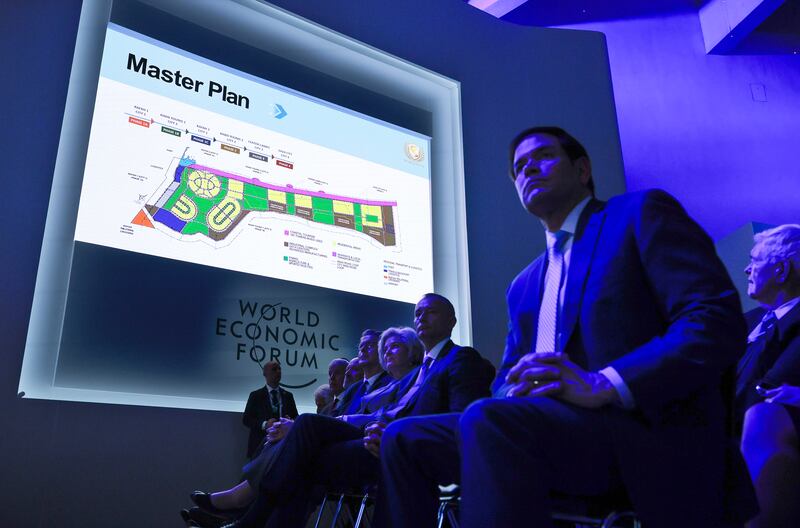
While 2.2 million Palestinians are to remain in Gaza under the plan, most are living in tents, schools, and damaged buildings as Israel has not allowed temporary mobile homes and prefabricated shelters to enter Gaza. Israel will have to change this policy and also permit sufficient food and medical supplies into Gaza.
Under Kushner’s plan, 50,000 Palestinians could be employed in construction. This amounts to a major shift from Trump’s early 2025 plan to relocate Palestinians and turn Gaza into a “Riviera of the Middle East.” Despite the shift, Palestinian interests have not been considered. They will have to be compensated for their rights to land, homes, and business premises which will be erased by the plan. Palestinians allowed to stay in Gaza will be vetted and given biometric identity cards which will grant surveilled and controlled freedom of movement. Palestinians will live in planned zones similar to refugee camps with infrastructure, schools, health centres, and other amenities.
[ Trump is ‘power-crazy’ and Board of Peace a delusion of power, Mary Robinson saysOpens in new window ]