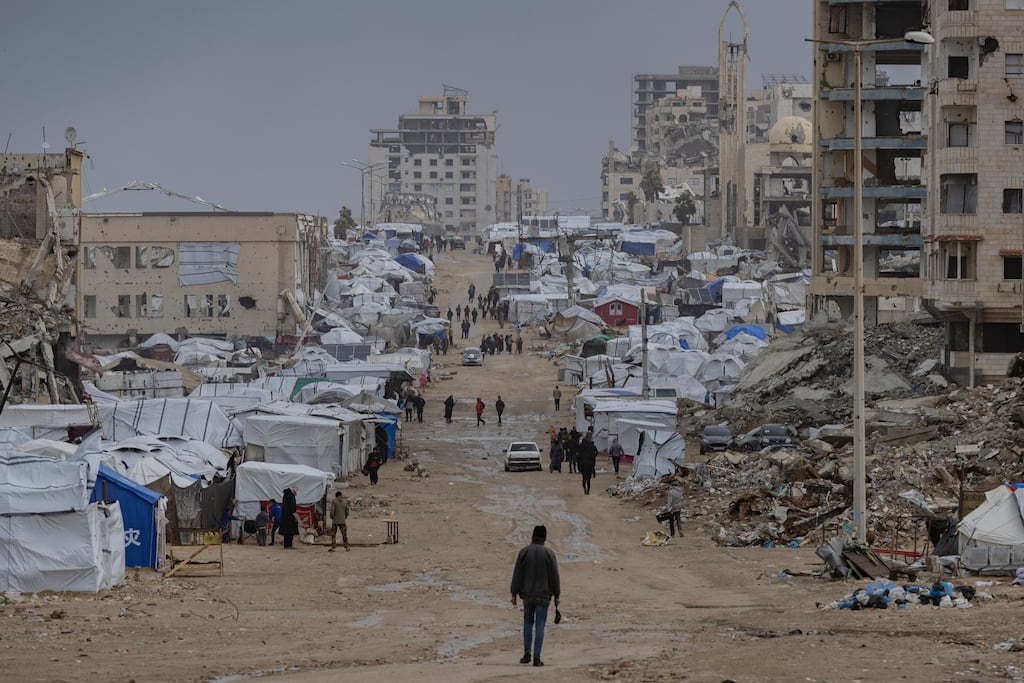
US president Donald Trump’s special envoy Steve Witkoff announced on Wednesday the launch of phase two of the plan to end the conflict in Gaza with the establishment of a technocratic Palestinian administration in the enclave.
“The US expects Hamas to comply fully with its obligations, including the immediate return of the final deceased hostage. Failure to do so will bring serious consequences,” Witkoff wrote in a post on X.
Egyptian mediators, meeting in Cairo on Wednesday with Hamas officials, finalised details of the formation of a technocratic committee to govern the war-torn enclave.
Egypt’s foreign minister Badr Abdelatty said a consensus was reached with all the Palestinian factions. “We hope that following this agreement, the committee will be announced soon ... and will then be deployed to Gaza to manage daily life and essential services.”
READ MORE


Under a 20-point programme presented by Mr Trump in October, Gaza would be administered by the transitional Palestinian committee which will be responsible for the enclave’s day-to-day management, including sanitation, infrastructure and education.
A Hamas official said the Cairo meeting aimed to address the formation of the committee and its operational mechanisms.
Israel reportedly vetted the names of the members appointed to the technocratic committee to make sure they had no links to Hamas.
According to Palestinian sources, the 15-member Palestinian body will be headed by Ali Shaath, a former Palestinian Authority (PA) deputy transportation minister, despite Israeli opposition to any role for the Ramallah-based PA, ruled by Palestinian president Mahmoud Abbas.
Other committee members include representatives from the private sector and NGOs.

Groups representing families of Israelis kidnapped in the Hamas October 7th attack criticised the decision to move towards phase two of the ceasefire while the body of the last hostage has still not been returned to Israel, warning that the result may be that the remains of police officer Ran Gvili may “disappear forever.”
Relatives of Ran Gvili described the reports of progress in the ceasefire deal as a “punch in the gut” and said they would do everything in their power to torpedo implementation of phase two, as long as Ran’s body remains in Gaza.
Senior Israeli officials denied that prime minister Binyamin Netanyahu had linked progress in the ceasefire to the return of the body and stressed that the search in Gaza for the hostage’s remains could continue for a long time.
The make-up of the 15-member international “Board of Peace”, to be chaired by Mr Trump himself, is also expected to be announced shortly. Nickolay Mladenov, a Bulgarian diplomat, who was the UN’s special coordinator for the Middle East peace process between 2015 and 2020, will serve as director of the board.
Despite Mr Trump’s determination to push ahead with the second phase of the ceasefire, significant problems remain.
Hamas remains opposed to disarming, one of the core conditions of the peace plan. Without this happening, most states, particularly Arab and Muslim countries, will be reluctant to commit troops to the International Stabilisation Forces (ISF), which is slated to deploy in the enclave as Israeli forces redeploy.
Separately, the United Nations Children’s Fund (Unicef) has published a report noting that over 100 children have been killed since the ceasefire between Israel and Hamas was signed in October.
Unicef reported that at least 60 boys and 40 girls were killed in Gaza despite the cessation of hostilities, a figure the organisation says is likely higher, as it only reflects “incidents where sufficient details have been available to record.”
“A ceasefire that slows the bombs is progress,” Unicef said, “but one that still buries children is not enough. It is a warning, and it demands enforcement, humanitarian access, and accountability.”
“This is the time to turn reduced violence into real safety: open access for aid, massively increase medical evacuations, and make this the moment when the killing of children in Gaza truly ends,” it added.
[ Israel hopes for regime change in Iran after decades of tensionsOpens in new window ]