
European governments could not afford to “snooze” through the second energy crisis wake-up call in recent years and needed to cut their reliance on fossil fuels, European commissioner Dan Jorgensen has said.
European businesses and households were still feeling the pinch from the spike in energy prices that followed Russia’s invasion of Ukraine four years ago when the war in Iran sent costs shooting up again, the Danish politician said.
Jorgensen, the European Union’s energy policy chief, said a decision by many governments to subsidise the cost of petrol and diesel by cutting excise and tax on fuel during the recent energy shock was the wrong approach.
Last month the Irish Government decided to maintain reduced excise duties on petrol and diesel until September 1st. The supports have reduced the cost of petrol and diesel by 27c and 32c respectively, at a cost of hundreds of millions of euro in foregone taxes.
READ MORE


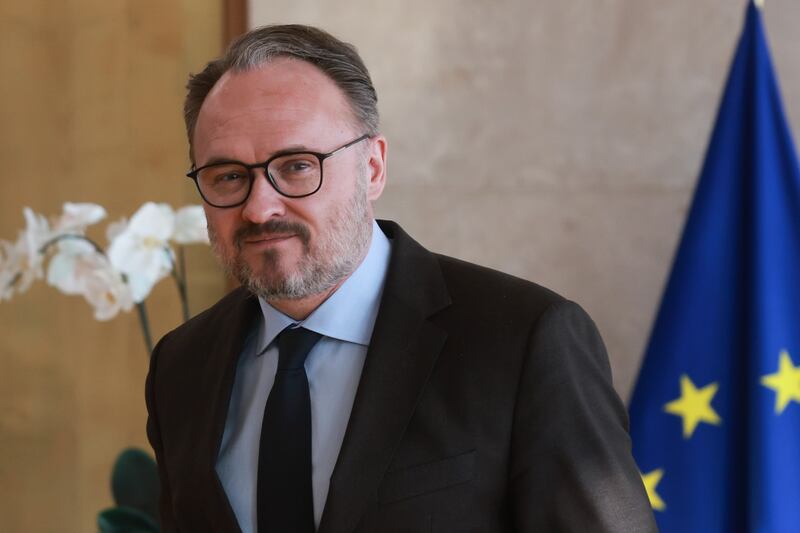
The EU had to double down on its ambition to transition away from fossil fuels towards clean energy, even if that was costly at the outset, the energy commissioner said.
Tehran’s choking of the Strait of Hormuz, a key shipping lane bringing oil and gas from the Gulf, had forced Europe to pay an extra €50 billion for fuel “on top of what we normally pay” since the US started bombing Iran in February, he said.
“For me this should be a wake-up call for everybody … This must be the final wake-up,” Jorgensen said. “The present situation is not sustainable,” the commissioner said.
China was racing ahead on a path to become an “electro-state” that ran on renewable energy sources, while European electrification efforts had “stagnated”, he said.
The US, Japan and Korea were also making faster progress compared with EU countries, something that would give them an economic edge.
“We have a problem with our competitiveness due to too high energy prices … We cannot be dependent on buying expensive fossil fuels. We need to grow our own cheaper renewables,” Jorgensen said.
The fact some governments continued to subsidise fossil fuel consumption was “very counterproductive” and like “giving diabetes patients sugar”, he said.
At present electricity accounts for 23 per cent of the EU’s energy consumption.
The European Commission, the EU’s executive arm that proposes laws, wants to double that by 2040, so that electricity would supply close to half of the bloc’s energy needs.
In an interview with The Irish Times and a group of other newspapers, Jorgensen predicted the new electrification target would be attacked as too high by some people.

The “architecture” for how that transition might be achieved, such as whether the target would be legally binding similar to emission reductions targets, had not been decided, he said.
Brussels officials want governments to help shift people to buy electric vehicles and heat pumps for their homes, and to electrify public transport networks and encourage businesses to draw their energy supply from electricity rather than oil and gas.
There would be upfront costs for businesses making the switch to more sustainable energy sources, Jorgensen said.
The uptake of electric vehicles is increasing as the cars become more affordable, a trend EU officials want governments to really lean into.
The commission also wants countries to roll out charging networks for battery-powered electric trucks in the future, to wean the haulage sector off its dependency on fossil fuels.
Jorgensen said countries had to end mismatches where electricity was taxed at higher rates than gas in utility bills. Governments needed to phase out state subsidies for fossil fuels “once and for all”, he said.
The energy commissioner pointed out that Russia’s war in Ukraine would end and transatlantic relations with Washington would eventually return to normal, but that climate change “will not disappear”. Governments and societies had to make changes to avoid an environmental catastrophe, he said.


