

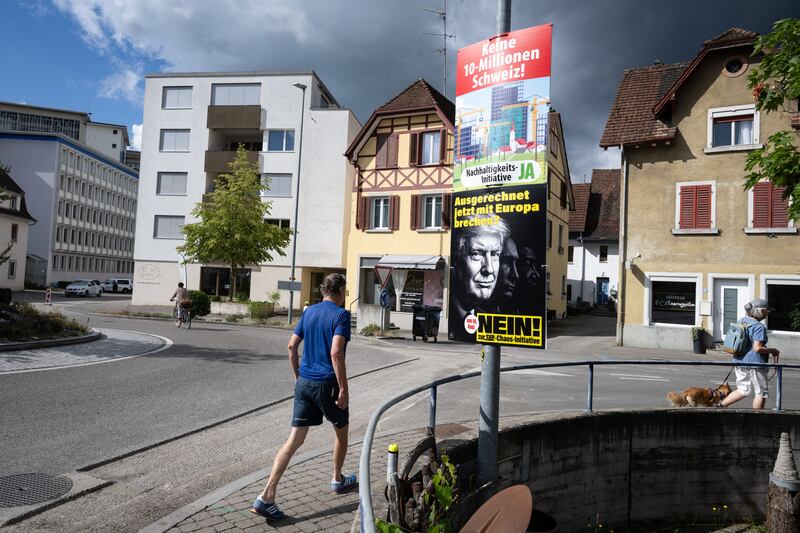
Swiss voters will decide on Sunday whether to cap the country’s population at 10 million until 2050, the 20th time they have faced a popular vote on immigration in the past six decades.
Framed as a “sustainability initiative”, supporters say a population cap will cut crime and ease pressure on housing, hospitals and schools in a country where the population has grown by a quarter in the past 25 years.
Critics warn it will undermine the Swiss economy, hugely dependent on immigration and border commuters, and knock out key bilateral deals with the European Union and other international treaties.
“We want to spread the message that the initiative will lead to chaos, whether in the care, gastronomy or security sectors,” says Adrian Michel, co-ordinator of the No campaign.
READ MORE


After heated debate, final polls from a week ago indicate 52 per cent of voters will reject the initiative with 45 in favour. With 3 per cent of voters undecided, however, the No side’s lead could yet melt away on polling day.

Adding to the uncertainty: the final poll was carried out before a May 28th knife attack in the city of Winterthur. A Turkish-Swedish national was arrested at the city’s main train station. He is accused of shouting “Allahu akbar” and stabbing three passersby at the main train station before he was restrained. Police say the 31 year-old has links to the local Islamist scene and has received psychiatric treatment in the past.
“Events like in Winterthur could lead to a reassessment of the arguments, particularly in urban areas,” says Lukas Golder of polling agency GFS Bern. “This will be a tight race.”
The Swiss People’s Party (SVP), which backs the June 14th initiative, was quick to frame the Winterhur attack as “the result of uncontrolled immigration”.
“This is not my Switzerland,” said Domenik Ledergerber, an SVP councillor, to the Tagesanzeiger daily. “It gives me pause to think that we now have to expect attacks like this in broad daylight. All the more reason to vote yes on June 14th.”
Final pre-poll analyses note a sharp city-country divide, with city dwellers opposed to the cap although they are at the sharp end of the challenges the initiative promises to address, from high rents to packed trains.
Rural Swiss voters, often more insulated from the negative effects of population growth, are more likely to back the 10 million cap.
Political scientist Simon Stückelberger says conservative rural Swiss voters are motivated more by abstract fears.
“They want to preserve Switzerland and are critical of population developments such as immigration, even if it hasn’t changed their own area as much,” says Stückelberg, an analyst with the Sotomo research group.
Switzerland’s population has doubled since 1900 to 9.05 million now. Some 27 per cent are foreign nationals and 71 per cent of those come from EU countries, thanks largely to a 2002 freedom of movement allowing EU citizens work and live in the non-EU Switzerland.
The initiative includes provisions to start winding down such agreements when the population crosses the 9.5 million mark – probably by 2030.
Swiss debates over national identity and immigration have raged since the 1960s and triggered regular public votes thanks to Switzerland’s direct democracy system.
In 1970 Swiss voters rejected an initiative promising to curb “Überfremdung” or over-foreignisation.
In 2014, a narrow 50.4 per cent of voters backed an initiative to “stop overpopulation” by limiting EU citizens’ freedom of movement in Switzerland.
After a marathon 11 years of talks between Bern and Brussels, a new bilateral agreement will be put to Swiss voters next year – unless a Yes vote on Sunday plunges Switzerland into a new period of uncertainty.


