Donald Trump’s olive branch to North Korea’s Kim Jong-un at the expense of a long-standing ally comes at a pivotal moment for US security ties in Asia, as partners from Japan to India reassess how much they can rely on Washington.
The US president’s abrupt decision last week to cut back military drills with South Korea, which he described as hostile to Pyongyang, has reinforced fears that Trump’s unpredictability could strain alliances that have long maintained peace in the region, government officials and security experts said.
Japan worries it too could find itself in Trump’s crosshairs as it embarks on thorny security negotiations; Taiwan is warily watching an upcoming summit between Trump and Chinese president Xi Jinping; and India is growing less certain of its place in Washington’s strategic calculus.
“The decision will certainly fuel growing doubts in the region about US security commitments,” said Jeremy Chan, a senior analyst with political risk consultancy Eurasia Group and former US diplomat in Japan and China.
READ MORE


Adding to the anxiety, the United States cancelled another military exercise with South Korea scheduled for next month, Seoul said on Monday, after Washington cited constraints on US forces due to the Iran war.
Trump has been frustrated by the failure of US allies to support the war and made it clear that many of them must spend more on their own defence, a White House official said when asked about such concerns. The US president is eager to restart talks with North Korea and secure a win on the international stage to counter his unpopular conflict with Iran, according to a person briefed on discussions between US and South Korean officials.
Trump’s push to meet Kim – which has so far drawn a frosty response from Pyongyang – could backfire and embolden nuclear-armed North Korea, said Itsunori Onodera, an influential Japanese lawmaker and former defence minister. Such a prospect is “extremely troubling” for Tokyo, he said on a Fuji TV news programme last Thursday.
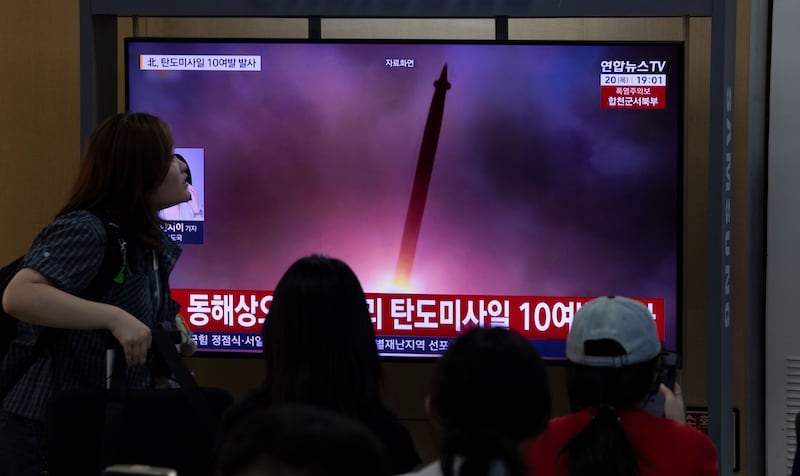
Despite Trump’s overtures, Pyongyang fired a volley of ballistic missiles off its east coast earlier that day, triggering alerts in neighbouring South Korea and Japan.
What worries Japanese officials more is Trump’s approach as Tokyo embarks on talks with Washington over how much it should pay towards the cost of hosting US forces, America’s largest overseas deployment.
Japan is bracing for the possibility that Trump could, with little warning, demand a sharp hike that would be politically difficult to swallow, said a senior Japanese government official, requesting anonymity due to the sensitivity of the matter.
Trump could also wield upcoming US military exercises with Japan in October as leverage, analysts said. Officials in Washington and Tokyo said they did not expect the exercises to be curtailed, though Trump could change his mind at any point, they cautioned.
The drills, known as Keen Sword, may already be smaller than their 2024 iteration because of the diversion of US assets and personnel to the conflict with Iran. That shift – which recently saw America’s only forward-deployed aircraft carrier in Asia, the USS George Washington, depart for the Middle East to relieve the beleaguered USS Abraham Lincoln – has stirred concern that US deterrence against China is being eroded.
During a visit to Asia this month, Pentagon policy chief Elbridge Colby said working with allies to ensure combat readiness along the so-called first island chain that runs from Japan through the Philippines is a priority for Washington.
Nowhere are concerns about China’s growing military pressure more acute than in Taiwan, the democratically governed island claimed by Beijing.
Trump has held up approval of a $14 billion package of arms sales to Taipei in order to maintain warm relations and a fragile trade truce with China’s Xi.
[ Taiwan prepares for war, but China has other optionsOpens in new window ]
As Trump prepares for his latest round of summitry with Xi in Washington next month, officials in Taipei say they expect Washington will at the very least carve up the arms sales into smaller chunks to try to avoid upsetting Beijing too much.
Domingo Yang of the Taiwan defence ministry’s think tank, the Institute for National Defence and Security Research, says there is a distinction between Trump’s rhetoric and actual US behaviour, noting that US intelligence sharing, training and patrols with Taiwan remain substantial. A US Navy aircraft transited the Taiwan Strait on Friday in a move the United States described as demonstrating its “commitment to a free and open Indo-Pacific”.
Trump’s latest actions have also rocked confidence in India, where the US risks squandering years of efforts to draw New Delhi closer as a counterweight to Russia and China, security analysts say.
It also comes after the Pentagon’s decision in June to rename its Asia military headquarters to Pacific Command from Indo-Pacific Command, a move some analysts say is a sign India is no longer as strategically important to Washington.
The Pentagon denied any such shift. But Trump’s steep tariffs on Indian exports and repeated claims that he had mediated an India-Pakistan ceasefire had already exasperated New Delhi. Officials there are now “very, very cautious” about committing to long-term defence deals with Washington, according to two Indian sources with knowledge of the matter.
“The latest decision only reinforces president Trump’s transactional view of foreign affairs and serves as a reminder that differences over specific policies, even among allies, can carry costs for the broader bilateral relationship,” said Pearl Pandya, senior analyst at Armed Conflict Location & Event Data, a conflict monitoring group. – Reuters