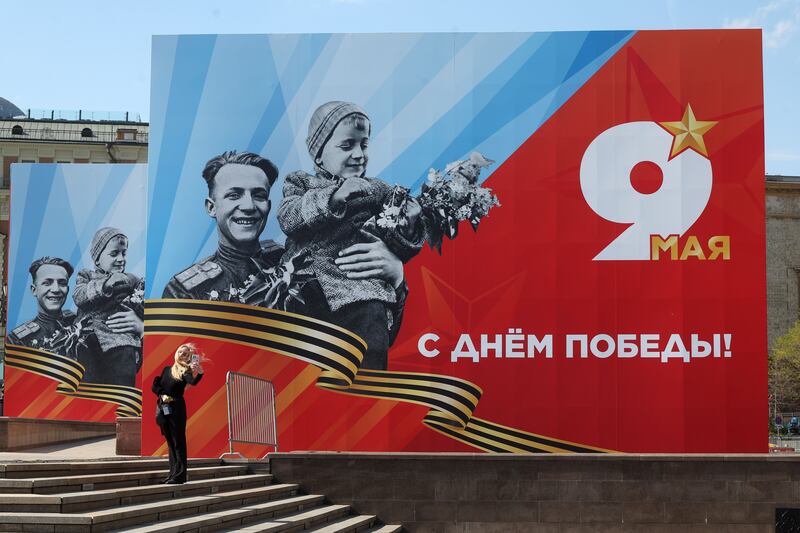
Russian flags in red, white and blue whip in the wind along Moscow’s wide boulevards. Parks and promenades teem with freshly planted flowers. Orange-and-black-striped ribbons of St George, symbols of Russian military valour, festoon nearly every shop window.
Since Soviet times, the “May Holidays” – the period from May 1st, International Workers’ Day, to May 9th, when Russia celebrates the Soviet role in defeating the Nazis in the second World War – have heralded the arrival of spring.
But this year, the mood is hardly festive.
Prices and taxes are rising as the economy struggles to bear the cost of the war in Ukraine. A new wave of repressive wartime measures has led to once-unthinkable internet restrictions, including another round of blackouts this week in Moscow and St Petersburg. Negotiations to end the war have stalled just as polls show that record numbers of war-weary Russians want peace.
READ MORE


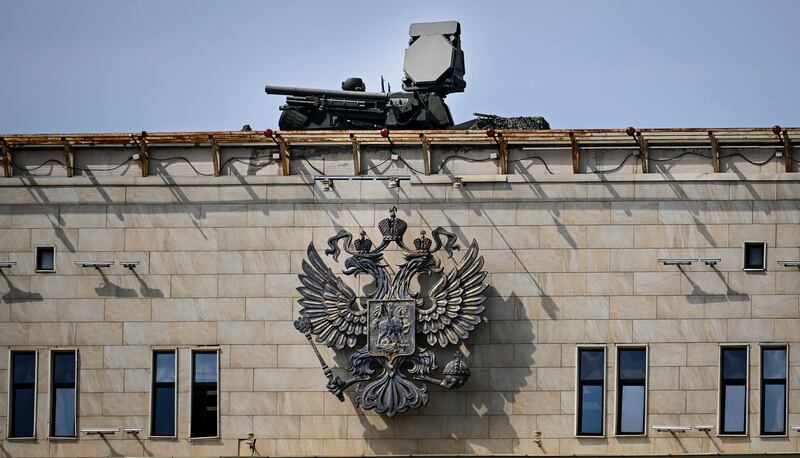
This parade season, the war is being brought home to Moscow, the capital. Parks there are decked out not just with flowers, but also with metal detectors. Saturday’s procession on Red Square – one of the year’s biggest events, staged in the heart of Kremlin power – is being curtailed because of the potential for Ukrainian drone strikes. That risk was borne out on Monday, when a drone slammed into an upscale residential building in Moscow.

Showing unaccustomed weakness, the Russian government appealed unsuccessfully to Ukraine for a ceasefire on the parade day and acknowledged “additional security measures” to protect president Vladimir Putin. The Kremlin has barred almost all journalists from the event, citing “terrorist threats from Kyiv”.
Far from the capital, Ukraine has repeatedly hit Russian oil facilities, including in Perm, more than 1,000km from the border, and in the Black Sea city of Tuapse, where a strike caused an ecological disaster.
A woman named Svetlana, who lives in Tuapse, described growing weariness over the war in Ukraine, which has lasted more than four years, longer than the Soviet participation in what Russians call the great patriotic war.
She said residents were starting to realise that the war was resulting “only in chaos and negative consequences for people”. Svetlana, who asked that her last name be withheld to avoid possible repercussions, described “a stupid vicious circle” in which taxes go up, the extra money is used to block the internet and then people find it harder to do the work that pays the taxes.
[ Frontline robots and killer drones: Ukraine’s new weapons for war with RussiaOpens in new window ]
The May 9th holiday, Victory Day, is the most important on the Russian calendar. The Kremlin has made the Soviet triumph in the second World War a civil religion for Russians. An estimated 27 million Soviets – soldiers and civilians – died in the war, the highest human cost among the countries that took part. The heroic victory that brought the Soviet Union status as a global power is a unifying force in Russia.
It is also a glaring contrast to the current quagmire in Ukraine.
Russia has gained little territory for years there despite enormous casualties. At least 213,000 Russian soldiers have died, according to the independent news outlet Mediazona, which tallies public reports of deaths. Western researchers have estimated the true count at well above 300,000.
The Kremlin has curated the illusion of a distant war to put it out of Russians’ minds. But as the war strains the economy and is used as a pretext for internet restrictions, a western ambassador in Moscow told me that he had sensed a shift in Russians’ willingness to put up with it all.
“There is a collective anxiety,” the ambassador said, because “no one can see how this ends”. The ambassador spoke on the condition of anonymity because he was not authorised to talk publicly about the matter.
According to the Levada Center, an independent pollster, 47 per cent of Russians expressed anxiety in April about their lives, up 11 percentage points from a year ago.
Discontent over the economy and internet restrictions is visible in public approval ratings for Putin, which have been falling for weeks and are now at their lowest levels since the war began. But beyond complaining to pollsters, Russians have few ways to broadcast their unhappiness, as the Kremlin increasingly views any public criticism as a threat to the state.
Authorities blocked efforts to hold protests in several cities over the internet outages and the throttling of popular apps such as Telegram. May Day gatherings traditionally organised by the Communist Party were not permitted in many regions. Even a rally to protest delays in the construction of school buildings in a village in western Russia was blocked.
As the economy stagnates, weighed down by overspending on the war, high interest rates and western sanctions, even Russians connected to the establishment are ringing alarm bells.
“I sincerely believe that we are in trouble,” Robert Nigmatulin, an economist at the Russian Academy of Sciences, said at an economic forum in Moscow last month.
The Soviet Union’s standard of living, he said, was lower than Europe’s. “Still, we were building the country; we were building space, nuclear energy; we were ahead and, of course, we sacrificed for this,” Nigmatulin said. “Now we’ve lost everything and are still the poorest. Even in the poorest regions of China, incomes are higher than in our poorest regions.”
[ How culture became one of Ukraine’s most powerful weapons against RussiaOpens in new window ]
He rattled off Russia’s bleak indicators: consumer prices that have risen by 77 per cent since 2015, higher taxes that are putting too much pressure on small- and medium-size businesses, and low birth rates that portend severe demographic challenges. Some respected economists poured cold water over his dire predictions, but, still, many ordinary people feel the pinch.
Irina, who works in business consulting and also asked that her last name be withheld, said she had “this feeling of an impending storm.”
“I see that the economy as a whole is restructuring and becoming increasingly difficult,” she said. Her clients have been laying off employees, she added, and inflation wiped out a salary increase she had received.
The immense uncertainty in Russia is compounded by the shrinking space for freedom of expression, as Russians navigate the constantly shifting lines of what is allowed.
Raids at Eksmo-AST, one of Russia’s largest publishers, show the deepening chill. The police recently detained its top managers for several days, ostensibly over a book with LGBTQ+ content, which is prohibited. The book had been published by a subsidiary of Eksmo that was shuttered in January.
The company was targeted even after trying to placate the Kremlin by publishing patriotic, pro-war books. The current state of Russian publishing, Eksmo’s owner, Oleg Novikov, told the local news outlet RBK, is a “minefield,” given the “vague criteria” for what is forbidden.
When news of the Eksmo raids broke, I was having lunch with Alexei A Venediktov, who ran the capital’s last independent radio station, Echo of Moscow, until it was forced to close after the war started in 2022.
Venediktov was once friends with Dmitry Peskov, the Kremlin spokesman, and Margarita Simonyan, editor of the state media outlet RT. Now, Venediktov is facing an administrative charge of “participating in the activities of an undesirable organisation”.
Details of the charge have not been made available to him or to his lawyer. The Russian ministry of justice maintains a list of organisations that have been deemed “undesirable” and banned from operating in Russia. Venediktov pulled up the list, which has more than 350 organisations, including independent news outlet Meduza, environmental group Greenpeace, Yale University and the Elton John Aids Foundation.
“I haven’t collaborated with a single one of these groups,” he said.
Not all Russians are unhappy with the state of things. Some see Russia more positively by dwelling on other countries’ failures.
Konstantin V Malofeev, an arch-conservative media mogul, told me that the United States had “made a gigantic mistake” in going to war with Iran and had been exposed as a “paper tiger”.
In a conversation in his office on Moscow’s central Garden Ring road, he referred to the influence that the Israeli prime minister, Binyamin Netanyahu, had on US president Donald Trump’s decision to attack Iran. He questioned whether Trump was in charge, saying that the American president’s perceived ineffectiveness was weakening Washington’s chances of bringing an end to the war.
“The less we see that he’s in charge, the less likely he is to act as a negotiator, some kind of arbitrator or mediator between us and Ukraine,” he said of Trump. In addition to failed diplomacy, the increasing robotisation of the battlefield, Malofeev said, meant that the war could last even longer. – This article originally appeared in The New York Times