

Despite a build-up low-key to the point of inertia, the GAA marks 100 years of national league finals this weekend. The competitions began in the 1925-26 season and were won by Laois and Cork in the football and hurling respectively with Dublin the runners-up in both.
Laois were outliers in that even in their province they would have been rated behind Wexford, Kildare and Dublin. But they had already caused a surprise in the quarter-final by beating a Kerry team that would later win that year’s All-Ireland.
Their victory in the final was unusual in that it was played in New Ross on September 19th, overshadowed by a Munster final refixture in Thurles on the same day.
The inaugural hurling league final was first staged on May 14th at the Athletic Grounds, Cork – the only county contesting the title either side of the centenary, although Dublin are playing in this year’s Division 1B hurling final, and opponents Clare topped Division 2 in 1926.
READ MORE


There is further history in the fact that for the first time the hurling finals have been sell-outs in two successive years.
Hurling was able to finish first because of its uncomplicated, seven-team (Cork, Dublin, Laois, Galway, Tipperary, Limerick and Kilkenny) round-robin format, whereas football was unwieldy and regionally organised with some fixtures from local competitions commandeered as part of the league.
Padraig Ferguson is a long-time researcher of GAA records and has gifted his collection from over 40 years to the association. During this work, he has looked at the origins of the league.
“It was a Cork delegate, Seán McCarthy [future GAA president and Fianna Fáil TD], who proposed it. ‘National’ was used in the title because that was important after independence and a new national competition had been under consideration.
“It was delayed until the Tailteann Games [1924’s GAA Olympics] were finished. The league was quite ambitious because it was nearly 1919, I think, before you had all 32 counties playing in the championship. It was intended to improve standards, but in the first few years you sometimes got the impression it might fizzle out.”
Marcus De Búrca, in his definitive history of the GAA, concurred in that the golden jubilee year of 1934 featured sundry disappointments.
“There were justifiable murmurs of dissatisfaction at the failure of hurling to take root outside of half-a-dozen counties and only slightly less warranted criticism of the slowness of the National League to improve playing standards in weaker counties ...”
Its early days were chaotic. There were blanks in what should have been the second year, 1926-27 and again in 1931-32. In the 1930s, both competitions were dominated by single counties: Limerick won the hurling five years in a row and the Mayo footballers did six-in-a-row before the second World War forced a five-year hiatus.
Gradually re-established in the postwar years, the leagues expanded and some finals were played in the US. In 1950, Cavan and Tipperary travelled to play New York in the football and hurling finals, which were also the first live television broadcasts of intercounty Gaelic games.
In recent years, the competitions have provided decent revenue streams to the GAA. In February, figures for 2025 showed revenues from both the football and hurling leagues have risen: football marginally to €4,784,918 and the hurling by a massive 58 per cent – helped by the sold-out final in Cork – to €3,425,476.
Feargal McGill, the GAA director of games administration, says the competitions have become “hugely important for the provision of regular games and regular opportunities for spectators” and trend setting in other respects – primarily in his view, the introduction of a calendar-year schedule, firstly in the 1997 hurling league and then, four years later in football.
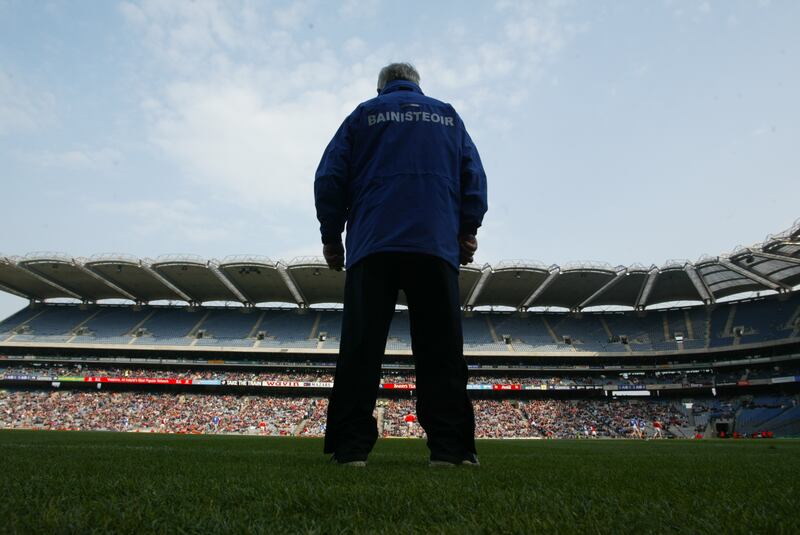
“The calendar year is the biggest change and has completely changed the dynamic of the leagues. The momentum of the fixtures wasn’t broken from a media perspective. It allowed a narrative to develop week on week and that changed everything in a positive way.
“The other massive change for me was the involvement of TG4 in the broadcasting of league games, something that was absolutely unheard of until roughly 20 years ago. We’ve always had this kind of love-hate relationship with live television, to be a bit reserved over the possible impacts on attendances.
“But the opposite happened. It brought that hype; it brought that interest to the leagues and it really pushed them on.”
Last weekend saw an unprecedented number of games covered, between broadcast and streaming, from the final rounds of the leagues, with starts staggered in different divisions.
Floodlights were also innovated in league matches from February 2003 when the Cork footballers played Kerry under lights for the first time and opened the door for Saturday evening fixtures. A year later, Cork’s match against Wexford became hurling’s first.
The most successful managers in league history are also the most successful in the championship: Brian Cody with 10 and Mick O’Dwyer, eight.
Bringing each divisional football final to Croke Park has meant that every county in the league except London has qualified for one, giving teams who wouldn’t usually get to play in the stadium that opportunity.
Jack O’Connor, who is the current manager with the most elite league titles under his belt, is again in a football final this weekend, hoping to add his sixth in the knowledge that the previous five have been a springboard to the All-Ireland.
Cork and Limerick meet in next week’s hurling equivalent for the first time in 46 years, knowing that whoever comes out on top will be regarded as front runners for the championship.
After 100 years, the leagues have never been more consistently relevant.


