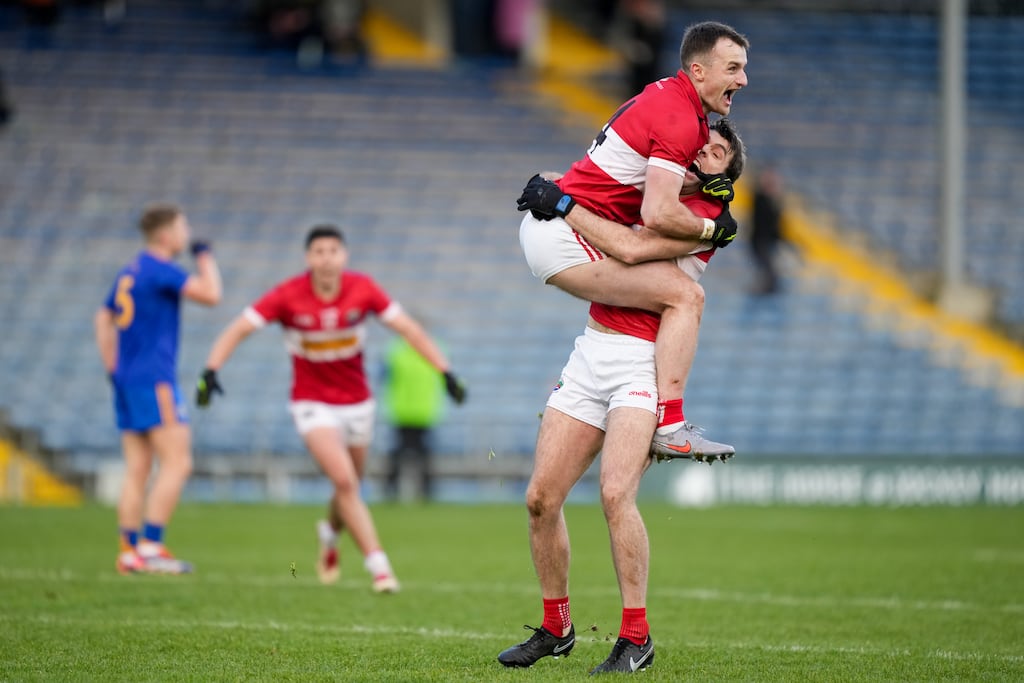

The first thing to say about Dingle’s one-point win over St Finbarr’s in the Munster senior club football final on Sunday is that it’s the sort of game you could easily have missed. Quite apart from the other sporting events clamouring for your attention, you might have been in your nearest shopping centre to buy a few Christmas presents on the last Sunday in the year before they become unfit for human habitation.
There are, quite frankly, many reasons not to be watching GAA in December. So, there was a particular feeling of satisfaction to have seen it, because it was one of the best games of the year – in the best year of football many of us can remember.
Finbarr’s were the better team, but they’ll have regrets forever about the final minutes of this game. I’m not just talking about the last free, given against Ian Maguire for over-carrying and then brought forward 50 metres, to just outside the scoring arc, because Dylan Quinn was adjudged to have delayed handing the ball back to Dingle. They had multiple chances to close it out before then.
But the rules merely state that Quinn needed to hand the ball back in a “prompt and respectful manner” in that moment. A referee should be absolutely sure that Quinn had purposely held on to possession in a deliberate, cynical attempt to slow the Dingle counterattack down, before advancing the ball 50 metres.
READ MORE


Quinn’s actions fell well short of that mark, whatever about handing the ball back in a “prompt and respectful manner” to a player charging at him. He shouldn’t have picked it up in the first place, of course. But when you include words like prompt and respectful, you can expect a fair degree of confusion, and that’s what occurred here.
Between the push on Maguire’s back before the free that was then given against him, and the subsequent advancement, it was a terrible way for a great game to end.

The fact that the free was moved right up to the edge of the arc, and not inside, meant Conor Geaney had no choice to make. If the ball was placed five metres inside the arc, he’d have had a kick to force a draw, from a tough position on the field. He could have brought it back out of course, and gone for the two-pointer regardless, but that would have had the potential to backfire horribly.
There’s no guarantee he’d have scored the free from five metres inside the arc – every free-taker will tell you a kick to draw is harder than a kick to win. And there are plenty of reasons to think he might also have missed it if he’d made the decision to bring it back outside and go for broke, to turn a one-point deficit into a one-point lead. It would indicate a level of self-confidence that would have been thrown back in your face if you’d missed. That’s not a thought you want running around your head as you’re about to take a last-second free.
[ Seán Moran: 2025 was a GAA year of evolution, when skill was rewarded over brawnOpens in new window ]
But he had clarity. He had no option but to kick it from that spot. Whether it was 45 metres, 50 metres or 55 metres from the spot of the foul, we can’t be entirely sure. And neither, let’s face it, could the ref. On the angle, it might well have been exactly 50 metres from the spot of the foul to the spot where the free was taken. But the game was decided on it – and it’s very difficult to see how he could have been precise in that moment.
For all that one of the new rules was to blame for an unsatisfactory end-game, the new rules had also given us much of what had gone before. The madcap harrying that Dingle did in the last few minutes wouldn’t have been possible if Barrs had the full pitch and the goalkeeper to use as an extra man. They had possession three times in injury-time and couldn’t kill the game.
[ Denis Walsh: GAA volunteers are taken for granted and now a reckoning has comeOpens in new window ]
The two-pointers built the lead for Barrs and also helped Dingle reel them in. Steven Sherlock’s display of kicking (0-16 from 14 shots) was genuinely extraordinary on a cold day in December. He wouldn’t even have been going for them 12 months ago, but the risk/reward dynamic has changed. In ways, it’s a fitting way to put a full-stop on the year (the Ulster final this weekend notwithstanding). The new rules have improved the game out of sight . . . but they’re not perfect.
Teams also can’t be forced into change, no matter how advantageous change might be. Brian Hayes caused massive trouble any time he went near the Dingle goal. It will hardly have escaped his attention that lorrying ball down on him is looked on far more positively in hurling than in football, but it’s no less effective with the big ball. Paul Geaney was given a nondescript 60:40 ball to run out towards the sideline for. That was all he needed to take on his man, turn him inside-out and score a fantastic goal before the cover got back to him in the first half.
Referees are dealing with a lot, particularly in relation to applying the spirit as well as the letter of the law. Teams will surely spend the winter thinking about risk and reward. For the rest of us, being clear-eyed about the improvements we’ve seen in 2025, without being a cheerleader or a cynic, is worth considering.