Journey times on the main Belfast to Dublin train are to be cut to under two hours following a €700 million investment deal that aims to transform the cross-Border service.
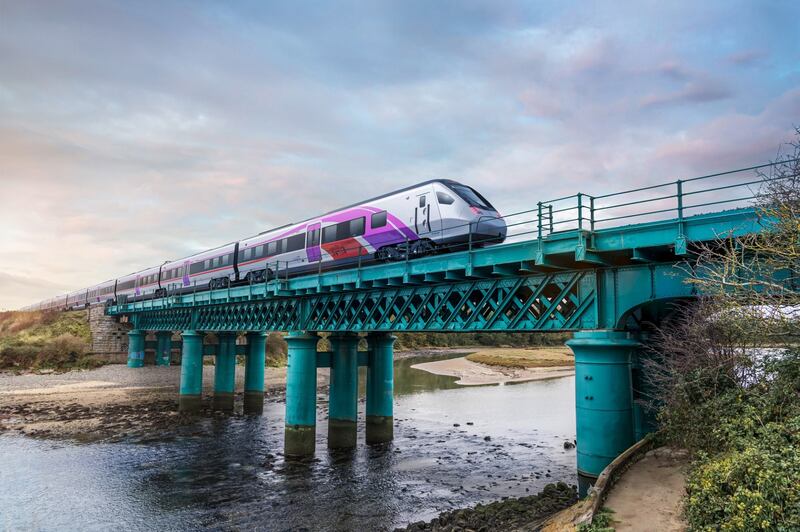
The plan, which will see the delivery of eight new intercity Stadler trains by late 2028, was unveiled at a signing ceremony at Belfast Grand Central Station on Thursday.
The new fleet will support expansion of up to 16 daily services in each direction.
Journey times are currently between two hours and five minutes and 2¼ hours, with stops in Portadown, Newry, Dundalk and Drogheda.
READ MORE


With about 400 seats, the new trains will be designed with step-free interiors to improve disability access.
A “target express journey time” of just under two hours has been set as a result of increased acceleration and performance.
Enhanced customer facilities such as USB charging points and power sockets, unaided boarding on exterior doors and a spacious dining/bar area are among the new features.
Covering a distance of 180km, the first Enterprise seven-carriage steam train travelled from Belfast to Dublin on August 11th, 1947. The Enterprise service is jointly operated by Translink and Iarnród Éireann. Passengers numbers have rocketed by 40 per cent since the introduction of a new hourly Enterprise service 18 months ago.
Translink said the tri-mode capability of the new trains – capable of operating on electric, diesel and battery power – will reduce emissions, enable quieter journeys and ensure “seamless operation” as the Belfast–Dublin line transitions towards “full electrification”.
The €698 million investment in the new rail service is jointly funded by the Irish Government and the Northern Ireland Executive and includes €165 million funding through PeacePlus, an initiative also involving the UK government and European Union.
Speaking at the Belfast train station in advance of the signing ceremony, Taoiseach Micheál Martin said the deal “heralds a significant new chapter for cross-Border rail connectivity on the island of Ireland”.
He noted the Dublin-Belfast “economic corridor” was now home to more than two million people.
“These projects will bring high-frequency trains, better journey times and sustainability benefits which will simply transform our rail system for passengers and wider society across the island,” he said.
There will be additional investment in the North’s rail network through the Shared Island Fund “to be announced shortly”, the Taoiseach added.
Minister for Transport Darragh O’Brien and Stormont Minister for Infrastructure Liz Kimmins formally signed the contract with Swiss manufacturer Stadler on Thursday.
Taoiseach Micheál Martin, Tánaiste Simon Harris, Northern Ireland First Minister Michelle O’Neill and Deputy First Minister Emma Little-Pengelly also attended.
O’Neill said it was a “momentous day”, adding the investment will bring “better connectivity” to the island that will create jobs and “simply faster, better journeys between Belfast and Dublin”.