Ernest McCall is no doubt that the commemoration for Royal Irish Constabulary (RIC) in Dublin during the Decade of Centenaries in 2020, which collapsed in controversy about recognition of the Black and Tans and the Auxiliaries, should have gone ahead.
“Typical politicians. They’ll say they’ll do something and then when there’s a wee bit of pressure, they collapse,” said McCall, who spent decades serving in the Royal Ulster Constabulary (RUC).
In the wake of the Dublin controversy, the branch of the RUC George Cross Association in Newtownards, Co Down, mulled plans to acknowledge the service of the largely Catholic RIC, which existed between 1867 and 1922.
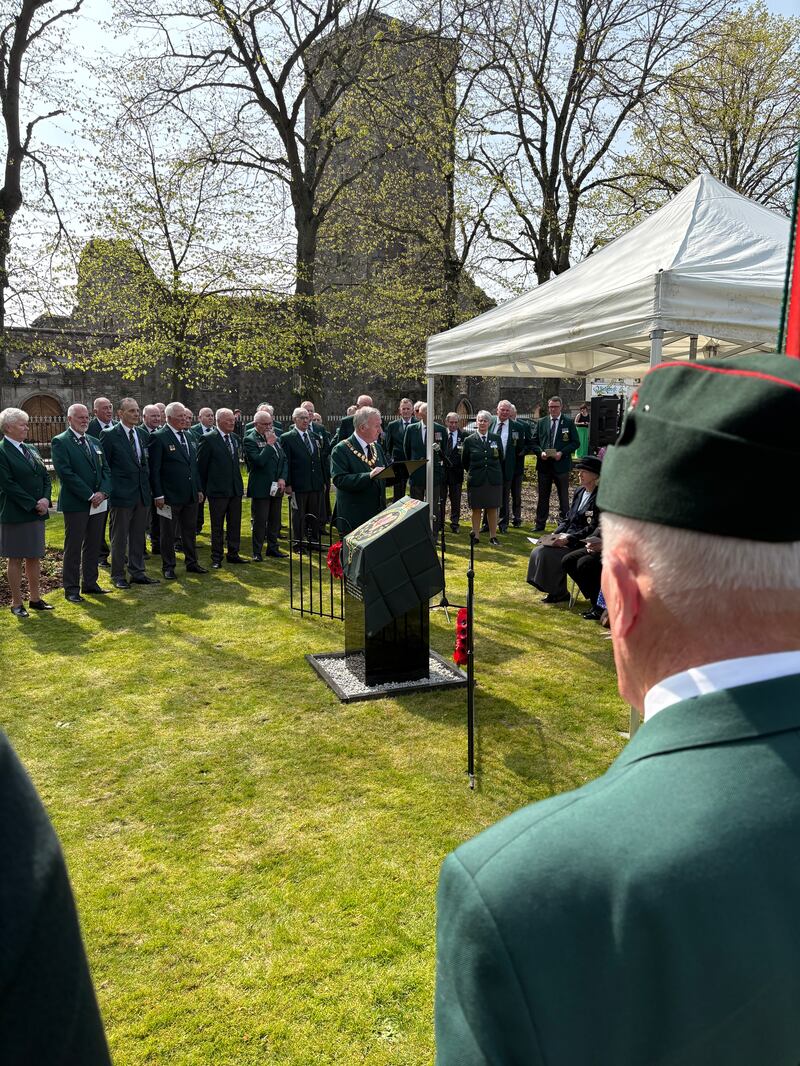
On Sunday, McCall and his colleagues ended the gap of more than a century without a memorial for the RIC, unveiling of a polished marble monument next to the war memorial in Newtownards.
READ MORE



The war memorial honours local men killed in two world wars and other conflicts, too, including four young local Ulster Defence Regiment soldiers killed in April 1990 in a 1,000lb IRA car bomb at Ballydugan, outside Downpatrick, Co Down.
However, newer shadows could be felt, too.
Milling around in the minutes before the unveiling, many of the former RUC men, and a few gardaí, discussed Saturday’s attempt by dissident Republicans to attack a PSNI station in Dunmurry, outside Belfast.
“Six cylinders of explosives made from fertilisers,” one former RUC officer told The Irish Times, “and some poor young [man] was told to drive that there. It could just as easily have blown up underneath him.”
Conscious of the past, Co Down’s deputy lord lieutenant, Amanda Blackmore, said everyone present – including many former RUC members – “stand here fully aware that history in Northern Ireland is never abstract”.
“It is lived, it is felt and it continues to shape our present. That is why acts of remembrance must be approached with care, humility and respect for all traditions,” she said.

“This memorial is not an attempt to reopen old wounds nor to elevate one narrative above another,” she said, noting that it was a recognition of human stories, of lives lived and lives lost, and that every community’s experience deserved dignity.
The Sunday gathering was attended by retired gardaí, including former Cork sergeant and police historian Jim Herlihy, one of those who was deeply involved in the 2020 commemoration efforts.
Still in favour of a memorial in the Republic to the RIC, Herlihy, who faced serious abuse at the time, helped the Newtownards team’s plan. “Well, we obviously weren’t going anywhere in the south,” he said.
For local Democratic Unionist Party MP, Jim Shannon, the memorial was long overdue, especially, in his view, after the “enormous outburst of complete hatred” shown towards the 2020 plans.
It was Shannon’s second time in a week to be at Newtownards war memorial, following a gathering on the Saturday before to mark the UDR men’s killings 36 years ago. “I knew three of them well,” Shannon said. “I knew John Birch [one of the men] since the day he was born.”
He also remembered a conversation with Birch’s wife, Angela, a year before her husband was killed, when she worried about the risks Birch faced in uniform.
“She said she was worried sick about him, you know. I said, ‘Angela, there’s nothing to worry about’. How wrong was I. Oh, I still feel a wee bit… you know,” said Shannon, with tears in his eyes.
A week ago, Birch’s widow shared memories with Shannon of the last time she saw her husband when he had painted a bedroom at the family home.
Like everyone else in the local community, she heard the Ballydugan explosion. Even without an official confirmation, she knew that her husband – ever punctual – was never again coming home.
“Then she says that she went upstairs to the bedroom where he’d been painting the day before. There was his ashtray with his cigarette butts, the empty tin of Coke, the tin of paint and the paintbrush. Twenty-four hours before, he was there, and 24 hours later. That’s a wee story about John Birch that I always remember,” the Strangford MP told said.
Referencing the controversy in Dublin six years ago, Herlihy said there was “nothing” on the Newtownards memorial specifically noting the RIC’s Auxiliary Division, the unit of former British army officers sent to Ireland at the height of the War of Independence.
Controversy was sparked when people realised that a Glasnevin Cemetery monument commemorating all the names of the dead during the period would, inevitably, include the names of Auxiliaries and of the Black and Tans.
“Then there was the distinction between remembrance and commemorations, and it all went downhill after that – especially after it took off on the airwaves,” Herlihy said.