
There is no prospect for now of Fianna Fáil, Fine Gael or Sinn Féin acquiring even a shadow of the dominance that was associated with a governing party until a decade ago.
This is an age of Lilliputian politics: big issues are too much; reality is too unpleasant and real solutions are either too complex or require more time and determination than we want to give. So instead we focus on symptoms rather than causes.
The cost of living, a main concern of voters in the two byelections in Dublin Central and Galway West, was chiefly expressed as a demand for subsidies, not the structural change that would bring lasting benefit.
We don’t know what the world will look like when the next general election is held, probably in 2029. But a takeaway from the byelections is that in addition to those who came out to vote against the status quo, there are proportionately more who remained at home and who will be available to vote for what may turn out to be the most complex Dáil in Irish history.
READ MORE


The paradox of last Friday’s byelections is that the increasing fragmentation of Irish politics masked a unity so complete it went unmentioned. From the increasing right-wing challenge to the status quo, to the Government parties representing that status quo, to the left opposition that purports to change it, the consensus was that whatever came next would involve ever higher levels of public spending. Among 31 candidates in two constituencies, no one questioned the giving powers of the national magic money tree. Many vigorously shook it for more.
The byelections results are a structural and an ideological compendium of where we are now politically. There is little knowledge and less concern that public spending increases of 8.9 per cent so far this year are highly risky in an uncertain world. Fears about the long-term cost of runaway spending may have fed into unspecified angst, but not to the extent of voters demanding answers that make sense.
Describing this consensus as ideological would be a stretch. The only item for debate is how much more should be spent and how soon. In that sense, the past few weeks may have been a political Indian summer. What the byelection campaigns demonstrated is a complete lack of preparedness for a move away from a status quo that sees more money but no real change as the answer to every question.
Nothing much was at stake last Friday for voters, and decision-making in a general election is invariably more complex. But what is clear, regardless, is that further political fragmentation is in process.
[ Dublin Central: Daniel Ennis of the Social Democrats elected after ninth countOpens in new window ]
There are ever fewer people casting a vote for the system and more against it. We have arrived at European-style politics with many smaller parties, much more complex coalition-making and a far less direct connection between voter intention and eventual political outcome.
Fine Gael had a good day with the performance of Seán Kyne in Galway West, but a good candidate Ray McAdam did less well in Dublin Central, which will be left with no Government TD. For Fianna Fáil, the results were unremitting awfulness. Its new candidate and councillor in the east of the Galway West constituency Cillian Keane is good for another day, however. Dublin Central was a wipeout for the party and its candidate John Stephens.
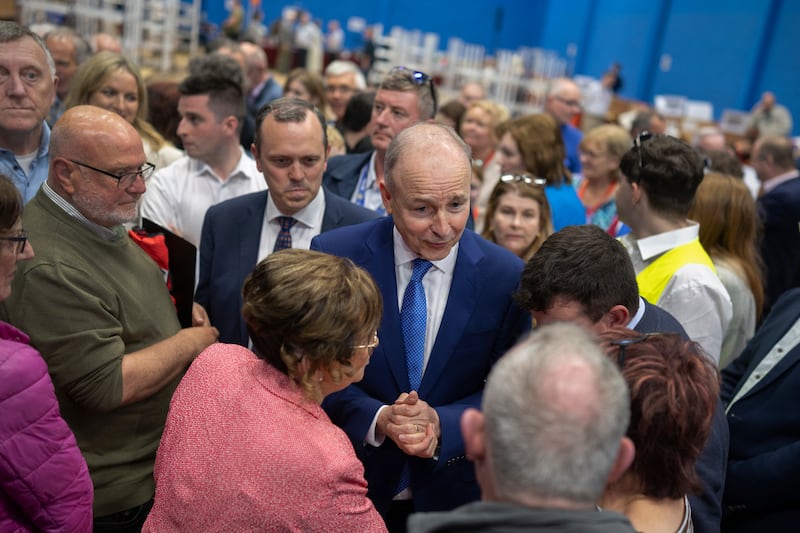
In November 1979, Jack Lynch suffered two byelection defeats in Cork. For several reasons, he was soon gone. But Martin is going nowhere. He has learnt to channel the weakness of his party into his political strength.
But Fianna Fáil, which long ago lost its working-class base to Sinn Féin, is a middle-class party in perennial danger of blending into Fine Gael – and has surrendered its identity and most of its urban base to become indistinguishable from its Coalition partner.
The good showing of Kyne notwithstanding, Fine Gael’s problem is that blue is turning purple and its support is leaking to the Social Democrats. As the last general election showed, the party is in dire trouble if it falls behind Fianna Fáil in any constituency.
For the Government parties, it’s a case of the devil take the hindmost. Everyone is out for themselves.
[ Byelections: Noel Thomas extends lead over Kyne in sixth countOpens in new window ]
Sinn Féin occupies an airless space in the sense that in terms of the public conversation, it is no longer the real leader of the Opposition.
This is one aspect of the structural change exposed in the results.
The other is that the population is growing every year by about the equivalent of three TDs, as defined in the Constitution. There were 14 extra seats in the last general election and there will be a similar increase next time. That does help protect vulnerable incumbents, but mostly it accentuates the trend. On a marginally smaller share of the vote, but because it managed to get ahead of Fine Gael in most constituencies last time out, Fianna Fáil won 10 extra seats. That changed the terms and conditions between it and its partner in Government.
Faced with a trend that is set against the status quo, lacking the energy to deliver the change required and left only with tactical manoeuvring between each other, the Government parties may well consider creating six seat constituencies. That might give them a chance of one each on a good day, or just one on a bad day.
The alternative is that several five seat constituencies will be divided into two three seaters. That could be a doomsday for the Government. The byelections may trigger a circling of the wagons and every wagon will be a six seat constituency.


