

When Northern Ireland and the Republic experience the same problem, it proves the cause is not a shortage of money.
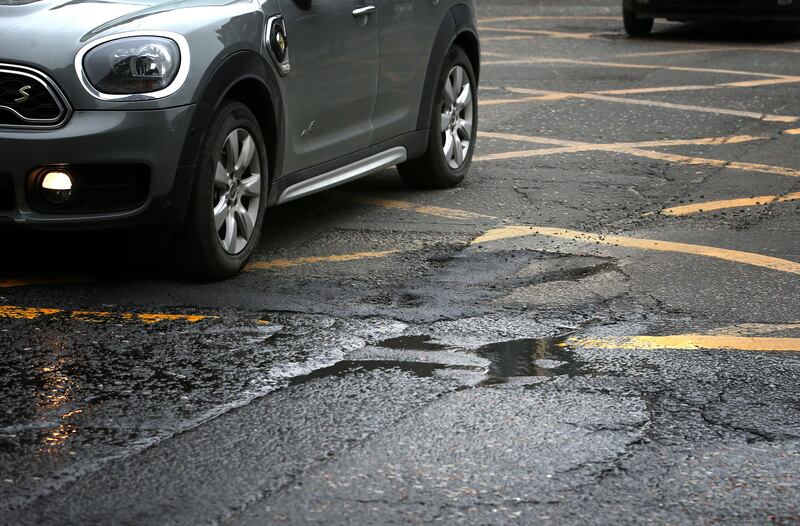
Potholes are the latest illustration. Stormont’s Department for Infrastructure is responsible for building and maintaining all roads north of the Border, including local roads. As usual, its minister – currently Sinn Féin’s Liz Kimmins – has blamed a lack of funding from Britain.
This familiar excuse is increasingly ridiculed, although more for its pettiness than through any understanding of Stormont’s finances. The Northern executive receives enough funding to deliver services to the same standard as in England, allowing for Northern Ireland’s higher needs and costs, according to its own independent economic experts. However, that is rather arcane and easy for politicians to obfuscate.
It is simpler to point to potholes south of the Border, where the Government clearly has more money than it can spend.
READ MORE


Councils bear much of the responsibility for road maintenance in the Republic and most are genuinely strapped for cash, but that need not complicate the comparison. Central Government has a supplementary grant for road maintenance, totalling €1.5 billion to councils this year, up 13 per cent from last year. Funding is not the problem.
Radically different neighbouring economies, such as the United States and Mexico, often capture popular interest. The field of development economics studies these types of contrasts.
In many ways Ireland is more intriguing and potentially revealing. Two culturally and legally near-identical economies sit side-by-side, one with enough money for a modern developed country, the other with so much money it cannot even pretend to face normal financial constraints.
This contrast is best studied by public choice theory, a mainstream field of economics since the 1960s that sadly remains little known beyond academia. Its premise is that politicians and bureaucrats act to maximise their individual self-interest, whether or not that serves the official goal of their government or institution.
Most economic theory has been built up over two centuries by taking the same approach to individual consumers and producers. It is surprising it has taken so long to include the public-sector mediators directing half a typical economy’s resources and regulating most of its interactions.
Public choice theory has been used many times by academics and think tanks to explain road maintenance failures. Its general assumption is that politicians and bureaucrats are motivated by the interconnected factors of power, status and the size of their budgets.
This leads them to prioritise large prestige projects at the expense of routine repairs. Pothole repair is particularly vulnerable as it is often dealt with on an ad hoc basis, using spare in-year funds to hire small contractors. This does nothing to increase any official’s sense of importance.
Pothole repair can also fall foul of that other great bureaucratic motivator: inertia. It takes quite a lot of effort to arrange a large number of one-off minor repairs, certainly compared to rolling a budget over every year. As an administrative task, potholes repel both the ambitious and the unambitious.
Public choice theory says this problem cannot be solved by replacing people or restructuring institutions. The best that can be hoped for is to make a high standard of ongoing maintenance part of the regular budget, while being constantly on guard against ministers and officials trying to divert this funding elsewhere.
The theory predicts rent-seeking by the private sector, who will lobby for lucrative long-term maintenance contracts. Officials will grant these contracts, despite their additional cost, because they convert an unglamorous chore into a prestigious decision. One-third of the Republic’s motorways are maintained under this model.
Conversely, the theory says officials will resist too much outsourcing as it shrinks their empires and reduces their status. Letting a private company build and operate a new stretch of tolled motorway is fine; privatising the routine repair of ordinary roads is surrendering territory.
An equilibrium will be established somewhere in the middle, with the sum total of official interests as the decisive factor. The interests of taxpayers and road users are secondary considerations.
This might seems like a grandiose analysis, but once you see public choice theory in a pothole you will see it everywhere, and once you see it North and South you see that money is often beside the point. Prestige is a notorious issue in infrastructure, likewise inertia in healthcare and lobbying in education. We have become a fascinating island laboratory of purely bureaucratic motivations.
This is an especially vital lesson for Northern Ireland. Although unionist and nationalist parties still affect ideological differences on economics, in practice most now plead poverty to explain Stormont’s failures.
They dare not admit how much they have squandered over decades to flatter themselves and placate vested interests, all while neglecting basic provision. Every similar problem across the Border makes that harder to deny.


