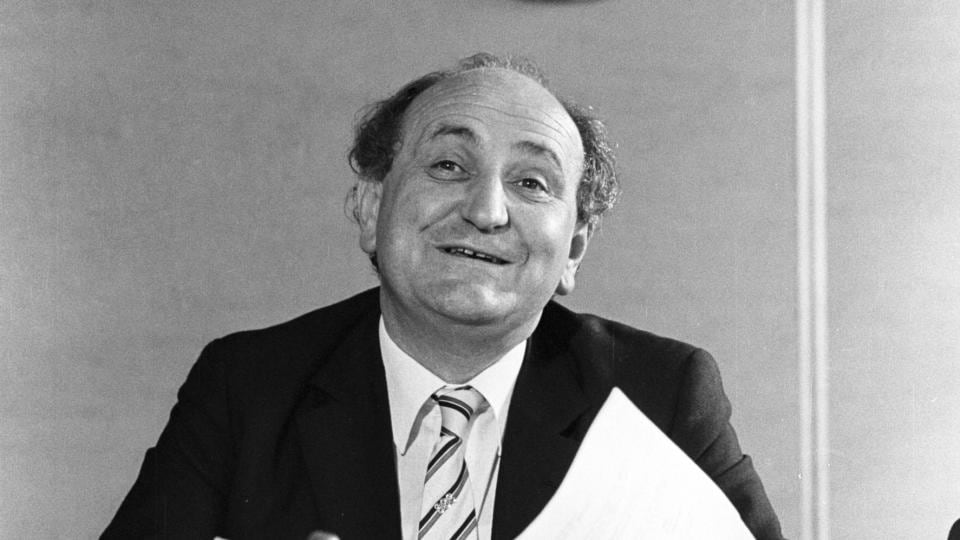
Born: October 16th, 1938
Died: November 1st, 2026
Gerry Collins was a significant figure in Irish political life for more than 40 years. He played a leading role in government from the 1960s until the early 1990s, and finished his career as an influential member of the European Parliament (MEP).
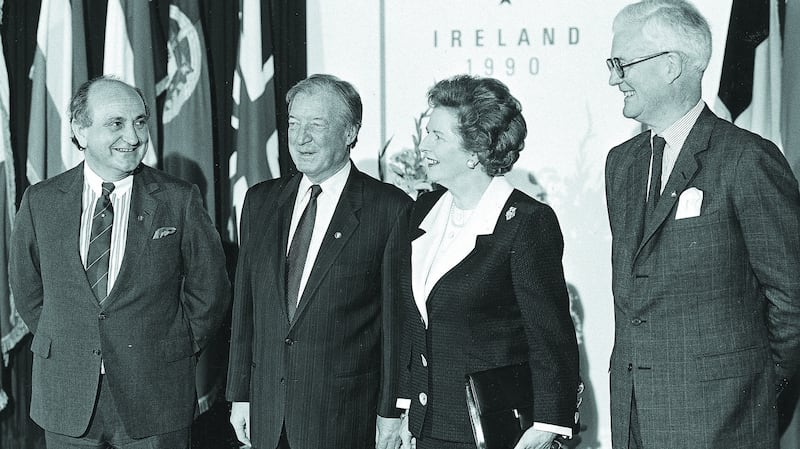
One of the highlights of his career, which was not widely known, was the crucial role he played as minister for foreign affairs in facilitating the unification of Germany during the Irish presidency of the European Economic Community (EEC – now the European Union) in 1990.
READ MORE


Following the fall of the Berlin Wall in November 1989, two of the most powerful political leaders in the EU, French president Francois Mitterrand and British prime minister Margaret Thatcher, expressed strong opposition to German unification. Under pressure from Mitterrand, then-taoiseach Charles Haughey was initially cool on the notion.
Collins, though, took the opposite view. Following discussions with German foreign minister Hans-Dietrich Genscher in December 1989, he was convinced of the case for a united Germany and was determined that the Irish presidency would facilitate it.
He persuaded Haughey to drop his opposition, using the argument that it would be unconscionable for the EEC to keep a wall between the two Germanies after the people had torn it down. The taoiseach was quickly persuaded of the merits of the case, and the Irish presidency went on to facilitate German unification.
It was a decision that earned the deep appreciation of German chancellor Helmut Kohl, who ensured that Ireland benefited enormously from EU cohesion and social funds in subsequent years. Collins’s attitude to German unification was typical of his practical, no-nonsense approach to big political issues.
James Gerard Collins was born in Abbeyfeale, Co Limerick, the son of long-serving Fianna Fáil TD Jimmy Collins, who represented West Limerick in the Dáil from 1948 until 1969. After attending the local primary school, he was sent to boarding school at Ballyfin Patrician College in Co Laois.
He went on to UCD, where his main focus was on student politics rather than exams. He developed a political organisation in the university which became known as “the Machine”. It won control of the Student Representative Council for a number of years and Collins was the president of the council for nearly two years. He reportedly took seven years to graduate.
While at UCD, he founded the Kevin Barry cumann of Fianna Fáil, and was its first chairman. After graduation he worked for a short time as a teacher, before becoming assistant general secretary of Fianna Fáil in 1965. He was catapulted into national politics when his father died in 1967 and he was elected to the Dáil in the subsequent byelection.
Having held his seat in the 1969 general election, Jack Lynch appointed him as a parliamentary secretary (as junior ministers were then called) at the Department of Industry and Commerce. Following the ministerial sackings and resignations that accompanied the arms crisis of 1970, he was promoted to the cabinet as minister for posts and telegraphs.
Despite coming from a strong republican background (his father Jimmy was a leading figure in the Old IRA in Limerick during the War of Independence), Collins was loyal to Lynch and his policy of conciliation and consent in relation to Northern Ireland.
He became embroiled in a national controversy in 1972 when he sacked the RTÉ Authority following the broadcast of an interview with IRA leader Seán Mac Stiofáin. Collins defended his decision on the basis that RTÉ had broken the law and should be held accountable.
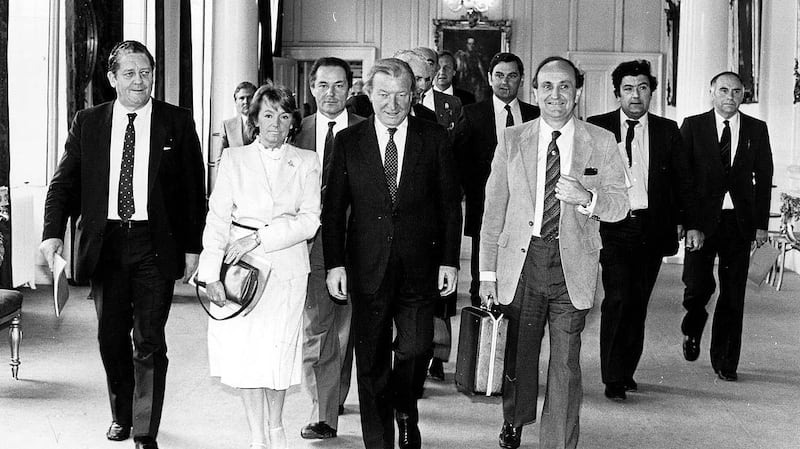
After Fianna Fáil’s defeat in the 1973 general election, he was appointed party spokesman on agriculture, and became spokesman on justice in 1975. He found the justice brief much more congenial, as it gave him an opportunity to attack the unpopular minister for justice, Patrick Cooney, and question the behaviour of gardaí in interrogating IRA suspects.
When Fianna Fáil returned to power in 1977, Lynch appointed him minister for justice. Despite his earlier criticism of Cooney and An Garda Síochána, he adopted the same uncompromising approach to the republican movement as his predecessor, even if it was sometimes disguised in softer language.
[ Guns, Haughey and tribunals: 40 years of Fianna Fáil Ard FheiseannaOpens in new window ]
In the leadership contest of December 1979, Collins backed George Colley against Haughey, but retained his position in the cabinet when Haughey prevailed. It was widely reported that Colley made Collins’s continuance in justice a condition for his own participation in Haughey’s first government.
He served as minister for foreign affairs in Haughey’s short-lived second government in 1982. He was put in an invidious position during the Falklands War when he opposed the invasion of the islands by Argentina at the UN and at EEC level, only for Haughey to adopt an anti-British stance during the conflict – which did serious damage to Irish-British relations.
During the heave against Haughey as party leader in early 1983, there was considerable speculation that Collins might mount a leadership challenge. In his biography, Charles Haughey: Glory, Greed and Guns, Vincent Browne recounts a story that Haughey visited Collins in hospital and told him he was about to resign. He encouraged Collins to put his name forward for the leadership as a ruse to get as many candidates as possible into the field in order to fragment his opponents into rival camps.
[ FF colleague claims Haughey knew phones were tappedOpens in new window ]
In the event, Haughey survived, but he still appointed Collins to his opposition front bench, and when Fianna Fáil returned to power in 1987, he returned for another stint in justice before resuming at foreign affairs from 1989 to 1992. It was during that period that he developed a high profile as a member of the European troika of foreign ministers who met in the period before, during and after the Irish presidency.
He featured regularly as a character in the RTÉ satirical radio programme Scrap Saturday talking about the troika, about which the Irish public had previously been oblivious. It was his interaction with his senior European colleagues that convinced him of the importance of German unity.
When Haughey faced the fourth heave against his leadership in November 1991, Collins made a noted “don’t burst the party” appeal to then minister for finance Albert Reynolds in a radio interview. In the event, Reynolds went ahead with his challenge, and while Haughey survived once again, he was forced to stand down a few months later. When Reynolds became taoiseach the following year, he fired Collins and seven other ministers who had served under Haughey.
[ Albert Reynolds: Razzmatazz politician and supreme negotiatorOpens in new window ]
At that stage, Collins set his sights on becoming a member of the European Parliament. He was selected to contest the 1994 European elections in the Munster constituency on the same ticket as Brian Crowley, who died earlier this year. There was fierce competition between the two, with Collins remarking at one stage: “How can you compete with a man in a wheelchair?”
In the event, while Crowley topped the poll, Collins was comfortably elected. He retained his seat in 1999 and 2004, and retired from politics at the end of his third term as an MEP. His brother Michael replaced him in the Dáil as TD for Limerick West, and subsequently their nephew Niall became the TD for the constituency. Niall is currently Minister of State at the Department of Agriculture.
Over the course of a long and eventful career, Collins established himself as a serious politician – and through a mixture of shrewdness and competence, was a successful minister in the various government departments to which he was appointed.
He is survived by his wife Hilary and sister Mary.