
Nissan mugged us, and by us I mean the crowd of motoring journalists who had gathered to witness the launch of the latest, third generation Leaf in Ireland.
And by mugged, I mean … someone had dug out a video, shot during the original Leaf’s Irish launch in 2010, which featured yours truly and some colleagues being vox-popped by someone from Nissan with a camera, asking us what we thought about the car way back then. In that video, I honestly appear to be 12 years old. I’m surprised I didn’t need parental permission to appear in the video.
Which is a long-winded way of saying the Nissan Leaf has been, in various forms, on sale for 16 years, making it the longest-serving electric car brand on the market. Nissan was spectacularly early out of the gates with that first Leaf, and while by modern standards its 160km range would be pretty feeble, it set down a marker for others to follow.
To follow and to exceed, and over its first two generations the Leaf, although it steadily improved, was ever-hamstrung by relatively short ranges and relatively slow charging. Well, not any more. This third generation Leaf arrives with up to 622km of range available.
READ MORE


The new Leaf also arrives with an entirely new body. No mere nip and tuck for this third generation of Leaf – instead of a straightforward five-door hatchback, this one is clearly a crossover with a taller, but still sleek roof and a sharply sloping tailgate. In fact, visually it’s a little tricky to pigeonhole, which is maybe no bad thing. It’s handsome enough, but you need a striking colour for it to really stand out.
Inside, this is unquestionably the best Leaf yet, although that doesn’t come without a few caveats. The dashboard design and layout are clearly inspired by the bigger Nissan Ariya electric SUV, and that’s no bad thing.
The conjoined screens are clear and relatively simple and backed up by some slick Google-based software, but actually the best bit is the tiny ball. This is a little spherical, rotary controller on the steering wheel which can be set up to control either of the two main screens, and which makes accessing menus and functions so much easier, so much quicker, and so much safer when you’re on the move.
I hope the person at Nissan who came up with that took an early lunch break that day. Combined with heating and air conditioning controls that are separate to the main screen, and I’d call this one of the most successful infotainment set-ups of recent years.
[ Leapmotor’s B05 is a €29,000 Chinese EV with VW’s Golf in its sightsOpens in new window ]
It’s not perfect, though. The push-button gear selectors on the dash take a bit of getting used to, and the odd thing is that the Leaf just feels short of space. Up front, it’s hugely comfortable. In the back there’s plenty of headroom thanks to a big, heat-absorbing glass roof that doesn’t need a sunshade; it dims electrically too, and that helps to keep the exterior profile more sleek, which aids efficiency overall.
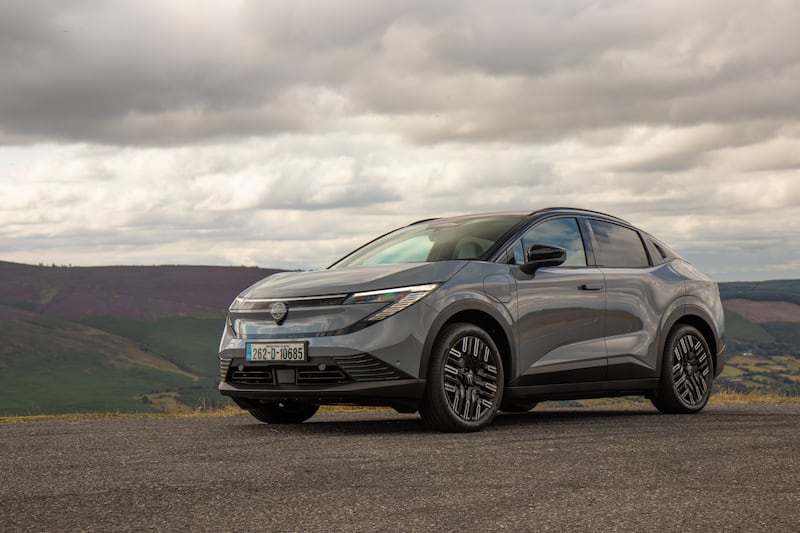


However, legroom in the back isn’t anything exceptional and the 437-litre boot seems a touch undersized compared to many direct rivals. The similarly-sized and priced Skoda Elroq swallows 470 litres, and the Nissan can’t even compensate with a “frunk” in the nose. It leaves the Leaf sitting in a slightly odd position, halfway between hatchback and crossover.
It is good to drive, though. I say “good” because it’s not quite brilliant. There’s quite a bit of weight with which to cope, especially in the big-battery 75kWh model, which weighs in at 1,973kg. You can really feel that weight in corners. No Leaf has ever been a bundle of fun to drive, exactly, but this one can feel a bit too hefty for its own good at times.
The flip side of that is this Leaf is superbly refined. Wind noise and road roar are kept very well at bay, and once you’re away from the twisty roads and on a motorway, the comfortable ride quality mixes with that silence, and some excellent front seats, to turn the Leaf into an excellent long-haul cruiser.
That’s a role no previous Leaf could have essayed, thanks to its truncated range, but with that 75kWh battery and that slippery bodywork, this Leaf is very efficient indeed. Against that 622km claimed range, you should easily be able to extract 500km or better and average energy consumption seems to work out at around 15.5kWh/100km in mixed driving, climbing to maybe 18kWh/100km on motorways.
True, 150kW of DC charging speed is no one’s idea of super-fast any more, but Nissan has worked hard on the Leaf’s charging curve – the measurement of how long it can sustain that maximum charging rate – and the upshot is that from a reasonably powerful DC charging point you can add 420km of extra range in about 30 minutes. Which seems like enough, to be honest.

There is a smaller battery version, with 52kWh of battery capacity and a 440km range. That should also be enough for many, and picking that one brings the price tag down to €36,095. It’s a still reasonable €39,995 for the bigger battery. Reasonable, but our top-spec Evolve model costs more than €50,000.
With 217hp of power on tap from the front-wheel drive electric motor, this Leaf has almost as much power as an early 1990s Ford Escort Cosworth, which seems mad until you remember that kerb weight, hence the relatively slow 7.6 second 0-100km/h time, but then the Leaf feels perkier than that figure suggests in more give and take driving.
Sixteen years ago, I still had brown hair and slightly less in the way of a protruding stomach. Now? I’m greyer and chubbier and live in a world where a Nissan Leaf can boast a 622km range. Which one of us has aged better?
Lowdown: Nissan Leaf 75kWh
Power: 160kW e-motor developing 217hp and 355Nm of torque, powering the front wheels via a single-speed automatic transmission.
CO2 emissions (annual motor tax) 0g/km (€120).
Electric consumption: 13.8 kWh/100km (WLTP).
Electric range: 622km (WLTP). Electric range: 500km (Observed).
0-100km/h: 7.6 sec.
Price: €51,75 as tested, Leaf starts from €36,095.
Our rating: 3/5.
Verdict: Sixteen years on, the Leaf doesn’t quite rule the electric car roost, but it’s a solid choice with excellent real-world range and no little style. Needs more space in the back and boot, though, and higher-spec models are notably pricey.


