
It takes something special to make us tear up our list of top five cars of the year. Yet that’s what happened after we got the chance to drive this BMW iX3 just days before we publicly christened The Irish Times Car of the Year for 2026.
This car nipped in at the last minute and nabbed the top spot.
So would the iX3 impress as much on Irish roads as it did on the twisting mountain passes, bumpy back roads and motorway stretches of southern Spain? Were we being beguiled by BMW’s engineering bluster?
Our gamble is as nothing compared to BMW’s. This car encapsulates the eternal automotive battle between engineers and accountants. It makes financial sense when investing billions in R&D to spread that spend over multiple models. So the so-called “neue klasse” formula on which the new iX3 is built is billed by BMW as its most important move this century. It will shape every BMW that follows, from the new 3 Series to the full-size seven-seat X7.
READ MORE


For the accountants, one formula shared across the range means cost savings and hopefully meaty profits. For engineers, however, a mistake here could cripple the entire model range. So failure is not an option.
The promise is enticing. A completely new platform heralding a new generation of BMWs that claims to deliver the latest tech while retaining the brand’s core DNA. At its heart is a revised battery format which promises to put BMW alongside premium rivals Mercedes and Volvo in terms of market-leading range: up to 805km claimed on a single charge.
Combined with this potential game-changing range, there is a reimagined cabin format and the promise of AI assistants plus selected hands-free autonomous driving.
Let’s focus for a moment on that cabin before we take the iX3 on the road. Since the modern EV arrived and autonomous driving became a potential reality, promises have been made on revolutionising the format of cars. No engine up front, no mechanical connections to the steering wheel – indeed, no wheel – would give designers free rein to stretch their imaginations. Yet when it comes to what’s showing up on forecourts, so far, imaginations have yet to be flexed.
BMW is at least trying to make a difference here by moving a lot of the information to a strip that seems to float along the base of the windscreen, dubbed the “panoramic vision”. It’s a clean, efficient way to deliver information. Not new – others have opted to use this sort of format, such as the Renault Espace back in 2002. Yet now delivering a digital interface that promises to cater for the age of AI, courtesy of a rather odd-looking floating head digital avatar.


That alien head hovering in your eye line is unlikely to become your BFF, but it’s getting a proper AI brain.
Of course, conversing with your car is nothing new. It’s just that once BMW’s Intelligent Personal Assistant – IPA for short – is promising to hook up with Amazon’s Alexa AI capabilities, so it will be able to talk back about topics other than the temperature or tyre pressures.
In 2001, BMW caused uproar among its loyal customer base with the iDrive control. The fact we’re now nonplussed about chatting with our car shows how much the world has changed in 25 years.
Which brings us to the practicalities and appearance of the iX3. It’s your typical boxy crossover, but thankfully with more subtle styling than some siblings in this class. It’s better looking than its sibling iX, for example.
It has a similar footprint to a 5-Series and offers similar bootspace, starting at 520 litres and going up to 1,750 litres with the rear seats flat. Where it delivers over the 5 Series is in the slightly better head and legroom, plus a more upright seating position and a cabin that feels spacious and airy, particularly when fitted with the optional panoramic roof.
One oddity is the steering wheel, the singular faux pas on the iX3. It’s an odd mix of seemingly flimsy plastic touchpad buttons and unintuitive hand grips. The buttons let you control the “panoramic vision” display, but you can also do that with the touchscreen. There are parts where you might have hoped for more premium materials, but overall, it’s a well-dressed cabin.


Thankfully, there are times when you don’t need to hold it at all. The iX3 arrives with BMW’s Highway/Motorway Assistant system. Unlike other active cruise control systems that control steering but require you to keep a grip on the wheel, this is a hands-off system that requires the driver to pay attention to the road – and monitors their doing so. Legal changes introduced just last month make this system legal for use on certain Irish roads.
For the times when you do take control, the iX3 offers a standout performance. Despite its crossover format, the car does really handle well, with the sort of traits we would previously associate with a 5-Series saloon. Amid the tidal wave of new tech, BMW has managed to preserve its driving DNA, which is an impressive feat. With so many new car brands delivering competent but dull driving characteristics in their EVs, it’s all the more delightful to find a car that’s somewhat engaging.
The steering feel can be a little light, and the ride quality choppier than you get in the ultra-cushioned EVs, which means you might get the odd rattle and complaints from passengers. BMW mastered the quiet cabin with the iX, and this new car benefits from those learnings, though on 1980s suburban housing estates with their concrete roads or small back roads, tyre noise and bumps are an issue. These niggles aside, the overall sense you get from time behind the wheel is positive. This is a nice car to drive.
The iX3 is pacy, delivering 469hp in old money and an official 0-100km/h time of 4.9 seconds. The figures are fine, but the real trick is the way it’s delivered. Unlike slightly faster rivals on paper, this power hits the road in a nice linear fashion, packing a kick but not the neck-snapping jolt you get from other EVs. And the best bit is the hefty torque: 645Nm is the sort of pulling power you got from the big block diesel in the 530d.
Alongside its landmark claim of up to 805km range (or 729km in our Sport Pro version on test that had weighty options such as the panoramic roof and sat on sizeable 22-inch wheels) from its 108.7kWh battery pack, the iX3 is also boasting a maximum DC charging rate of 400kW. That’s significantly more than even the likes of Tesla’s Model Y can deliver, with its 250kW max. What that means is if you plug into the likes of an ESB 360kW “high-power charger”, at some stage during charging, you should see it hit its max.
From a practical point of view, BMW claims you can get from 10 per cent to 80 per cent of a charge in 21 minutes.
Our experience at an ESB high-power charger suggests that it’s close to reality. Arriving on a 63 per cent charge, we were hitting 169kW within two minutes. After five minutes, we had 13kWh added, equating to an estimated extra range of 75km.
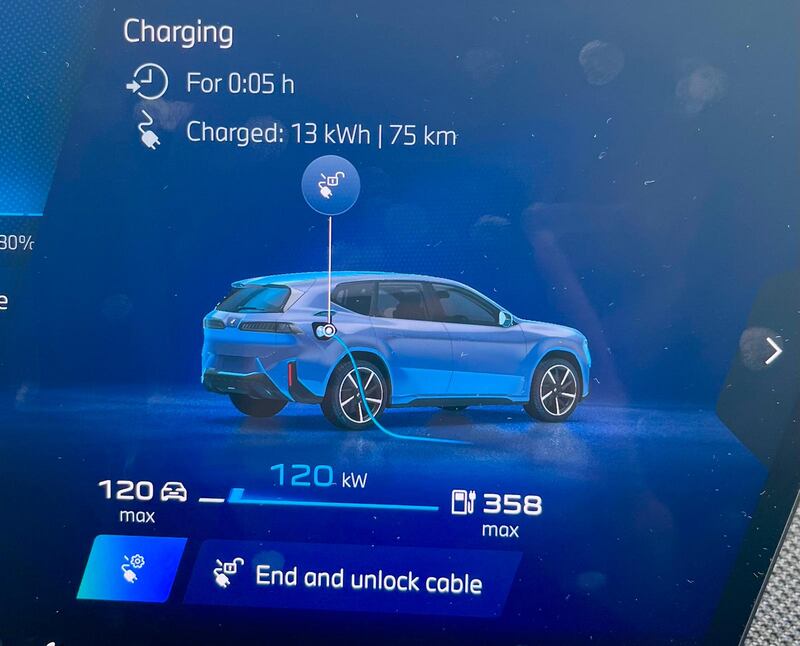
Fully charged, the promise of our car’s computer was 674km, partly based on our average consumption of 20.2kWh/100km, which accounts for the lower than official range. BMW reckons you can average 16.8kWh/100km.
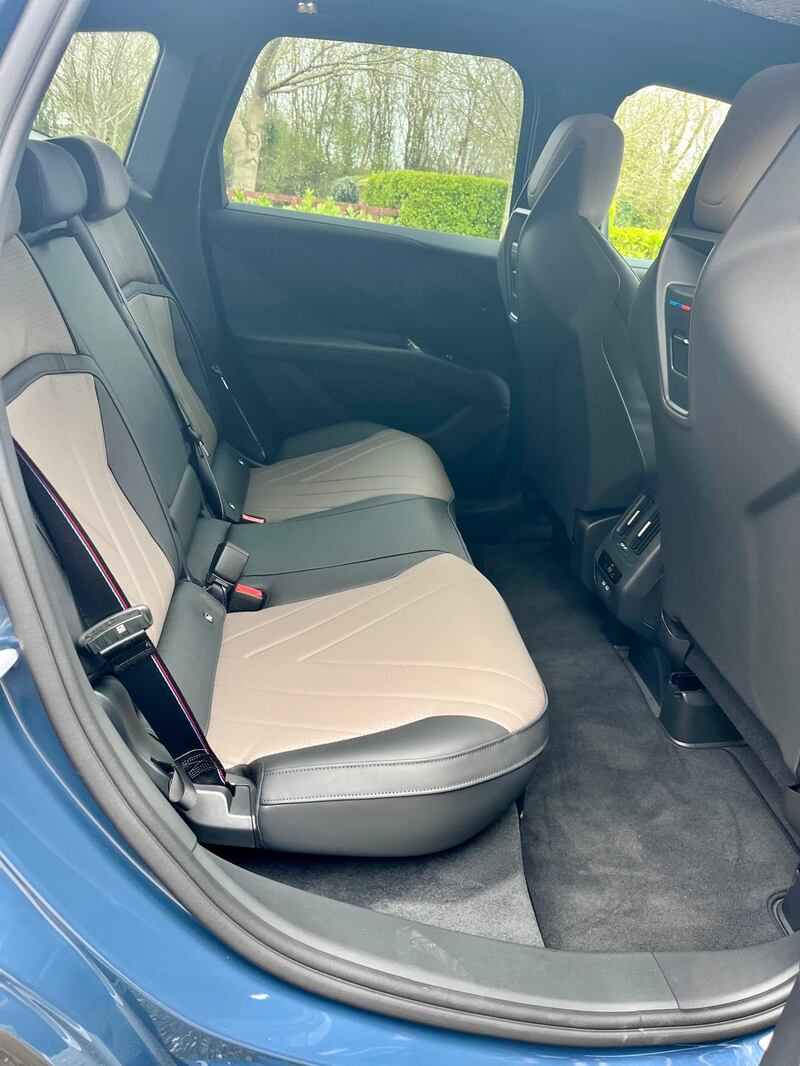
On one trip that criss-crossed the Dublin mountains and toured Wicklow with three adults in the back row – all complimenting the space and comfort – the iX3 endeared itself for its handling and poise, while not leaving the passengers feeling discombobulated.
This is a big car, though, so it only raises the expectations for when this “neue klasse” is cloaked in the lighter and neater body of the upcoming i3.
In a market awash with crossovers, and EV versions at that, we never expected the BMW to stand out. That’s why it never ranked for consideration on our Christmas list for 2026. But this car is full of surprises, and starting at €73,925, it’s competitively priced as well.

It’s a better buy than the slightly larger iX model, which starts at €92,785, or other all-electric rivals in this price range.
You can see why Tesla thought it timely to cut its prices for the Model Y. Its long-range version promises a max range of 616km and doesn’t match this car for driving pleasure or premium finish.
The new iX3 is part crossover, part data centre, part rolling battery bank. But this is not just another silent appliance. Ultimately, it’s a fun car to drive. And for that we can thank the engineers at BMW for holding the line as the tech nerds coded and the accountants quibbled.
Lowdown: BMW iX3 M Sport Pro
- Power: Two electric motors putting out 345kW (469hp) and 645Nm of torque combined with a 1-speed auto transmission delivering all-wheel drive power
- 0-100km/h: 4.9 secs
- Official consumption: 16.8 KWH/100km
- Range: 729km on test car
- Price: €78,955 (iX3 starts at €73,925)


