
I love it when a car just kind of pops up out of nowhere and surprises you. One about which you pretty much had the first and last paragraphs written in your mind, and the only work would be to fill in the remaining blanks. For the Renault Rafale “atelier Alpine” plug-in hybrid, the theme would read “nice, but too expensive and not special enough”.
Pardon me while I break out the virtual Tipp-Ex, because this most expensive of Rafales – and therefore the most expensive Renault you can currently buy, excepting the wild all-electric Renault 5 Turbo 3E – is something of a slow burner.
We can debate several aspects of this car. Can an SUV also be a coupe? Equally, can such a car actually be truly rewarding to drive? And, can a plug-in hybrid prove its worth in an increasingly all-electric world?
All of these are up for discussion, but the biggest question of all is – is this Renault worth its price tag? It is, in fairness, a large and heavy price tag, dropping to the ground at your feet with a clang that says €63,995. Gulp.
READ MORE


That’s a savagely big price tag for a family-friendly French car, even allowing for the fact that in the recent past we’ve tested the likes of the Skoda Enyaq (not even the RS) with a €70,000 price. That, surely, is ground that no mere Renault can conquer, right?
Having spent some time with the Rafale, I’m not so sure now.
There will be some instant responses, most of them along the lines of “you could have an Audi/BMW/Mercedes for that cash” and “what about the depreciation?”
Such knee-jerks have a kernel of truth, but I’m reminded that just weeks ago, I drove a new Audi Q3 SUV, smaller than the Rafale, less well equipped, and with the most basic (and oddly thirsty) 1.5-litre petrol engine. An Audi which actually cost €4,000 more than this Renault, yet was so anodyne that now I’m struggling to recall what it was like to drive.
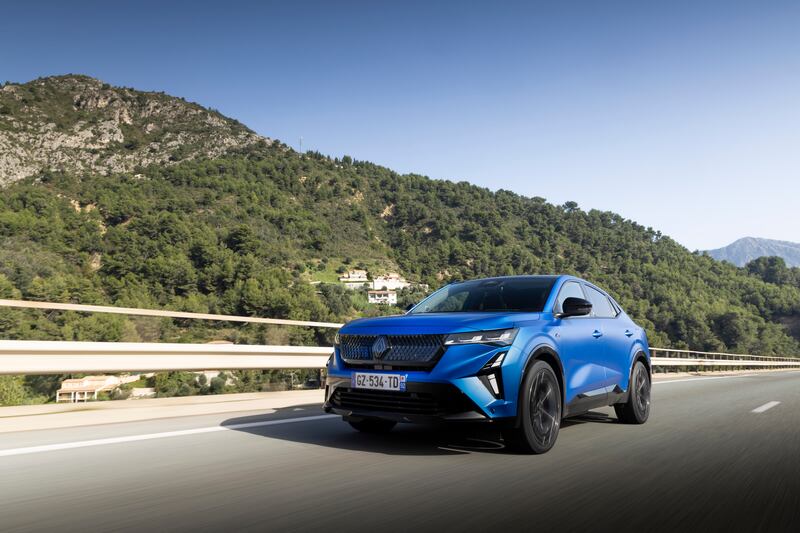
Deprecation or otherwise, life is surely too short to bother with boring cars. The Rafale is not boring, and I’m only being slightly swayed by its nominative relationship to a 1920s racing aeroplane (a silhouette of which is etched into the rear of the electric-dimming glass roof).
The paint helps – a matt blue called Satin Summit Blue, set off by gorgeous 21-inch alloy wheels, and topped with some neat A-with-arrow Alpine badges. Those signify, in this specific case, not just a sporty trim level, but actual spanner-work by Renault’s Alpine sports car brand when it comes to the Rafale’s suspension and steering.

The Suspension is electrically adjustable from stiff to soft and the steering also turns the rear wheels to tighten up the turning circle. Do these Alpine efforts turn the Rafale into a driver’s car?
[ The Kia EV5 is close to unbeatable, but needs a touch more rangeOpens in new window ]
Almost, but not quite. You can have some serious fun in this relatively tall, certainly heavy, SUV. The steering is quick, if a touch lifeless, and the balance between ride and handling is pretty deftly struck. There is a windscreen-mounted camera which scans the road ahead for bumps and warns the suspension what’s coming up, but it’s still a bit hard-edged at times.
The Rafale PHEV is what you might call a seven-10ths car – drive it briskly, and it’s good. Push it too hard, and it becomes a bit clunky, but then the same is true of most sporty SUVs. And again, the Rafale is putting in a far more interesting performance here than the Audi Q3.

It’s certainly faster. The plug-in hybrid system uses a beefed-up version of the 1.2-litre turbo three-cylinder engine used by the regular Rafale hybrid, allied to a complex gearbox and three electric motors.
Two of those drive the front and rear wheels, while the third is packed into the gearbox to act as both an infinite ratio and a starter-generator.
The total power output is a robust 300hp, and the Rafale feels suitably swift, easily kicking its heels up when you fancy it. There are some odd noises, as the engine doesn’t always run in direct synchronicity with the speed of the car or its wheels, but you get used to that.
Economy? About 8 litres per 100km if you’re driving it without charging up the big 22kWh battery, but much, much better with a regular top-up (although there’s no fast charging facility). Range on one charge is reputed to be better than 100km, but I couldn’t get more than 75km out of it in the chilly, wintry conditions in which I was driving it.
Chilly, wintry conditions which turned to a sudden heavy snowfall just after new year, and yet the Rafale was unperturbed by such conditions (helped by niceties such as a heated windscreen, seats and steering wheel). You really get the measure of a car when the conditions turn as challenging as that, and despite its big wheels and low-profile tyres, the Rafale was utterly dependable.
It’s nice inside, if not exceptional. The bucket front seats are superb, but the rest of the dash is a little too cheap in places for the price tag.
The big touchscreen is excellent, however, thanks to Google software and plenty of proper, physical buttons too. Space in the back is absolutely fine, in spite of the sloping roof, and the boot holds a better than reasonable 535 litres.

We have to come back to the price tag though, which seems like an ill fit for the badge, and one that will trigger catastrophic depreciation. However, I still can’t help but feel more than a little affection for this unusual Renault.
While it’s true that a similarly priced German premium model will hold its value better, none of those cars are quite as quirky, quite so interesting, and quite as refreshing as this Rafale.
Equally, the Rafale PHEV is now an official transport of the French president, joining such previous great French cars as the Citroen DS, the Renault 25, and, er, the Renault Safrane (you can’t win them all, Monsieur Le Président). You’d have to be brave to buy one, but I would utterly applaud such bravery.
Lowdown: Renault Rafale PHEV atelier Alpine
Power: 1.2-litre three-cylinder turbo petrol engine with three electric motors developing 300hp and 230Nm (engine) + 400Nm (e-motors) of torque driving all four wheels through a CVT gearbox.
0-100km/h: 6.4 secs.
Emissions (motor tax): 17g/km (€140).
Fuel consumption: 0.6l/100km (WLTP claimed).
Fuel consumption: 8.0l/100km (observed).
Price: €63,995 as tested. Rafale from €51,495.
Our rating: 3/5.
Verdict: Overpriced, which places it under a burden, but the Rafale PHEV is clever, handsome, fun and interesting.


