
Recently, Castrol, the famous maker of engine oils and lubricants, has been on a scientific mission to find out if “the thrill of driving” can be quantified. By hooking a series of drivers up to a frankly hilarious-looking skullcap, the conclusion is that a full immersion in the task at hand is the secret to driving joy.
Honestly, I could have made this far simpler and saved Castrol a bucket of time and money. The secret to driving joy? A Morgan Super 3.
Morgans have been made in the same gradually extended factory on Pickersleigh Road, in the small town of Malvern in the west of England, for more than 100 years now.
It’s the only car factory I’ve ever been in that fits neatly into a suburb of low houses. No belching chimney stacks here. Just a series of brick buildings full of craftspeople planing wood (ash for the body frames), gently bending aluminium, and installing BMW and Ford engines into their home-grown chassis. It’s car making the artisanal way.
READ MORE


The traditional Morgan – the Plus Four with its flowing wings, protruding lights, and luggage rack on the back – is still very much in production, and externally still clearly a descendant of the original 1936 Plus 4.
But the Super 3 is actually even more of a throwback. Morgan started by making small, frugal, three-wheeled cars that were supposed to be cheaper to buy and run than other, heavier, cars of the day.
That hasn’t changed. The three-wheeled shape was revived in 2012, with an exposed V-twin motorbike engine at the front, just like the originals, and then refined into this Super 3 in 2022, which tucks its three-cylinder 1.5-litre Ford engine under enveloping bodywork, although the suspension and wheels still stick out the front.
Power, and there’s only 120hp of it, goes through a five-speed Mazda gearbox to a robust chain drive to the single rear wheel. All three wheels look more like something you’d see on a mountain bike, and there’s no roof. No windscreen come to that, just a pair of deflector screens to send the worst of the tumbling vortex of air over your head.
Inside, there’s a simple – and rather gorgeous – pair of digital dials which look as if they could have come from a Cold War fighter jet, as does the tiny starter button which lives under a small flick-up cover.

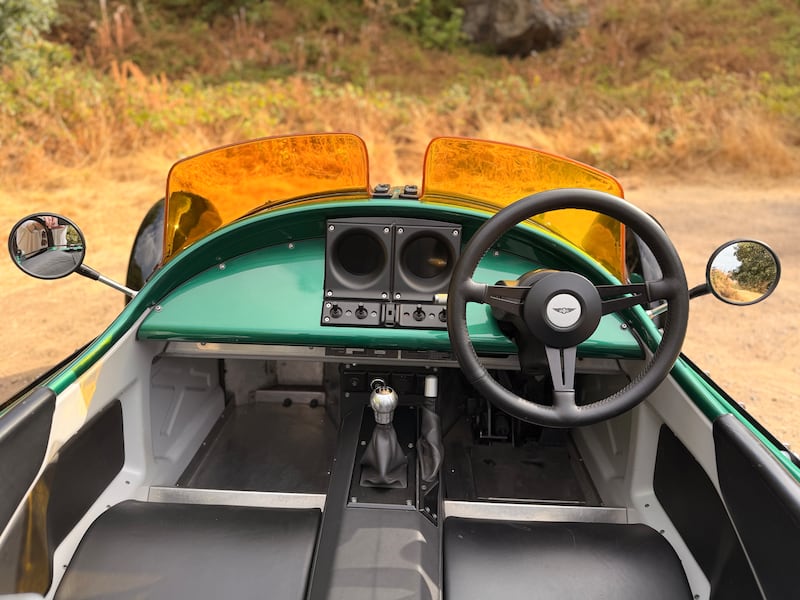
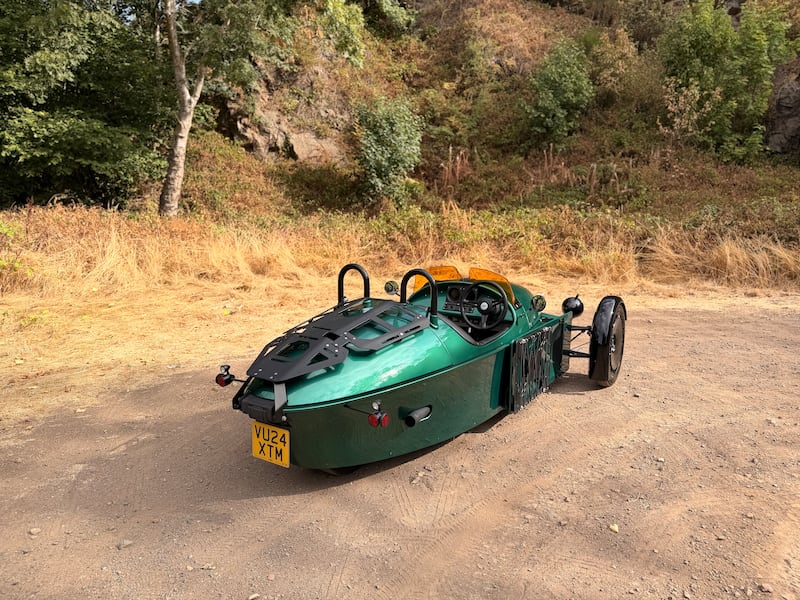
Flick up, thumb the button, and the little Ford engine burbles into life, revving happily through a truncated exhaust that exits just below and behind your right elbow.
You are totally exposed in a Super 3, and I should probably have worn a crash helmet rather than the baseball cap and sunglasses I was using. Certainly biker wear would be appropriate in the winter, although the interior is sealed against water and dust, the seats are heated and there is a cabin heater too. And there is a proper boot under the rear clamshell bodywork. On the seats, they are fixed: the pedals and steering wheel move instead.
Thankfully, our day of driving was one of the last few glorious days of our overheated summer, and the good thing is that we were not dramatically contributing to climate change here. The Morgan is a sports car, of course, but thanks to weighing just under 700kg, it can do an easy 6.0 litres per 100km and has CO2 emissions of just 130g/km.
Out on the road, everything feels immediate. Whether you’re going at 10km/h or 100km/h, the air whooshes into your face (and up your nostrils), the engine parps and farts entertainingly, and the five-speed gearshift feels almost as good as the steering.
Some carmakers liken their car’s handling to that of a go-kart; the Morgan Super 3 makes good on the promise. Your hands, feet (dancing on tiny, close-set pedals), and your bottom all feel everything. You could not be more in touch with the road. Literally – you can languidly dangle a hand over the side and touch the tarmac at traffic lights.
You would have to be some kind of raving masochist to use a Super 3 as a daily car, but Morgan’s other car, its latest, is billed as a true daily driver and a rival to even the likes of the Porsche 911.


The Morgan Supersport arrived last year as a replacement for the old V8-engined Plus 8. As before, underneath a heritage-style body (albeit this time one with very modern detailing and surfacing work) it uses an aerospace-spec bonded and riveted aluminium chassis, although there’s still an ash wood frame under the hand-beaten body panels.
Inside, there’s a cabin of rare comfort and luxury by Morgan standards, and even a proper external boot, although it will be taken up by the pop-off sidescreens should you decide to go entirely alfresco. There is an optional carbon-fibre hardtop for winter use or long journeys, and of course a traditional folding mohair soft-top too.
More importantly, under the long, long bonnet – which stretches away endlessly beyond the three dinky little windscreen wipers, a Morgan tradition – is a BMW B58 3-litre turbo straight-six engine. BMW doesn’t hand out engines like candy to anyone who wants them, so clearly Morgan has continued to impress the mandarins of Munich, and the Plus Four uses a BMW turbo four-cylinder engine too.
As standard, the Supersport has the same 340hp as the BMW M240i or M340i, but this is a Supersport 400, which has been tweaked specifically for Morgan by the experts in Germany, and now produces 407hp (a nice, round 300kW) driving the rear wheels through an eight-speed automatic gearbox (alas, there’s no manual option, but at least Morgan has done away with the incongruous BMW gearshifter).
That much power in a car that weighs just 1,170kg at the kerb has some monstrous consequences. A 0-100km/h time of just 3.6 seconds is in the same territory as some of the hottest performance EVs, but no EV ever sounded like this, blaring a gorgeous flat-six song through a special sports exhaust.
Performance is muscular, and there’s a terrific feel through the tiny Alcantara-rimmed steering wheel, although sitting as far back from the front wheels as you are, you have to build yourself up into the Morgan’s rhythm, and forget what you know about boring old conventional cars.
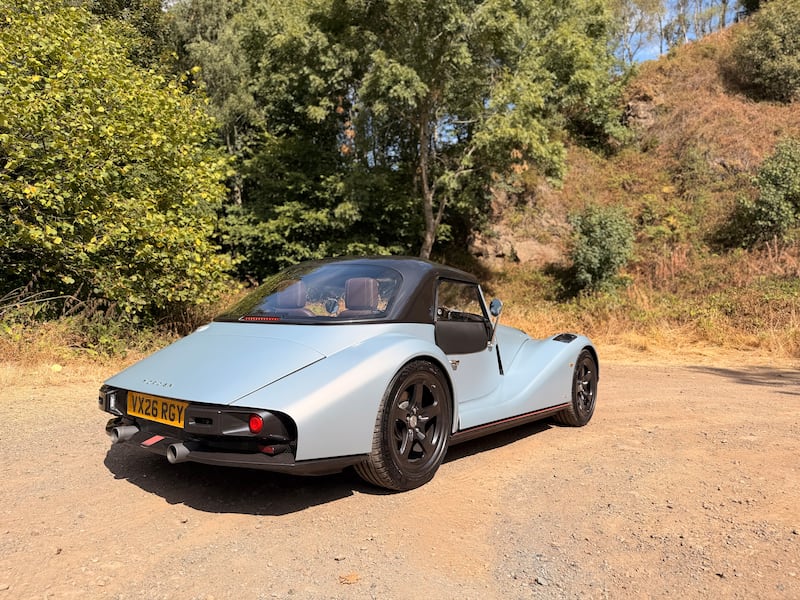
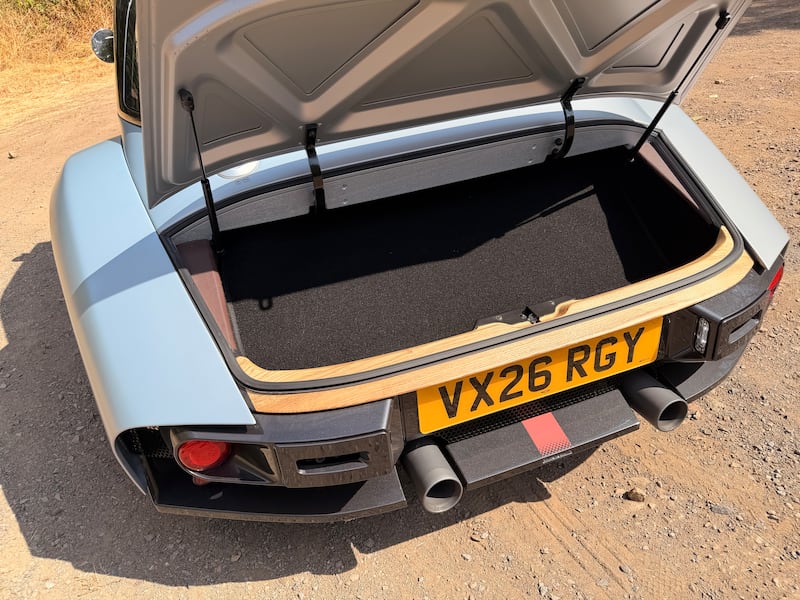

Could you use one every day? I don’t actually see why not. Fuel economy of 7.6 litres per 100km on average isn’t too ruinous, and the cabin’s actually pretty easy to get in and out of, in spite of the low height and those flowing wings.
Seat comfort improves with use (they feel a bit narrow at first, but either you or they adapt as you go) and the hard top gives fantastic all-round visibility compared to the normal soft top.
The Supersport 400 is firmly sprung, but not aggressively so, and some of the roads around Morgan’s factory felt pretty similar to rural Irish tarmac, so it should do fine at home. A manual gearbox would be nice, but you can’t have everything, even with a likely €200,000-plus price tag.
That sounds like stupid money, but then it’s comparable with a well-specced Porsche 911, and Porsche makes circa 50,000 911s every year. Morgan only makes a grand total of 800 cars annually, and only around 200 of those will be Supersports, so you’re extremely unlikely to meet another on the road.
A perfect two-car garage, then? Maybe so. The Super 3 for sunny days and short hops to the shops. The Supersport 400 for transcontinental holidays (send the luggage on ahead) and longer commutes. Throw in a cheap used Toyota Corolla for the days when neither car quite suits your needs, and I’d say that’s the true secret recipe for motoring joy. No skullcap and trailing wires needed. Castrol should’ve just asked us.


