

Jaguar’s new electric “GT” four-door super saloon will be known as the Type 01, a name that has clearly evolved from the Type 00 name given to its somewhat controversial coupe concept model, first shown in 2024.
It is the first model in a long-gestating plan to move Jaguar away from direct competition with the likes of BMW, Mercedes and Audi and instead raise the brand’s prices to a level that competes with Bentley, allowing – in theory – Jaguar to make profitable sales from fewer models, with a commensurately smaller dealer network.
The plan has certainly not been without controversy. Jaguar could have already expanded its electric car line-up.
But the ground-breaking I-Pace electric crossover was allowed to wither on the vine as rivals introduced longer-range and more sophisticated models.
READ MORE


An all-electric replacement for the XJ saloon, which would have rivalled the likes of BMW’s i7 and the Mercedes EQS, was dramatically cancelled at the very last minute, with the car already having reached the final prototype stage.
Instead, Jaguar embarked on a total reinvention, ending production of its XF, XE and F-Pace models entirely, leaving Jaguar’s dealers with no Jaguar-branded cars to sell for more than a year. In the meantime, work commenced on a cutting-edge electric car platform, called the Jaguar Electric Architecture, or JEA.
The Type 01 will be the first car to use that platform, and it has been designed around long range (about 700km from a roughly 100kWh battery) and fast charging (adding 300km of extra range in about 15 minutes).
The Type 01 will not only be the first of this new lineage of all-electric Jaguars, but it will also be the most powerful Jaguar production car ever.
Indeed, with more than 1,000hp from its three electric motors, it will even eclipse the 650-700hp XJR racing cars with which Jaguar won the Le Mans 24 hours in the late 1980s, and the Jaguar-Cosworth Formula One cars of the early 2000s, which may have scored no wins but which were extracting about 900hp from their 3.0-litre V10 engines.
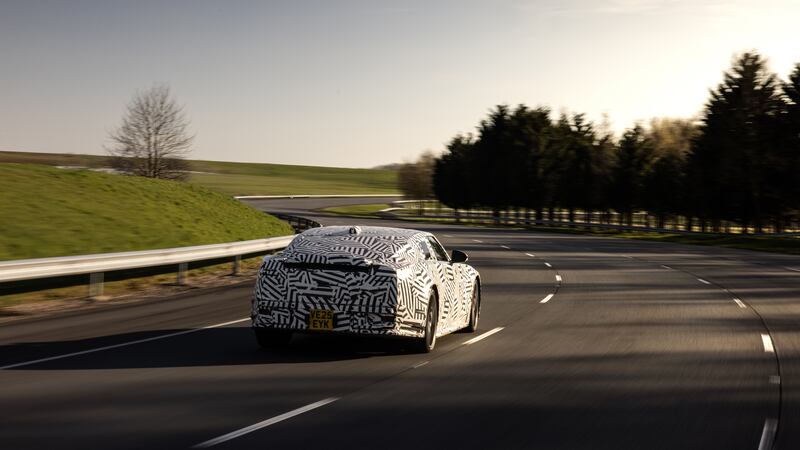
Of course, both the Le Mans and F1 racers were substantially lighter than the Type 01, which is reputed to weigh about 2.7 tonnes. It’s a low, and very long (more than 5 metres) four-door coupe, with an elongated bonnet and a truncated boot. Four-wheel drive, thanks to one front motor and two at the rear, should give a 0-100km/h time of less than four seconds.
[ Denza ramps up BYD’s premium ambitions in EuropeOpens in new window ]
Early reports are that the Type 01 is a graceful and engaging car to drive, in the Jaguar tradition, and while the brand courted controversy with an online ad campaign that included imagery designed to enrage the anti-woke brigade, the fact is that tradition is very much still on Jag’s mind. The use of “Type” in the name evokes memories of C-Type and D-Type racing cars, and of course the famous E-Type sports car of 1961, still the firm’s most famous product.
Jaguar’s engineers have also said the car they have benchmarked the Type 01 against, in terms of its combination of comfort, performance and handling prowess, is not a modern Chinese or German EV, but the 5.3-litre V12-engined XJ12C coupe of the early 1970s.
Bravo to that, frankly. Matt Becker, formerly of Lotus but nowadays Jaguar’s head of vehicle engineering, said: “At the outset we took the unusual step of spending time behind the wheel of great models from our past – to get under the skin of what truly makes a Jaguar.
“At its best, Jaguar has always delivered two characters – performance and comfort – in perfect harmony and our new luxury GT is no different. It embodies everything the brand stands for. Jaguar’s founder, Sir William Lyons, used to say that ‘driving should be a joy, not a chore’.”
Rawdon Glover, Jaguar’s managing director, said: “We have reimagined Jaguar for a new era, with inspiration from what has gone before. Our engineers have achieved this with a vehicle that looks and drives like no other electric car, yet reflects a unique provenance.”

The chutzpah Jaguar is showing with its new car is impressive, but the overriding question is: will buyers be moved? It’s debatable.
Jaguar is a badge beloved of car enthusiasts, but this reinvention as an all-EV super-luxury brand has been driven by one thing: falling sales. Jaguar found itself unable to compete on even terms with BMW or Audi, and so has had to resort to a make-or-break “moon shot” to give the brand any future at all.
[ Cupra Born again – sporty version gives GTI performance for a savingOpens in new window ]
Former chief designer Gerry McGovern’s comments, at the initial showing of the Type 00 concept, that Jaguar “had no brand equity” – which is possibly why he soon left the company or was shown the door, depending on whom you speak to – rang true to the extent that buyers were staying away from Jaguar dealerships.
But the online furore created by the “Copy Nothing” campaign that surrounded the Type 00’s reveal showed that, perhaps, people still care about Jag.
Equally, buyers were staying away not because the cars weren’t good to drive, nor stylish enough, but because they couldn’t compete with the big German brands on PCP and leasing rates, and the company’s Ingenium four-cylinder engines were proving to be a reliability nightmare. The Type 01’s electric drivetrain and more upmarket positioning seem to sidestep those two issues.
[ How should I replace a 26-year-old diesel ‘jeep’?Opens in new window ]
Even so, is there actually a market for a large, expensive, electric luxury four-door (and subsequent SUV and roomier saloon models to follow, presumably to be called Type 02 and Type 03)? Mercedes, BMW, Audi and Porsche are all backing away from an all-electric future right now, but that may well prove to have been the wrong move.
Electrification is the future, whether existing customers or management like it or not. While EV sales are sharply down in the US, according to Global Market Insights, the market for luxury electric cars is set to almost triple by 2035. By a combination of planning, happenstance and sheer luck, Jaguar might just be about to strike when the timing is right.
In the meantime, we have a name. And Jaguar certainly has the ambition. By the end of this year, we’ll also have seen what the final production car looks like.


