

“You cannot say what Patagonia is like in words,” says Francisco, our driver, as he collects us from the airport at Punta Arenas. “Nevertheless, I will try.” He tells us of thundering winds, inhospitable plains, towering mountains, explorers and rare creatures. There are outlaws and gauchos, fossils and flowers, deserts, steppes, fiords, penguins and glaciers. Extending from the southern part of the Andes mountain range, down to Cape Horn, Patagonia is not a country but a region spanning Chile and Argentina. It also seems to be a state of mind.
From Bruce Chatwin to Paul Theroux, Patagonia has been so much mythologised that actually being there feels a little like arriving in the west of Ireland after looking at too many Paul Henry paintings. Imagination has overlaid reality to the extent that it’s hard to see what you’re looking at, and your emotions feel both intensified and somehow second hand. This happens with travel: some destinations get pre-imagined more than others. We may find what we are looking for when we get there, because we have brought it with us in our minds. Ireland has it with martyrs, music and myth for a certain element of the diaspora, and Patagonia encapsulates it for those inspired by wanderlust.
When Chatwin’s In Patagonia was first published in 1977 (Theroux’s The Old Patagonia Express would follow two years later), it spawned a generation of explorers, off to find themselves in harsh terrain, renarrating their lives as brave adventurers. In a letter to his publisher, Chatwin wrote “Patagonia is the farthest place to which man walked from his place of origins. It is therefore a symbol of his restlessness.” The book was a huge hit, despite, or perhaps because its author made no bones of the fact that he had invented many details and conversations.
Exploring by sea from Punta Arenas in Chile, down to Cape Horn, and up to Ushuaia in Argentina on board Chilean vessel, the Ventus Australis, I certainly find my wanderlust satisfied, but I do begin to wonder about the need to make things up. Patagonia’s documented past and astonishing present, to me, seems plenty. Down by the harbour in Punta Arenas we spot a monument to the Yelcho. The tug boat that rescued Ernest Shackleton’s marooned men in 1916 sailed from this spot after the Endurance had sunk in pack ice. Shackleton, Frank Worsley and Kerry man Tom Crean had made their now legendary journey, receiving help at this port. And it was to Punta Arenas that the crew were all safely restored.
READ MORE


Today the town is a blend of colonial architecture, metal frontier-town style shacks and an elegant square, with grab rails at one corner for when the winds get too strong. The winds round here mean business, and it’s fun to sit in a sheltered spot and watch people, quite literally, hanging on to their hats. We follow the place’s past through a tour of its celebrated cemetery, and it is not hard to imagine the occupants of its ornate mausoleums emerging to dance after dark along its cypress-lined avenues.
It is a bright autumn day, and the stalls on the square are doing a brisk trade in woolly hats and sheep-related trinkets. Hot chocolates and churros in La Chocolatta are the perfect post-cemetery snack and, fortified, we stop by the museum (Museo Maggiorino Borgatello), which is either intriguing or frustrating, depending on your attitudes to taxidermy, colonialism and the Catholic Church. The displays on the level dealing with “immigration” endeavour to be tactful, but there is no escaping the wholesale slaughter of indigenous people in the late 19th and early 20th centuries as sheep ranches, gold mines and oilfields were imposed.
Punta Arenas had once been a key city for global shipping, the major port on the Strait of Magellan, but the opening of the Panama Canal took away its role, and these days it has a sleepier air. We refuel with a seafood lunch at La Yegua Loca. This local hotspot has views across the harbour and earns its reputation as the best place for high-end Patagonian cuisine. We could easily have hung out on the terrace all afternoon, but we can see our ship, and are itching to get aboard.
The Ventus Australis has been purpose built to sail smoothly and cut through the narrow channels of the Strait of Magellan and Glacier Alley. Sleeping up to 210 passengers across three decks, it is large enough to ensure you don’t suffer cabin fever, while being small enough to feel intimate. The food is excellent, and the cabins are beautifully comfortable, with large windows to marvel at the fiords and glaciers, although this is best done in the lounge on the fifth deck, where the bar team shake up a mighty Pisco Sour flavoured with the local calafate berry. The calafate has lately been dubbed a “superfruit” – even better than acai – so it can’t just have been the pisco (a kind of grape brandy) making us feel so good.
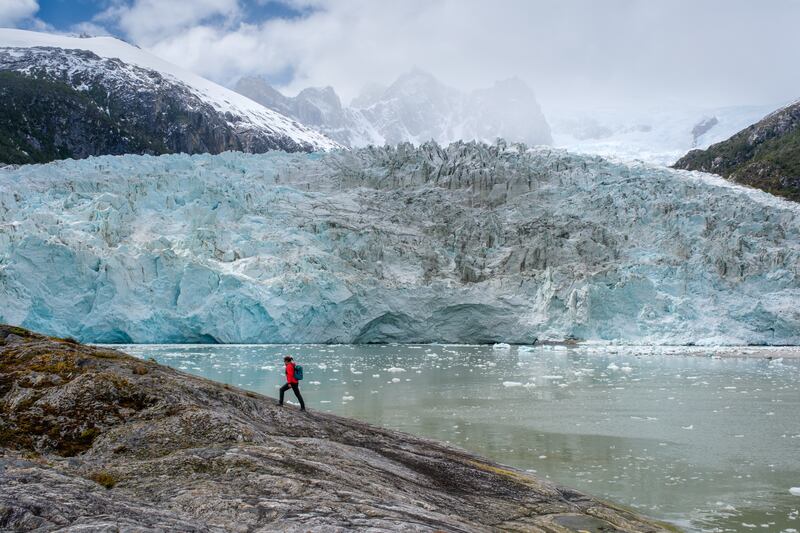
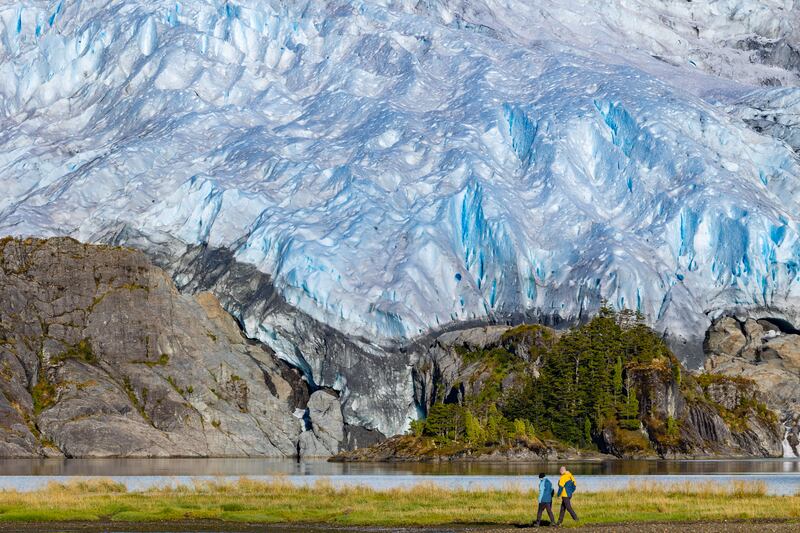
Our itinerary will take us to Ainsworth Bay, the Tucker Islands, hiking at the Pia Glacier, and sailing along Glacier Alley. With a series of five glaciers, this stretch of the Beagle Channel causes me to realise that sometimes words just aren’t enough. Spectacular, awesome, extraordinary, astonishing, jaw-dropping, humbling: I give up and gawp. Adjective defying as all this is, the goal for many of the passengers is Cape Horn. The southernmost point of Chile’s Tierra del Fuego, Cape Horn, or Cabo de Hornos, marks the entry to the Drake Passage, where the Atlantic and Pacific Oceans meet.

I get chatting to a man from England who is here with his grandson, fulfilling a life dream. “I want to land at Cape Horn,” he says. A retired sailor, he tells me of the 800-plus ships that were wrecked in its waters in the days of sail, and the more than 10,000 seamen who perished. “I’m going for them.” While today’s ships are far safer, winds and seas will do their work, and we only have a 70 per cent chance of being able to land. “I really want us to get there, for him,” says the grandson, himself now a sea captain, as we wait at the bar for another round of sours. I don’t tell him I’m really here for the penguins, as their ambition is clearly loftier.
Outside the ship’s windows, tonina (Commerson’s dolphin) arc about. Soon we will also be joined by humpback whales, larking in front of glaciers, while in the skies, petrels and skuas rise and dive. My eyes are peeled for an albatross, and I mistake a number of overly large gulls, until at last I see the real thing and, once again, I am lost for words.
Our first stop is Ainsworth Bay, where outing options range from strenuous hikes to woodland strolls, and groups are sorted out by language: Spanish, English and German. The guides are local and passionate. Catalina leads the woodland walk, describing the indigenous wealth of plant knowledge, and introducing us to the canelo (or winter’s bark tree), which she says contains more vitamin C in its bark than oranges. The Marinelli Glacier hovers in the distance.
In the evenings, backdropped by incredible sunsets, talks range from glaciers to the original tribal settlers of these lands. “Studying glaciology is like studying psychology,” says Javier. “Each has its own personality.” He describes how glaciers provoke air currents and so ventilate the atmosphere, and conjures such descriptions of the ecosystem as to make me think we are not actually at the end of the world, but at the vital centre of it. And apart from us, there is not a soul to be seen.
We take a Zodiac outing to see a colony of Magellanic penguins, and I experience that thing you get when you go to a live football game: the glimpses are more fleeting, the action more distant than the coverage on TV, but the emotions are amplified and the real thing is in another register entirely, and joyful too.
And then Cape Horn. We are taking a five-day trip and getting off at Ushuaia, but some passengers are doubling up and returning via a slightly different route, to maximise their chances of a Cape Horn landing – and to see more penguins. We get up early, and the signs are good. The winds are right, and the weather is calm enough. The Zodiacs launch. We put into a sheltered inlet and climb flights of steps to the windswept top, hiking a boardwalk to the monument, erected in 1992. There, a poem in Spanish translates as “I am the albatross that awaits you / At the end of the world. / I am the forgotten souls of dead mariners / Who passed Cape Horn / From all the oceans of the world.” It is all very epic.

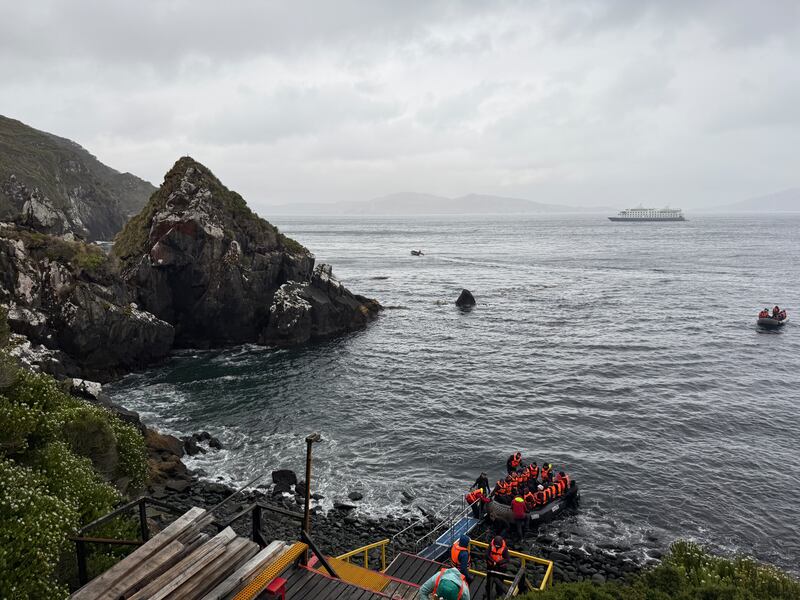
From here we walk across to the lighthouse. A lighthouse keeper from the Chilean navy is stationed here, with his family (it has always been a “he” so far), for a stint of a year at a time. It’s fun to watch the more rugged of the Instagram filmers trying to get heroic footage that excludes the swing, slide and seesaw presumably enjoyed by the lighthouse keeper’s little ones. Returning for breakfast, I meet the retired sailor again. He has tears in his eyes. A dream fulfilled. It has been a truly remarkable trip.
Thirty-six hours in Santiago

Surrounded by vineyards, and flanked by the Andes to one side, and the ocean to the other, Santiago was part of the Inca empire, until the Spanish arrived, following the Inca trail down from Peru in 1540. Today it is a city of distinct districts, from the historic centre at Plaza de Armas to vibey Bellas Artes and Barrio Italia and the newer Las Condes, nicknamed Sanhattan for its high-rise buildings. There is an excellent and safe metro system with seven lines, even reaching a vineyard or two.
We stop at the Los Dominicos Craft Centre, a rambling complex built on lands shaded by jacaranda trees that are populated by shrieking green monk parakeets. The site had been donated to the Dominican Order in 1803 by an Irish immigrant whose name had evolved into Don Juan Cranisbro. There you can buy alpaca wool, ceramics, wicked-looking knives and lapis lazuli jewellery. Lapis lazuli is the national stone of Chile, which, along with Afghanistan, is one of the few places it can be found.
Later, armed with gifts and souvenirs, we take the funicular up to the Sanctuary on San Cristóbal Hill, which is presided over by a huge stature of the Virgin Mary. Before the Spanish came, it had already been a sacred site, known as Tuhahue or “place of god” in the indigenous Mapuche language. Just below the summit, we enjoy a surprisingly delicious mote con huesillos, a drink made of dried peaches and wheat that would keep you going all day. And it does, until we head up to the foothills of the Andes for an evening feast courtesy of Carolina Montellano, who shows us how to make empanadas in a traditional clay oven, washed down with excellent local wines (book a private dinner at cookex.cl).
We stayed at the Hyatt Centric in the Las Condes district, a handy stroll to plenty of bars and restaurants, which are a little glossier than the older downtown hotspots. Expect brilliant beds, great breakfasts and a rooftop pool to lounge your jet lag off, from €94 per room, hyatt.com.
Getting there

Gemma Tipton was a guest of Australis Cruises. A five-day/four-night voyage between Punta Arenas and Ushuaia, or vice versa costs from $2,645pps, plus port boarding fees of $145, travelling between September 2026 and April 2027. Book before May 15th for up to $1,000 off based on two sharing. Or take the eight-night Darwin’s Route journey, from $4,761 with a half day in Ushuaia, returning to Punta Arenas and taking in three different glaciers plus Magdalena Island en route. Includes accommodation, all meals, open bar, and shore excursions. Stay at Hotel Cabo de Hornos in Punta Arenas, a short walk from the port, from about €133 per night plus taxes.
We flew British Airways from London direct to Santiago, and then Santiago to Punta Arenas with Latam Airlines. No travel visas are needed for Chile, but keep the PDI tourist card (a white paper slip) given on landing at the airport to present at hotels for a 19 per cent VAT exemption when paying with a foreign credit card.


