

I really enjoyed growing up in Bray. It’s a nice, pretty place to live and I feel privileged with the mountains and the sea right there.
I’m lucky with my mom. She’s been a very big support for my whole baton-twirling journey. I started when I was seven and she found a club for me. When I wanted to start, she was initially really confused. She didn’t know what baton twirling was.
I somehow knew. I used to pick up sticks when we’d go on walks in the forest and throw them around. It was some sort of game or magic – a ninja stick or a wand. I remember having sticks at home that I’d do weird martial arts movements with.
Baton twirling takes hours of practising repeat movements. So much is to do with balance and placement. A lot of the time you can’t see where the baton is, so your hand needs to be trained to go and grab it. I spend time drilling different flips and rolls in my kitchen. I’m infamous with my neighbours for always being out on the road [practising].
READ MORE


I remember my first few lessons. I was so eager. I could do the beginner stuff quite easily.
I wanted to be really good at it. I was inspired by watching YouTube – there are loads of clips of the world championship, lots of Japanese and American athletes. I’d recognise certain people and then I’d go and look their name up, and find other videos of them twirling.
I’ve done a lot of artistic performance. I did drama in school, and during transition year in secondary school I went to dance college in town. We did ballet and contemporary dance. That definitely forms a big part of competitive baton twirling. You need to have good dance technique. Ballet and classical posture.
You can be really creative with what you do with a baton. It can also be quite solitary. There are certain team events, but generally you have to go away by yourself and practise it. There’s a lot of self-discipline to it. If you’re someone who follows the crowd, it mightn’t be for you, but if you’re looking for something unique, it might be. I’ve never been into the regular team sports; I’ve always been more of a solitary person.
Several weeks ago, I became the solo one and two baton-twirling European champion in Eindhoven. The difference between the two disciplines is simple – you perform your routine while manipulating one baton for solo one, or two batons for solo two.
Within the international federations, they have “elite”, the championship level, which is what I won. They also have development levels A and B, which are basically for the countries that don’t have a lot of competition.
There were two organisations in the past, but they’ve been merging them to create the International Baton Twirling Federation, which is the umbrella of both. You can’t have two organisations claiming a world champion if you want to get Olympic status, which one day we hope baton twirling will gain. So, although I won [at the European Championship] in Croatia in 2024 too, I wasn’t the definitive European champion then.
In Ireland, baton twirling is really small, so the development levels mean you can go to the European Championships, compete at level B against loads of other athletes from small countries, and see other people competing. It makes you aspirational to strive for a higher level.
In Eindhoven, there were 19 countries competing, and dozens in the Irish delegation. Just me and one female athlete competed at an elite level.
I competed at level B when I was 14. That was my first time competing for Ireland, and I won my solo one baton. At that first competition, I don’t think I felt very strongly about representing Ireland. I was really excited to be going away competing, but it definitely wasn’t a dream to represent my country. I had dreams in my head about winning the world championship.
It’s quite expensive. Any sport, if you’re going to compete at a high level, it’s going to cost a lot. I don’t think there’s a lot of financial support for Twirl Ireland Federation. It’s hard to get recognised for scholarships.
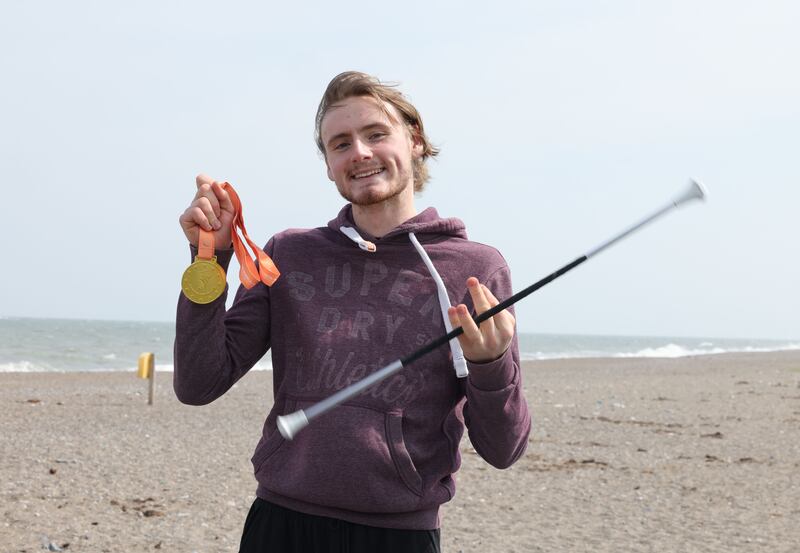
Baton twirling is extremely female-dominated. There are more boys joining since I started over 10 years ago. I can see the difference, but it’s a shame that there aren’t more.
There’s nothing inherently feminine or girly – not that there would be anything wrong with that – about twirling a baton around. We all go to competitions in these sparkly costumes – it’s associated with dance and there are less boys in dance as well.
But I think, as a recreational hobby, it should be as accessible to boys as it is to girls. It’s this aversion to some of the femininity that we have in the sport that keeps boys out of it.
I think it is objectively cool and impressive. If a little boy could start doing some of this stuff, he’d enjoy it. There’s one of the little boys in my club – he must be eight now, but I remember, when he was five, seeing him pick up the baton and throwing it around. I felt really moved, because that’s how I was. It’s just the magic of it flying up in the air, and being able to manipulate it in so many ways. That’s just so exciting and impressive.
I’d like to think I’d be a good role model for somebody who wants to follow in my footsteps, especially if someone wanted to work towards competing at the world championships.
I’d love to get a medal at the world championships for Ireland, but that might never happen. You can’t work towards getting a medal. If three people are better than you, they’re better than you. But I want to push myself to a certain level where it’s possible. I’ll know when I’m happy with what I’ve done.
In conversation with Cian O’Connell


