
Corrado Grappiolo (45) first moved to Dublin in 2005 after a friend told him the Irish accent was easier for Italians to understand than the British accent.
“I thought, yeah, let’s give it a try, and she was right. It was really fun being here for 18 months,” Grappiolo says.
When Grappiolo first moved to Dublin, he had just graduated from university in Milan, Italy. He had initially looked for a job in that city.
“Because of the cost of living in Milan and the salaries of the job offers I was receiving, I wouldn’t have been able to sustain my life in Milan. It was too expensive compared to the salaries. That’s why I thought, okay, maybe I can go abroad and ignore the capitalist dream.”
READ MORE


Grappiolo found a job in Dublin through the European Union job portal. “I was shocked by the amount of availability for computer science experts or graduates in Dublin,” he says.
[ ‘The more I read about Italy, the more I don’t want to go back’Opens in new window ]
Working as a video game tester, his job was to ensure games that had been developed in English and translated into Italian had correct language and up-to-date slang.
“What I noticed when I moved to Ireland was the number of opportunities for graduates as opposed to what I experienced in Milan.”
While Grappiolo was very happy with his life in Dublin, after 18 months, he felt that he had no choice but to move again, as he wanted to work in artificial intelligence (AI).
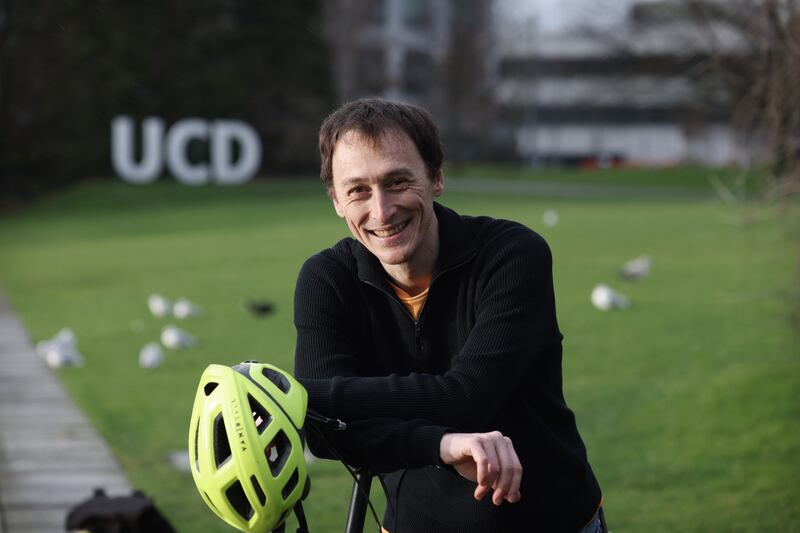
“That idea led me to move to Amsterdam, where I went to study a master’s degree in AI. I lived in Amsterdam for four years and also worked as a game developer.”
Grappiolo then undertook a PhD in AI in Copenhagen. During that time, Grappiolo met his now-wife, who is from Poland.
When I moved in 2005, I found a room in Sandyford in south Dublin. So, when we were in the Netherlands and it was time to move, I told my wife, oh you know, we will easily find a place in Sandyford
— Corrado Grappiolo
“Our first encounter was at a train station. We met coincidentally, I was on holiday. We were waiting for the same train and we started chatting.”
The pair lived first together in Copenhagen before moving back to the Netherlands for work. They got married and then had two children in the Netherlands. However, Grappiolo had concerns about raising children there.
“In terms of interacting with public offices or if the situation gets serious, the need to talk to insurance companies [for instance], there’s this language barrier. Or for the children’s school, although I can speak some Dutch, I wasn’t fluent. I started to wonder, what if my kid has to do some homework in Dutch and I can’t help him? Will I fail as a father?”
Having grown up in a small town called Sedona on the coast near Genoa, Grappiolo said he had also greatly missed living so close to nature.
“Growing up, we had a lot of nature. We had woods and we had the sea 1km from home. I played outside with my friends, you know, playing football like all Italians. Every summer since I was five years old we used to go to the Dolomites, which is this branch of the Alps bordering Austria – beautiful stunning landscapes.”
Then an opportunity to work in Dublin again came along at CeADAR, Ireland’s centre for applied AI, at UCD.
Grappiolo jumped at the opportunity to live in Ireland again, and the family moved to Dublin in 2021.
However, quite a lot about Dublin had changed in the 16 years since Grappiolo had first lived in the city.
“When I moved in 2005, I found a room in Sandyford in south Dublin. So, when we were in the Netherlands and it was time to move, I told my wife, oh you know, we will easily find a place in Sandyford because there’s nothing there. In 2005 there were only a few scattered houses and it was close to the mountains, so it’s a win-win. But when we arrived, we were faced with a harsh reality.”
The couple initially tried to look for somewhere to rent in Sandyford.
“There was a lot of competition. It was shocking, like having these open days where 20 or 30 people were looking at the same house or apartment. We felt that we were in a disadvantaged position with respect to our chance of being able to secure a place as we had kids.”
Additionally, Grappiolo and his wife couldn’t provide a tenant’s reference as they had owned their previous house in the Netherlands.
“We started to relax our criteria of living in the south, and near the mountains. That’s how we ended up in north Dublin City. We saw there’s a lot of new developments, and that there was more availability for places to rent.”
Despite their difficulties in securing housing, Grappiolo is glad to be back, and plans to stay in Ireland until he retires, if not for longer.
Not long after arriving he began and now leads the AI2Peat project, which uses satellite images and AI to monitor the condition of Ireland’s peat bogs.
Recently he went to watch a play with his children in which the characters talked about playing in peat bogs.
“I was saying wow, it’s really part of the Irish culture. The fact that I work on these things with Irish companies – I feel that I’m making an impact. I feel I’m part of it. I’m contributing to Ireland.”
We would like to hear from people who have moved to Ireland in the past 10 years. To get involved, email newtotheparish@irishtimes.com or send us two lines about yourself using the form below.


