If ever you wanted proof of how endlessly generous nature is, you’ll find it in the simple act of dividing herbaceous perennials. For those gardeners who balk at the sometimes finicky, unpredictable, often time-consuming nature of raising plants from seed or cuttings, this is propagation at its easiest, its cheapest and its quickest.
There’s no need, for example, for seed compost, or vermiculite, or electric propagators, or horticultural fleece. Nor is there any need for careful, regular monitoring of temperature. moisture and humidity levels, or for a frost-free, covered growing space. Instead, you just do exactly as the term suggests and divide the root-ball of a large, very well-established perennial into several individual smaller ones, which you then replant as quickly as possible. Simple as that.
Careful timing, however, is crucial. Divide a herbaceous perennial in summer when the plant is in full growth, the soil dry and the temperature warm, and those divisions will almost certainly struggle to recover, while any flowers, stems and leaves will quickly wilt. Divide the same plant in winter and it’s a similar story, albeit for a different reason, which is that neither icy-cold weather or saturated soil are conducive to quick, healthy root establishment, the possible consequence being death by decay.
Instead, the two optimum times of year for propagation by division are autumn (considered best for most spring or early summer flowering perennials), and spring (considered best for most late summer and autumn-flowering perennials).
READ MORE


So, for example, if you’re thinking of dividing perennials such as sweet rocket, geum, trollius, Solomon’s seal, brunnera, and epimedium, it’s best done in autumn. But for later-flowering perennials such as helenium, sanguisorba, aster, hemerocallis, hosta, monarda, crocosmia, hardy geraniums, phlox, nepeta, achillea, delphinium and tricyrtis, it’s best to divide these in March-April.
I use the word “best” here intentionally, because the truth is that the vast majority of perennial plants can be successfully divided in both these seasons. The only important difference is that by timing the division of earlier-flowering perennials for autumn, and later-flowering perennials for spring, you’re maximising the amount of time available to the plant to develop vigorous new root systems before it starts the energy-sapping process of flowering and setting seed. In short, you’re minimising disruption to its growth.
Unlike winter or summer, spring and autumn also provide the right set of growing conditions required for vigorous root development, where the ground is typically cool and damp, and average temperatures are neither broiling nor icy. Crucially, both seasons also coincide with points in the annual ebb and flow of a perennial plant’s life cycle when division poses the least threat to the viability of its stems, leaves and flowers.
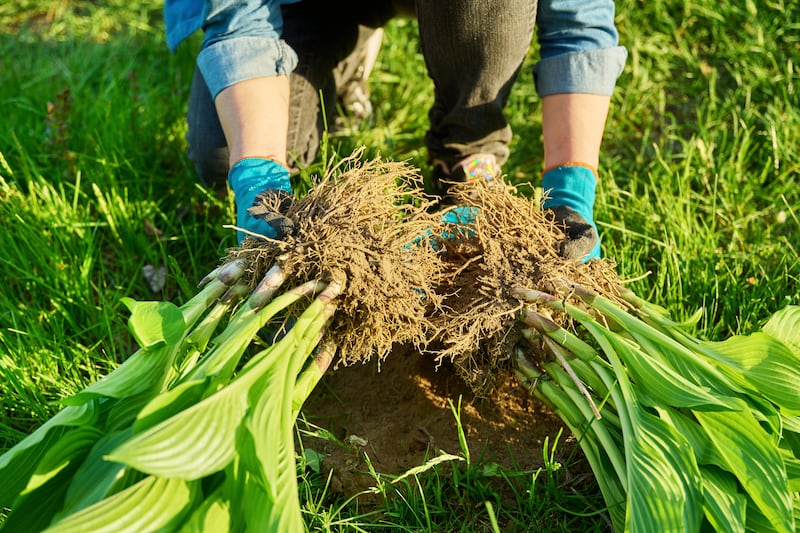
In my own garden, I prefer to mainly divide its herbaceous perennials in spring for the simple reason that it allows me to simultaneously deep-weed any large, established clumps that may have slowly become infested with stubborn weeds. To minimise plant stress, I always try to choose a cool, dry, cloudy day to do this, ideally with a forecast for rain in the following days to further help the divisions to quickly establish.
The process of division couldn’t be more straightforward, but does require a bit of muscle. To start, clear away any dead or faded stems and leaves before using a sharp spade or garden fork to dig around the base of the clump and loosen the root system, taking care to minimise damage. Then once fully loosened, lift the root-ball up and on to the ground, ideally placing it on a wide wooden board.
[ How can I start growing my own plants from seed this spring?Opens in new window ]
Closely inspect it for any weeds, which should be carefully removed. Next, depending on the type of root-ball (see below), use your hands, a sharp knife or saw, or two garden forks placed back-to-back in the centre of the clump to divide it up into several smaller sections. Just make sure that each division has its own generous amount of roots attached, as well as some new shoots.
These new plant divisions should be planted as soon as possible into a suitable spot in the garden, making sure to do so to the original depth. If you can’t do this immediately, then place them in a box in a cool, shady spot out of direct sunlight and give them a light watering. If you’d like to pot some on to give to friends, speed is also of the essence.
To help quick root growth, always water generously immediately after planting, as well – if the weather remains dry – in the following weeks. To avoid accidental damage before the new divisions properly emerge, it’s also a good idea to clearly label them.
Finally, if you’re new to division, bear in mind that, depending on the species, herbaceous perennials have a variety of different root systems, some of which are much easier to excavate and to divide than others. The roots of lady’s mantle (Alchemilla mollis), for example, are shallow, fibrous, and relatively easy to lift and divide. By comparison, those of delphinium are much deeper and more brittle, so need to be handled very gently, while those of phlox are so dense and woody that a saw works best for division.
[ Lawn order: How to get your garden grass back to glory after winterOpens in new window ]
Others, such as crocosmia and dierama, have bulbous root systems whose individual chains of woody corms should ideally be kept intact. These aside, the root systems of a small number of other popular garden species are so very deep and fleshy – for example, those of peonies, lupins, oriental poppies and acanthus – that they’re extremely tricky to successfully excavate as well as to successfully divide.
But these are in the minority. The good news is that division of large, overly mature clumps of herbaceous perennials is typically a win-win that benefits the plants themselves every bit as much as it does us gardeners.
This week in the garden
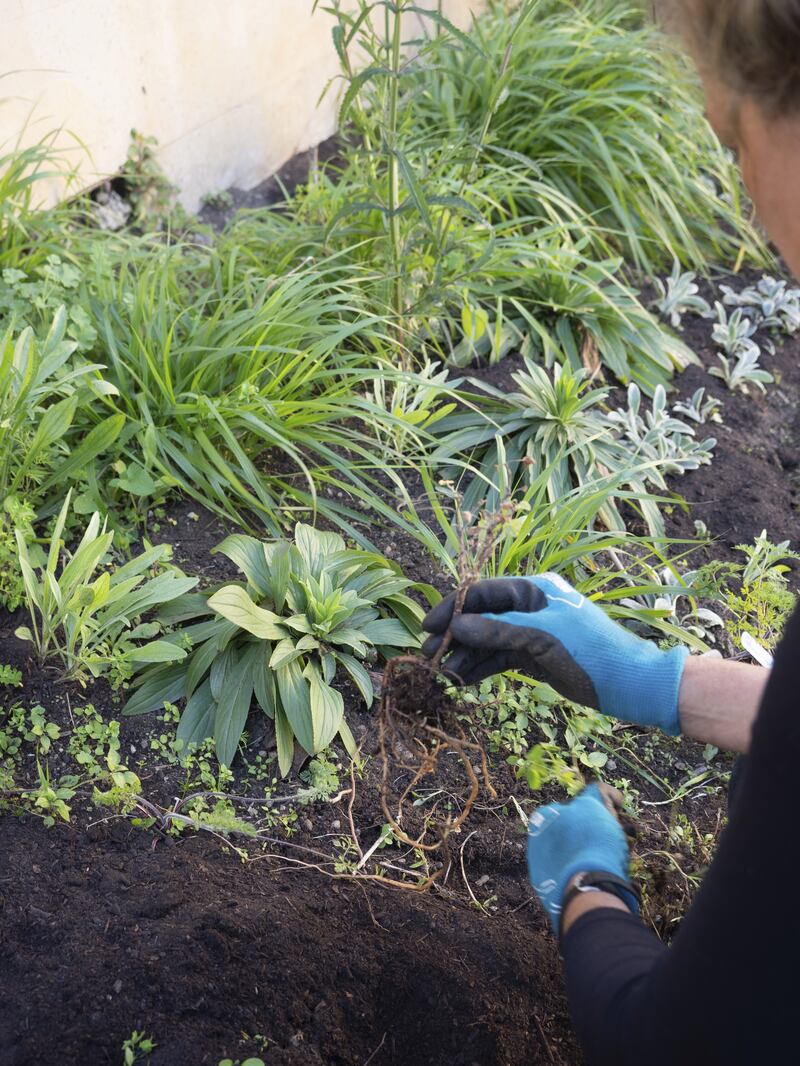
- Where soil conditions have improved sufficiently to allow it, cut back old faded growth and clear weeds from flower and vegetable beds in preparation for planting as well as to encourage good healthy growth and minimise the risk of slug damage to emerging young shoots. Then ideally finish of with a generous organic mulch.
- Tired, winter-worn lawns can be greatly improved by scarifying to remove dead thatch and moss, while any ugly bare patches can be reseeded, making sure to aid germination by top-dressing the surface first with some good quality topsoil or seed compost. It’s important to temporarily fence these reseeded areas off from use to allow the new grass plants to properly establish. A temporary cover of horticultural fleece, pegged down securely into the ground, will also protect against garden birds stealing the seed
Dates For Your Diary
- Saturday 21st March (11am-1pm), Rothe House, Kilkenny City. Creating a Sustainable Perennial Cut-Flower Garden, an illustrated talk by me, Fionnuala Fallon, pre-booking essential, see rothehouse.com and eventbrite.ie
- Sunday March 22nd (11am-4pm), RHSI Bellefield Plant Fair, Bellefield, Shinrone, Co Offaly, with stalls from many of Ireland’s best independent plant nurseries and plant growers. See rhsi.ie
- Sunday March 29th (11am-5pm), Claregalway Castle, Claregalway, Co Galway, Spring Plant Fair, with stalls from many of Ireland’s leading independent plant nurseries, local craftspeople and food producers, plus an exhibition of Irish botanic art. See galwaygardenfestival.com