

Not long ago, the most steady work a newly-qualified vet might find was in rural Ireland treating large farm animals.
A lot has changed over the last few decades, but perhaps nothing as dramatically as the rise in popularity of companion animals and people’s willingness to pay to keep them healthy.
Fifty-two per cent of respondents to a 2021 Central Statistics Office survey reported having a pet in their home, with one in five having acquired theirs during the Covid pandemic.
Care for dogs, cats and exotic animals now dominates the veterinary sector, a trend that does not look like it is going to change any time soon. With business booming for pet specialists, it is no surprise the influence of large corporate players in the veterinary sector is increasing.
READ MORE


A majority of Irish veterinary practices are still owned by individual practitioners. But greater consolidation of the sector is anticipated by 2030, especially in urban areas, according to a recent report carried out by advisory firm HLB Ireland. It shows the landscape is shifting.
“My dad was a vet and I just followed on and did what he did,” says Conor Ó Scanaill, a long-time vet in Dublin. “My brother does it; uncles have done it; cousins have done it. So we like it, and that’s the way. My dad came to Swords in 1949 and there’s been an Ó Scanaill vet here since.”
His practice, Ó Scanaill Veterinary Hospital, has transitioned over the years from “large animal economics” to “small animal care”. This is in line with the findings of a 2023 survey carried out by the Federation of Veterinarians in Europe, which drew more than 12,000 responses from across the Continent, including 253 from Ireland.
Respondents set out the broad shift and their expectation that “the trajectory for future veterinary practice is greater specialisation, with the corporate sector likely to pursue this more aggressively”.
Ó Scanaill sees it as a straightforward consequence of investment. If you sell your practice for €1 million, he says, the new owner will be aiming for a suitable return on that sum.
By the same token, if you invest in a CT scanner, you would “have to justify it”.
“You’d have to pay for it, so you’d be certainly working the unit,” Ó Scanaill says.
He fears that if he were working under a practice manager in a corporate ownership group, the pressure to turn in greater profits would negatively influence his approach to treatment.
For example, he says, some meetings with pet owners take longer than others, as not everyone communicates at the same speed.
“The one thing that you want with your dog is that it’s properly looked after,” Ó Scanaill says. “Not that it’s done through a stopwatch, not that you’ve been upsold or anything else. Really, what you want is the best for your animal.”
Larger, corporate chain practices can offer access to more advanced equipment and often provide 24-hour emergency care.
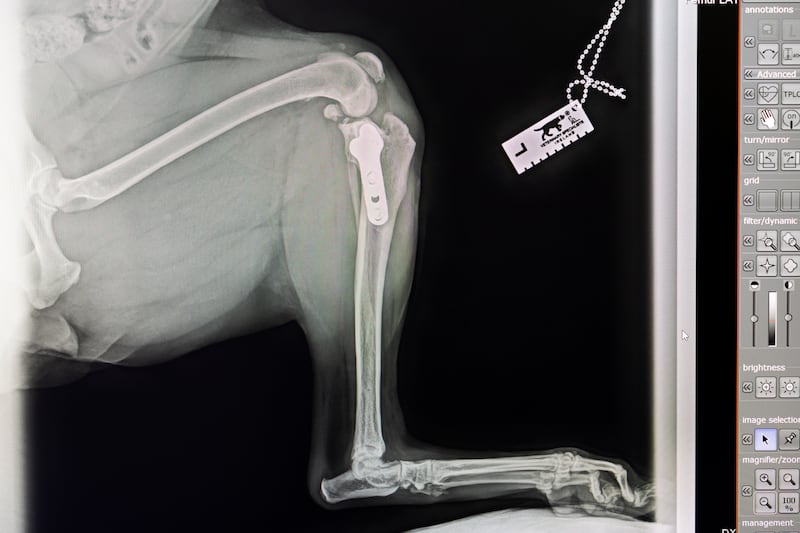
Ó Scanaill says he has conversations with some clients in which he gives his opinion and then recommends that they go elsewhere if they want to pursue a more elaborate or specialist treatment plan. This occurs “frequently with neurology” and at times, in complex cases of breaks.
The fear is that a heavy consolidation of the industry could result in higher prices for owners. In the UK, more than 60 per cent of veterinary practices are wholly or partially owned by six groups. An investigation by the Competition and Markets Authority found a lack of transparency around pricing, and ownership structures have led to clients being charged more.
This week, it was revealed that British ministers are considering establishing a regulator for the veterinary sector, introducing a mandatory licensing system similar to that for GP surgeries, and capping prescriptions for pet medicine at £21.
Part of the drift towards more corporate practices in Ireland could be driven by a lack of succession planning, according to the HLB Ireland report. Of those surveyed, 43 per cent said they had no identified successor in place, while only 46 per cent reported having a clear understanding of their practice’s current value.
When he was starting out, Ó Scanaill says having his father to show him the ropes helped. He does not see succession as a big issue, and it is not something he has spent much time thinking about.

He says he has been approached several times by corporate groups interested in acquiring his business, but has never wanted to sell.
Michael Canty qualified alongside Ó Scanaill and started working in mixed practice in his native Limerick. Unlike Ó Scanaill, Canty believes a lack of succession planning “is a problem”.
“You’ve got a practice that’s been developed over the years, maybe by just one or two vets, and now they have maybe a staff of 15 and they’ve invested heavily,” he says.
“Often times the simplest and cleanest option for a retiring partner is to sell it to a corporate.”
This was the case for Canty. His business partner, who is about eight years older, was approaching retirement age and was keen to explore the possibility of selling the business.
“We got a good offer and long story short, we elected to sell to IVC at the time,” he says. “I worked on then for approximately five years, and at that stage then, I just felt I needed a change.”
Canty recently took up a job at the independently-owned Limerick Veterinary Hospital, but has noticed a shift towards corporate ownership in his profession, as well as changes in dealings with clients.
“The level of care that owners are looking for their pets has skyrocketed,” he says. “There’s an awareness of what can be done and there’s a demand for that within practice. Everything costs. If you’re talking about CT scans and MRI scans and very complicated surgery, that’s all very expensive.”
One way for more cautious pet owners to navigate those costs is pet insurance, he says, though in his experience, those with cover are often the clients that would have paid for expensive treatments anyway.
“I would traditionally have recommended [pet insurance],” Canty says. “If you had a client coming in with a young puppy, I’d say ‘Look, get the insurance. You never know when the need might arrive.’ If it’s something significant like a big illness that requires a significant work-up or a big accident, the cost can be significant.”
It is difficult to pinpoint average costs for pet insurance, as it hinges on variables such as age, breed and an animal’s health history. Owners have to consider time-limited versus lifetime policies, with the former needing to be renewed annually.
With the advent of elaborate treatment plans, ethical dilemmas can arise around caring for pets that are approaching the end of their time.
Naturally, many owners will do whatever it takes to extend a pet’s life, but it is not always the right thing to do.
“We’re all the same, and I’m a pet owner too,” Canty says. “With an older pet, within reason, you want to hold on to them for as long as you can ... Usually, [owners will] listen to the voice of reason and experience saying while we can do X, Y and Z, it’s not really in your pet’s best interest. That wouldn’t be an unusual conversation to have.”
One of the concerns Canty has for the future of the industry is the exodus of young vets. High workloads and staff shortages are the top challenges facing the profession, according to the Federation of Veterinarians in Europe’s 2023 survey. Burnout and mental health were the top concerns identified by respondents to the HLB Ireland survey.
This appears to go beyond practitioners, with a recent survey carried out by the Irish Veterinary Nurses Association finding that nearly 76 per cent of respondents either “considering leaving, unsure about remaining, or planning to leave the profession altogether”.
Canty says it can be a stressful working environment.
“Not everybody is equipped to cope with that stress,” he says.
“To be very, very busy, [dealing with] very anxious owners. Obviously, people have other stresses in their lives too, so it can all add up to make for a very stressful job. You do have to put in coping mechanisms.”
Pet insurance in Ireland:
It is difficult to pin down average pet insurance premiums in Ireland due to variables around age, breed and health of the animal in question. There are no Ireland-specific industry reports for pet insurance either, as there are for car and health insurance.
With that said, below is a “typical premium” with Petinsurance.ie for an owner of two pets. One is a six-year-old, mixed-breed dog, and the other is a four-year-old pedigree dog. An owner that takes out an “Illness & Injury Time Limited” policy could expect to pay about €50 per month, or almost €600 per year.
Insuring two dogs with Petinsurance.ie (data from switcher.ie)
| Cover level | Details | Per year | Per month |
|---|---|---|---|
| Illness and Injury Time Limited | 1 mixed breed dog (6 yrs) | €287.34 | €23.95 |
| (no pre-existing medical conditions) | 1 pedigree (4 yrs) | €307.27 | €25.61 |
| Total | €594.61 | €49.55 |
The AA offers introductory or basic, accident-only tiers for cats starting at €6.21 per month and €8.33 per month for dogs, rising to at least €30.00 per month for top-tier, comprehensive plans.
It is equally difficult to put forward average figures for compensation, but below are typical caps from some of the main pet insurance providers in Ireland, including the AA, An Post, Allianz and Petinsurance.ie.
Veterinary and medical treatment for injury, accident and illness
| Cover Level | Typical annual cap | What’s covered |
|---|---|---|
| Accident-Only / Basic | €1,500 – €2,000 | Only pays out for physical trauma (eg, car accidents, bone fractures). Zero payout for illnesses. |
| Standard / Time-Limited | €3,000 – €4,000 | Covers both illness and injury, but will only pay for a single condition for a maximum of 12 months. |
| Comprehensive / Lifetime | €4,000 – €6,000 | Covers illness and injury. The limit resets every year at renewal, allowing for ongoing compensation for chronic conditions (eg, diabetes or arthritis). |
Other potential compensations, depending on cover level
Death benefits: Typical payouts range from €500 to €1,000 (but there may be caveats, such as age).
Emergency boarding fees: Typically pays out between €500 and €1,000 (to cover kennel or cattery fees due to unexpected hospitalisation).
Holiday cancellation: Typically pays out between €500 and €1,000 if you have to cancel or cut a holiday short because your pet requires emergency, life-saving surgery within seven days of your departure.
Policy excess: You rarely get the 100 per cent maximum figure because of the policy excess. In Ireland, the standard fixed excess is €100-€125 per condition per year.


