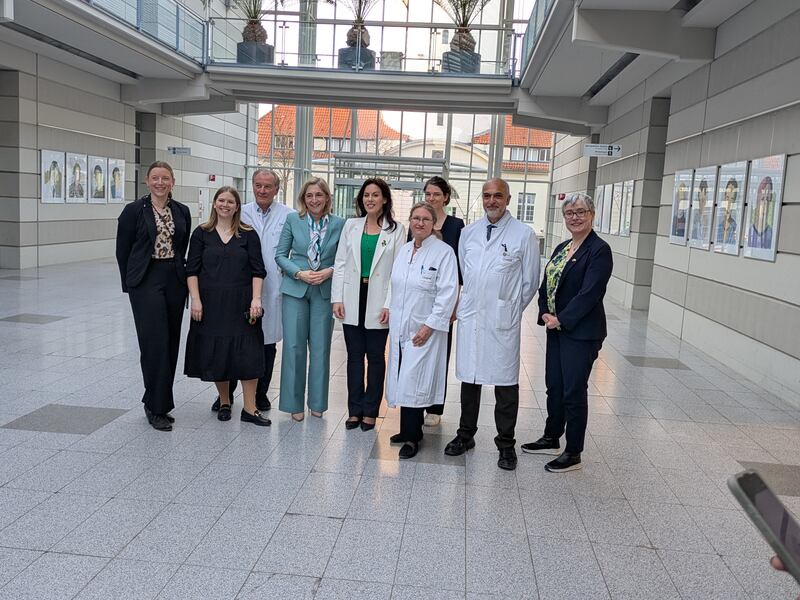
With a quick step and an alert gaze, Minister for Health Jennifer Carroll MacNeill concluded her recent visit to Germany with an unusual last stop – Berlin’s Virchow Clinic.
It opened its doors 120 years ago as the German capital’s most progressive hospital, named after Rudolf Virchow, a doctor dubbed the “pope of medicine” for his pioneering research into everything from leukaemia to spina bifida.
Carroll MacNeill’s visit was to learn more about the clinic’s pioneering work into endometriosis, the debilitating and chronic illness where tissue similar to the lining of a woman’s womb starts to grow in other parts of her body.
Five months after unveiling a national endometriosis strategy in Ireland, Carroll MacNeill plans to use the country’s upcoming EU presidency to raise awareness further with a conference on the disease.
READ MORE


After a partnership with Bordeaux, meanwhile, Berlin is next on her list for training fellowships to expedite treatment capacity in Ireland.
“We don’t have enough treatment pathways, specialist surgeons or fellowships in training, we are very much on catch-up, so for me to be here is a privilege to learn more,” she said during the visit with her German health minister colleague Nina Warken.
In her first 10 months in office, Warken has made women’s health a priority, too. As in Ireland, women in Germany with endometriosis can wait seven years to be seen and treated. The Christian Democratic Union (CDU) politician recalls a recent parliamentary health committee meeting on the disease, “where many of members asked: ‘what is this about again’?
“There is a certain amount of progress that we are sitting here today, speaking about this,” she said.
[ Endometriosis in Ireland: What is it, and how is it treated?Opens in new window ]
The Endometriosis Centre at the Virchow clinic, itself part of Berlin’s Charité university hospital, is headed by prof Sylvia Mechsner. She and her team have developed an endometriosis treatment pathway that takes a multi-modal approach, but struggles with costs and capacity.

Her clinic receives about 4,000 patient requests annually which, through triage, are reduced to 1,000 for a first diagnosis. Of these, around 90 per cent are treated with a range of approaches that include hormonal therapy. In cases of recurring pain, some 60 per cent of this group are offered multi-modal assistance including pain management, nutrition, psychotherapy, osteopathy and even acupuncture.
Carroll MacNeill repeats for her Berlin audience a story she has told in Ireland, of how young teenage girls living with endometriosis have been told by their doctor to address their pain by getting pregnant.
“My God, yes, it’s a nightmare,” says Mechsner. For her, progress on endometriosis can only come with greater awareness and acceptance of the common denominator that is women’s pain.
She is running a clinical study to help the 70 per cent of women and girls who suffer menstrual pain, of which she says 10 per cent will go on to suffer with endometriosis: “Recurrent pain is a risk factor for later on – migraine, arthritis, colitis or inflammatory bowel disease. Everything is higher in women but we have to start with menstrual pain.”
In her Berlin clinic less than 10 per cent of the patients go forward to surgery, she says, which turns the conversation to the best surgical approach to tackle lesions. Endometriosis is most often treated surgically either by excision – cutting out lesions down to their root – or by ablation, removing the top layer of lesions using heat, lasers or electricity. Sufferers say the latter approach, common in Ireland, does not lead to long-term relief.
“Do you ever use ablation?” asks Carroll MacNeill.
Mechsner shakes her head. “No, only when there is a dangerous area, but [otherwise] never,” she said. “Often the lesions are over the urethra so you can cause damage with heat.”
Carroll MacNeill is hopeful her visit to the Berlin clinic will lead to greater exchange, partnerships, research and training fellowships. But it was a “disappointing surprise”, she said, to hear from advocates that German women also have heard from their doctors the notion of getting pregnant to solve endometriosis.
“This is not just Ireland, this is happening everywhere, a consistent female experience of being overlooked and poorly understood by the medical system to date with this condition,” she said.
On the issue of pain relief, German women have immediate access to painkillers from paracetamol right up to – but excluding – opiates.
As for Irish voices critical on pain relief available to them, Carroll MacNeill insisted the Irish treatment framework “recognises the complete experiences” of women and that paracetamol works for some women. “But if you have complex endometriosis then paracetamol is in no way efficient,” she said.
She said that a major takeaway from her Berlin clinical visit was Mechnser’s surprise that anyone in Ireland views ablation as the right approach for tackling endometriosis.
“She was very clear that excision is the appropriate surgery,” said Carroll MacNeill. “I am not a clinician, I don’t set how people do things. But on behalf of the women I represent, if they are asking that question of me as often as they are, it is my job to ask that of the clinical community.”