
I got a picture of this owl in the headlights of my car on a fence near my home. What type of owl is it? Ger Fitzgerald, Co Kilkenny
This is a barn owl, the scarcer of our two breeding owl species. It is a nocturnal species that breeds indoors in old farm buildings, hollow trees and now, increasingly, in owl nest boxes erected by landowners to encourage their expansion. Barn owls catch small mammals such as mice, rats, shrews and voles. They can hear and pinpoint their exact location, as their ears are asymmetrically positioned within their heart-shaped facial disc. Then they drop – completely silently, even in total darkness – on the unsuspecting prey.

We had lots of mushrooms growing in our garden during the autumn. What are these? Jim Howley, Meath
This is the redlead roundhead – Leratiomyces ceres. It typically grows in large groups on decaying wood fragments/chips or on mulch. It has rarely been recorded in Ireland but is common in Britain where it is thought to have been introduced from Australia. The mycologist Tom Harrington identified it – he has seen them in Killarney National Park and there is a lovely image of it, inter alia, in the book Fungi of Killarney National Park by Louis O’Toole.
READ MORE


I saw this large bright spider on the patio on a sunny day in autumn. What was it? Marion Ashcroft Jones, Rathfarnham
This is the red form of the garden spider – Araneus diadematus. It is a female, which can grow up to 18mm body length, and it has the characteristic stripy legs and cross-like pattern on the back, that all colour variations of this species has. It spins very obvious orb webs in the garden, which are very effective at catching prey. It is commonly seen between June and November, or until the first frosts kill it off.

I found a pair of these at the bottom of a newly dug post hole in my garden, about 4-5cm in length. Someone mentioned they may be a kind of rove beetle, but I can’t recall ever seeing one before. Are they uncommon, or just secretive? Paul Magee, Co Derry
It is indeed one of the rove beetles – the devil’s coach horse. It is a nocturnal species that goes hunting at night in the garden for slugs, which it is well able to demolish with its large ferocious jaws. Long ago it came into houses at night and ran around earthen floors and cellar flagstones hunting its prey. When challenged by humans, instead of running away, it opened its jaws and raised up its tail threateningly, as indeed a coach horse of the devil could be expected to do. In Mayo children’s eyes were shielded from this terrible sight, as it was thought it would bring them bad luck if they saw it like this. Maybe that was done in Derry, too, which is why you never saw it before, as they are not uncommon.
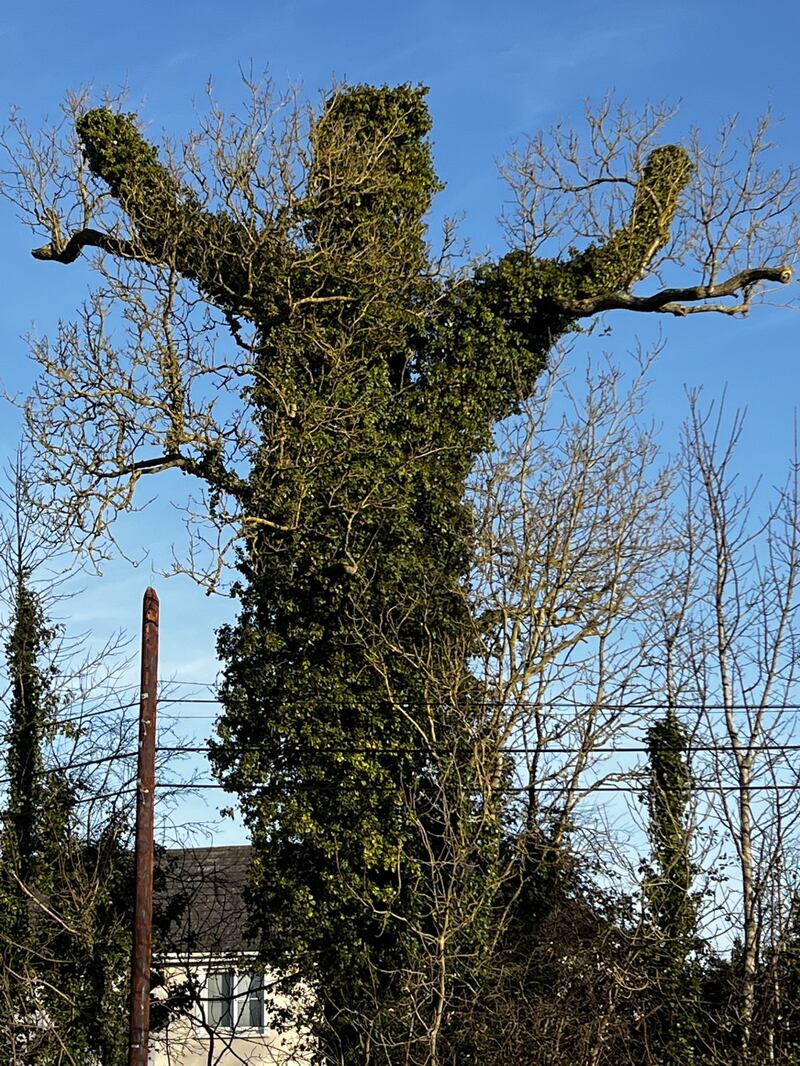
I spotted this tree “waving” at me as I left Cabra library recently. Is this amount of ivy on a tree normal or harmful to the tree? T O Toole, Dublin
Are you sure it was the library you were leaving and not any other type of establishment? This is a dead ash tree with ivy now covering all its trunk. The ivy didn’t kill the tree, however – it most likely succumbed to the Chalara ash dieback disease. Ivy – a native species excellent for biodiversity – is a nonparasitic evergreen species. It grows on anything (including trees already dead) to get up to the light in order to flower and have berries.
Please submit your nature query or observation, ideally with a photo and location, via irishtimes.com/eyeonnature or by email to weekend@irishtimes.com


