We throw the word “unique” around a little too freely. But, if it applies to any film-maker, it applies to Mark Jenkin.
The amiable Cornish man, now skirting 50, has been delivering singular work for a quarter of a century. Early features such as The Rabbit and The Midnight Drives. An extraordinary 2015 short entitled Bronco’s House. Then three festival hits that belatedly brought him something like an above-ground audience: the gruff Bait, from 2019, the perplexing Enys Men, from 2022, and, now, the spooky Rose of Nevada.
All are rooted in the Cornish landscape and seascape. Each thrives on enigma.
“I’m getting a lot of messages at the moment from people who’ve been at preview screenings,” the director says. “My favourite messages are the ones that say, ‘We talked about the film on the way home in the car, and we were still talking about it this morning.’ Somebody messaged me this morning saying, ‘It’s still playing in my head.’ And that’s just the best reaction.”
READ MORE


The sheer oddness of his work would be enough to set Jenkin apart: Rose of Nevada is about a fishing vessel that transports its crew three decades into the past.
But it is the way he makes the films that attracts the most curiosity. Jenkin is devoted to the oldest, clankiest cinematic paraphernalia. His last three features were all shot on 16mm using a clockwork Bolex H16 camera. Always his own cinematographer, he was still actually processing the film for Bait. So charmingly last century is the machinery that it allows takes of no longer than 28 seconds.
The result has a blotchy irregularity that roots the image in the past even before a character has opened his or her mouth.
He must get tired of being asked about this.
[ Film-maker Mark Jenkin: ‘We’re Cornish. We can just have our own culture’Opens in new window ]
“Actually, I don’t mind answering questions about this at all,” he says. “Because it’s kind of what I’m known for. The process is the thing that gets me into the room for meetings. It’s the thing that makes me stick out a little bit – and I’ve still got that passion for it. I’m not doing it arbitrarily. I don’t want to make films in any other way.
“So far I’ve been able to continue the handmade way of making films, even though the budgets are going up and the scales are going up.”
Jenkin dates his fascination with the process to helping a friend develop photographs when the two were still at school.
“I just saw this image of his face appear in the developing tray,” he says. “This kind of alchemy was happening. I just fell in love with the photochemical process at that point. So I went on to do photography at A-level. And, while I was doing that, one of the lecturers encouraged me to start shooting Super 8. So I got interested in doing photographic narrative work.”
Jenkin is in no way snooty about technology. He later moved on to working with digital equipment before realising he had “lost the enthusiasm for this and decided to buy a Super 8 camera”.
That proved an inspirational move. The experimental Bronco’s House led on to the critical triumph that was Bait. The elements were in place for what we now think of Jenkin’s house style. That film treated tensions between Cornish fishermen and the tourists whose presence transformed the social texture of their village.

Following a premiere at Berlin International Film Festival, Mark Kermode, writing in The Observer, declared Bait “a genuine modern masterpiece, which establishes Jenkin as one of the most arresting and intriguing British film-makers of his generation”.
I wonder how the industry reacted. That sort of critical acclaim often brings the most unlikely sort of attention from the studios. I wouldn’t be all that surprised if the Marvel Cinematic Universe had offered him a job. (You may laugh, but Chloé Zhao, director of Hamnet, somehow made an MCU flick.)
“Some people saw Bait and then looked up who the cinematographer was and then got in contact to see if I would shoot their movie for them,” he says with a West Country chuckle. “And there were a couple of quite big projects in America that I was offered – or at least offered meetings for – which I turned down because I thought there’d been a huge admin error. I’m a self-shooting director rather than the cinematographer.”
The American industry’s loss has been world cinema’s gain. Bait, Enys Men and Rose of Nevada each premiered at one of the three great European festivals: Berlin, Cannes and Venice respectively. He now has a following. Before long we will surely see rough-hewn films shot with antique equipment being described as “Jenkinian”.
People don’t often compare Venice to Cornwall, but that ancient city did, at least, provide a suitably maritime backdrop for Rose of Nevada.
“Venice was great,” he says. “My sister and my mum came over as well. It was brilliant. I absolutely loved it. We will always remember it fondly if the film is received as well as it was at the Venice premiere. So I’ve got nothing but good memories of Venice.”
Nobody will mistake Rose of Nevada for Dune: Part Three, but there is evidence of a greater budget than those put the way of Bait or Enys Men.
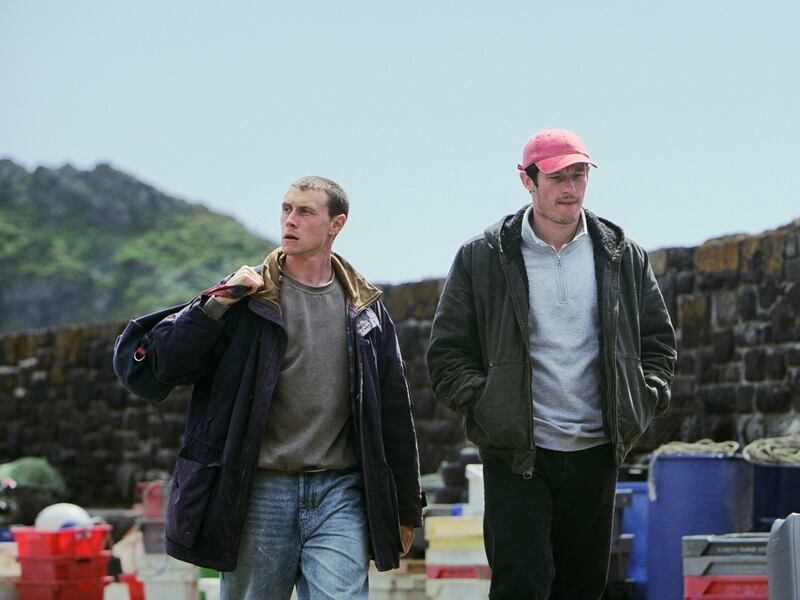
For starters, two actual movie stars appear on screen. George MacKay and Callum Turner – who is 4/5 favourite to become the next James Bond – appear as two fisherman taken aback when the titular vessel, presumed lost at sea 30 years earlier, reappears largely undamaged in their village. Returning home after a first voyage in the mysterious vessel, they find themselves transported back to 1993.
I wonder if Jenkin had any concern that the increased funding might somehow corrupt his hitherto organic aesthetic. Might some gloss inadvertently sneak in?
“The other day a friend of mine who was in Bait came to see a preview of Rose of Nevada, and she sent me a message saying, ‘I mean this in the best possible way, but, even with the bigger budget, you’ve still managed to make this film look like it was made with nothing,’” he says.
“That’s a twisted compliment. I knew exactly what she meant. We hadn’t smoothed off the edges of how the film looked or sounded. But, from my point of view, the way I worked was pretty much the same. You have a much bigger art department. We had a few more luxuries around us. It was a little a little less threadbare on the ground, which is helpful. But you don’t want to be luxuriating too much.”
I imagine Jenkin feels the restrictions he has placed on himself help to spur creativity. Just as a poet might savour being confined within the 14 lines of a sonnet, Jenkin makes the best of shooting brief shots on a wind-up camera.
I think it’s dangerous to romanticise the past
— Mark Jenkin
“I couldn’t do it without the limitations,” he says. “I’d just be sat in my studio, thinking about all the things I could do with everything that was available to me. That’s where the creativity comes from – when you’re forced to do something in a way that is difficult or limiting. You access those bits of your brain that you don’t normally get to if you’re just hypothesising. The limitations are absolutely everything.”
We have already mentioned how attached Jenkin, born in the port of Newlyn, is to the county – and Celtic nation – of Cornwall. Bait was fuelled by (putting it gently) an apparent scepticism about what gentrification has done to that part of the world.
One cannot help but wonder if the timeslip back to 1993 in Rose of Nevada takes in a degree of wish fulfilment. The two men do not find any sort of paradise in the older version of their home, but at least one of them comes to cherish what has been lost.
“Yes, but I think it’s dangerous to romanticise the past,” Jenkin says. “They weren’t looking to go back in time, but, when they did go back in time, there was an opportunity to, in the background, show what had been lost.
“I’m a big believer that being alive now is the best possible time to be alive. But that’s not to say that we’ve not lost some things along the way that I miss. I think sometimes we have lost stuff and we don’t realise we’ve lost it.
“I can’t even remember what those things are. Maybe they are not that important. But you can highlight them if you slip back 30 years.”
One can only imagine where Jenkin might next take his singular aesthetic. A charmingly verbose man – he admits to loving the promotional bit of the job – the film-maker lives with his partner and collaborator, the distinguished actor Mary Woodvine, in (obviously) west Cornwall, where he continues to plot new schemes and adventures.
I turned 50 a couple of weeks ago, and I started thinking, ‘How many films have I got left?’
— Mark Jenkin
It has been an interesting career. Years of experiment and now a peculiar school of popular recognition. Where next?
“Up until now it’s been one film after another – work on one film exclusively and then the next,” he says. “I turned 50 a couple of weeks ago, and I started thinking, ‘How many films have I got left?’ Thinking from the end of my career back to this point for the first time, I thought I’d get more things into development. It can’t just be one at a time. So I think there’ll be a bit of a gap before the next one.”
No. Give us more weird happening on rugged coastlines.
“Once the next one is up and running, I think they might come a little bit quicker, and I’ll try to get a film out every two years rather than every three years.”
We will take it.
Rose of Nevada is in cinemas from Friday, April 24th