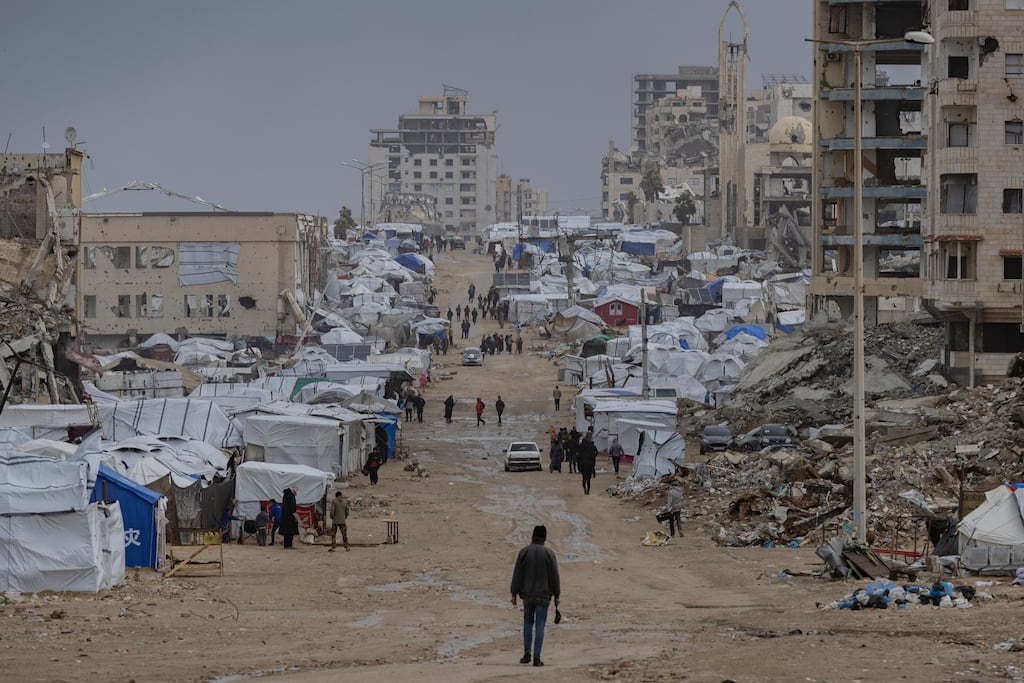
Before October 2023, the Gaza Strip was 41km long and 12km at its widest. Today, with much of it sand and rubble, Gaza’s perimeter has shrunk as Israel continues stealing land to create “buffer zones” to protect itself from the two million people it is pushing into an ever smaller concentration camp.
Now, as Israeli officials boast of “cleansing” the region and building a Trump-sponsored “Gaza Riviera” (or, recently, nominating Tony Blair to oversee a transitional government), Gaza has never been more imperilled. Ideas previously unthinkable now feel inevitable.
In Gaza: The Dream and the Nightmare, a slim, assiduously researched social and political history of the past century in Gaza, academics Julie M Norman and Maia Carter Hallward show us that there has never been anything inevitable about Gaza.
Even the Gaza many of us know – caged, sealed off from the world – has only been like this since Israel dismantled its Gaza settlements in 2005. Disengagement was not done to benefit Gaza, but out of concerns for security and the costs of occupation. Crucially, it provided cover to continue annexing the more strategically important West Bank.
READ MORE


Capitalising on a people exhausted by two intifadas, increasingly frustrated by Fatah’s corruption, and the failures of the Oslo Accords, Hamas won fair elections during this period. Displeased, the US and EU froze aid and Israel collectively punished Palestinians by withholding tax revenues for the Palestinian Authority-governed West Bank. Israel then refused to allow Gaza control its airspace, build a seaport or rebuild its destroyed airport, and began taking a scientific approach to determining how much food it needed to allow in so as to keep civilian society always nearing collapse.
One of their most astute observations is that while many Gazans were cautiously optimistic about Hamas, few imagined the isolation it would bring, or how it would set Gazans on such a profoundly different course from those living just kilometres away in the Occupied West Bank.
While the book’s first half examines the fallout from colonisation, the second is given over to October 7th and its aftermath, of which many readers will already be grimly familiar. Nonetheless, it will serve as an excellent and accessible introduction for those wishing to learn more not just about Gaza’s past and present, but also about the ordinary hopes and dignified aspirations of everyday Gazans.