

An interviewer arriving for an assignment without a recording device is chaotic behaviour. Not admitting to your much-admired interviewee that you submerged your now-defunct phone in the sink, and just asking him to share his earliest memory of disembodied voices instead, is a nightmarish way to proceed.
This, thankfully, is fiction. Ben Lerner’s new novel, Transcription, begins with the narrator, a 45-year-old writer, poised to interview Thomas, his 90-year-old mentor and father of his friend Max, with only his “corpse” of a phone and a feeling of “withdrawal indistinguishable from mild intoxication”. He is in his old college town – “facing the past” as his daughter describes backwards-oriented train seats – but drinking in the immediacy of a deviceless world in which he has become “more aware of silicates glittering in the asphalt”.
What follows in the American writer’s slender but layered fourth novel is a moving exploration of how technology both creates and eliminates distance, how smartphones change how we remember the dead and how we communicate across generations in the age of the screen. Anxieties, mostly earnest, permeate its pages, but this is not Lerner’s contribution to the “techlash”. It’s a book that trades in thought-provoking ambiguities and intellectual nuance.
“It certainly involves a sense of how these devices have degraded our attention and can separate us as much as they connect us, but it would be a very boring book that was just, like, cell phones are bad, because we all kind of know that, right?” he says.
READ MORE


In one section, Max, despairing about his young daughter Emmie’s refusal to eat, solves the problem by lifting her screen-time restrictions – her unlimited consumption of unboxing videos has the discomfiting outcome of unlocking her appetite for food.
“Part of it is to say that the effects and uses of these devices is unpredictable, but it’s also an instance of the interesting double meaning of screen. Max’s theory is that the iPad helps Emmie screen out some of the complexity of the world in a way that allows her to take in food. It becomes an example of an off-label use of the iPad.”
Max also recounts screenshotting a record of his phone call with a nurse who facilitates what they believe will be his last conversation with the hospitalised Thomas. His call history is a fragment of digital ephemera that carries too much emotional significance to just let slip away.
“I do think we’re now in this moment of strange new media relics, for lack of a better phrase,” says Lerner. “Like, what do you do? You might make a pilgrimage somewhere and take a stone home to keep you connected to that experience. What’s the digital equivalent of that? We conduct our lives, even our really intimate lives, through the medium of these devices.”
The poet and novelist is speaking over a Zoom call free of ironic hiccups from Paris, where he is staying at the bookshop Shakespeare and Company as part of the European promotion tour for his first novel since 2019’s The Topeka School.
Transcription emerges seven months after the 47-year-old had open-heart surgery to replace a diseased portion of his aorta with an artificial graft. He wrote about the condition in 10:04, his second novel, in which the narrator is conscious that the largest artery in his body might rupture at any moment.
“I feel good, I feel fine, but this is the first time I’ve made a big trip since the surgery, and there’s this feeling that everything is the first time again. The turbulence on the aeroplane feels a little bit different, and public speaking. Fragility wouldn’t be the right word for it, but there is just this kind of newness.”
In Cardiography, his recent essay for the New York Review of Books, he writes about how amplified his heartbeat sounded after the surgery. He mostly doesn’t hear it now, but the procedure has intensified his sense of the link between his body and the practices of writing and reading.
“Poetic rhythm feels less abstract to me now. It feels quite literally related to bodily rhythm.”
He expects the surgery will infiltrate his work in the future, but he isn’t sure how yet. “There are aspects of it that I’m still kind of processing. It’s been six or seven months, which both makes it seem like a really long time ago and like it was just yesterday.”
Generationally, we’re positioned to have a deep memory of the time before all this stuff but also be totally in it and corrupted by it
— Ben Lerner
One point of origin for Transcription, meanwhile, was his interview with the poet Rosmarie Waldrop for The Paris Review. The publication’s editorial process involves much shaping and revision, and Lerner was struck by how the final transcript “was authentic in a way”, but also bore little relation to the experience of being in the presence of a heroine of his. He started thinking about “the dynamics of what it really means to capture, or fail to capture, a voice”.
Thomas – whose erudite words are later reconstructed by the narrator from memory – is a composite of people and situations, but his speech is modelled on German author and film-maker Alexander Kluge, who Lerner collaborated with on The Snows of Venice, a “literary dialogue” from 2018.
[ The Hatred of Poetry by Ben LernerOpens in new window ]
He sent Kluge his novel in German, then wrote to him about how he had been inspired by his voice. “You never know how someone is going to react to any element of them appearing in fiction, but he wrote me a really beautiful note about it, which I will treasure,” he says. Kluge died two weeks later, in March, aged 94.
Mentorship and parenthood are bound up with each other in the novel, with Thomas confusing the narrator and his son, who is riled by his father’s loftiness in response to crisis. Lerner suggests that in his own life he is finding that the arts and fatherhood are spheres best kept separated. Before a recent book event at home in Brooklyn, New York, he and his wife – Ariana Mangual Figueroa, an anthropologist – discussed whether their daughters, aged 13 and 10, should come. “I felt that if they came, I wouldn’t be free to speak. I would be constantly thinking not about the honest answer to the question, or what I wanted to say about the book, but what I thought would be a responsible thing to say as a parent.”
Intergenerational transmission also surfaces in Transcription through the Glass Flowers, a Harvard-based collection of botanical models made by father-and-son Czech artists Leopold and Rudolf Blaschka. (A selection of their earlier, 19th century marine invertebrate models is on display at Dublin’s Collins Barracks.) Lerner fans who recall that amid the comically heightened self-doubt of his first novel, Leaving the Atocha Station, a young poet worries he might be “incapable of having a profound experience of art” may be intrigued by the narrator’s astonishment when taken to see them.
The flowers serve as “recording devices of extreme sensitivity”. Like fiction, they illuminate mysteries that “flattened” screen technology cannot. “The narrator talks about how he sees the flowers as real flowers one minute and artificial flowers the next,” he says. “There is a sense in which he’s having kind of a profound experience of the power of art.”

Lerner, born and raised in Topeka, Kansas, belongs to the generation that had offline childhoods but adulthoods that were online from the start. “Generationally, we’re positioned to have a deep memory of the time before all this stuff but also be totally in it and corrupted by it.”
Online surveillance may have been absent from his early years, but he was still conscious that he could be recorded. His parents – as close readers likely intuited from their fictional equivalents in The Topeka School – are clinical psychologists; Harriet Lerner, his mother, is the author of popular non-fiction books about family relationships.
“She did write about my brother and I, sometimes in disguised forms and sometimes more explicitly. And I haven’t really thought about this much, but Thomas says that Max hates it when Thomas writes about him. I did have an experience of knowing that it was possible, that I would be captured in my mother’s writing, and I think that probably is somewhere in the imagination of all this stuff,” he says.
“It’s not that she was following me around or taking notes or anything like that, but to have a writer in the family is to have a kind of recording device in the family, even if you don’t know exactly what form it will take”.
This didn’t so much give him the confidence to fictionalise his parents as it meant he felt “justified” in doing so, he says, delivering the word with a hint of relish.
While Transcription deals with “the perpetual present of screen time”, it also addresses a phase of communications history that has been semi-obscured by time: the often haunting influence of newly proliferated domestic radio sets. Thomas’s first “sound memory” is of hearing Hitler’s disembodied voice on a “never off” radio.
Screening out present-day news media is not something Lerner does, it seems. He watched the Artemis II mission launch “very nervously”, in keeping with Americans of his age – 10:04 makes several references to the 1986 Challenger shuttle disaster – and that turned out to be “a nice escape” from the “polycrisis”. Somewhat inevitably, the spectre of Donald Trump’s war with Iran hung over his Brooklyn book event. Should they talk about it or not?
[ The Topeka School: Portrait of the artist as a young, white, privileged manOpens in new window ]
“There’s this contradictory desire. One has to engage with it, and one has to try to imagine alternatives, and then, at the same time, it feels like we have to protect some space for thinking and talking about art and literature, and not only being dominated by the toxic assault of the headlines,” he says.
“I don’t have an answer to that. It’s a constant challenge to try to get that right. There’s no getting it right.”
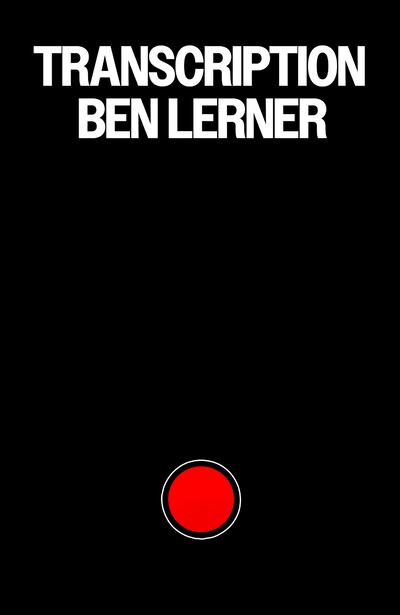
A red dot, familiar from the iPhone voice memos app, looms up from Transcription’s cover art.
“I like that cover, because part of the goal of the book, and part of why it’s a slim book, is that I wanted us to think of the book as another hand-held device, and to think about what one can capture that the other can’t.”
He heard someone joking at Shakespeare and Company that the only people who really love books are “the very old and the very young”. Everybody else is “just swiping or whatever”.
This person was “kidding”, Lerner stresses, but there is an unnerving plausibility to the generalisation and it makes his desire to remind people of the “capacities of the book that are distinct and important” feel urgent. The yet-to-be-deleted truth is that fiction such as his keeps us connected to reality in ways that even functioning smartphones cannot.


