
The era of arms control over nuclear arsenals is set to end on Thursday as the last legal check on the size of Russia and the US’s deployed nuclear weapons expires.
The New Start treaty, which caps the number of operational missiles and warheads in the world’s two largest nuclear arsenals, terminates on Thursday. With the prospects for future talks looking dim, it potentially opens a new era of great-power atomic brinkmanship.
“I genuinely believe we are now at the threshold of a new arms race,” said James Acton, codirector of the nuclear policy programme at the Carnegie Endowment for International Peace. “I don’t think in my lifetime there is going to be another treaty limiting numbers.”

The treaty cessation brings to a close more than half a century of Moscow and Washington attempting, with varying levels of mistrust, to limit their respective arsenals – efforts that have stretched from Richard Nixon and Leonid Brezhnev in 1972 through to Ronald Reagan and Mikhail Gorbachev’s 1985 talks at a lakeside villa in Geneva.
READ MORE


Signed in 1991, as the Soviet Union collapsed, the Start I treaty imposed the first significant limits on US and Russian strategic nuclear weapons and established an inspection regime that would provide a template for post-cold war arms control.
After a brief lapse, it was eventually succeeded by New Start, which was signed in 2010 and extended in 2021. This capped the number of nuclear warheads deployed by each country at 1,550 – more than enough to destroy each other and much of the world.
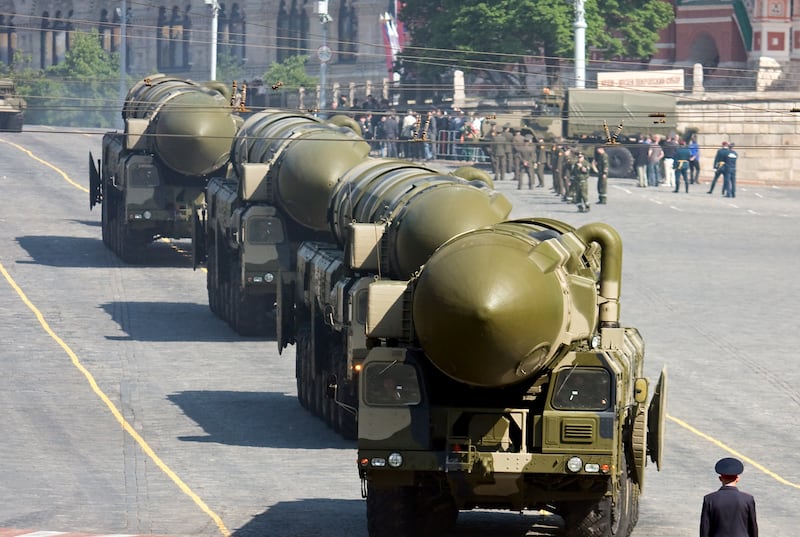
Russian president Vladimir Putin has suggested that both sides could voluntarily continue to adhere to current limits when it expires. Donald Trump, who has described his Russian counterpart’s proposal as a “good idea”, has yet to formally respond but suggested he would prefer “a new agreement that’s much better” with Russia and China.
“President Trump has spoken repeatedly of addressing the threat nuclear weapons pose to the world and indicated that he would like to keep limits on nuclear weapons and involve China in arms control talks,” a White House official said.
Discussions over the treaty, signed in 2010 during then-US president Barack Obama’s ill-fated “reset” with Russia, collapsed after Putin ordered the full-scale invasion of Ukraine in 2022. Putin then suspended Russia’s participation in the treaty a year later and hinted that Moscow could resume nuclear testing.
Last year, Trump ordered the Pentagon to restart nuclear testing “on an equal basis” with Russia and China. It was not clear whether he was referring to explosive nuclear tests or the testing of weapons capable of delivering an atomic device.
“You cannot have a treaty that is better than the general status of your relationship. So the fact that there is no treaty is a reflection of what’s happening” more broadly between the US and Russia, said Pavel Podvig, director of the Russian Nuclear Forces Project.
Trump, who is known for his unpredictable style, could still issue a last-minute announcement that he intends to accept Putin’s offer to observe the treaty’s limits for another year.

Rose Gottemoeller, who was the chief US negotiator of the treaty as under-secretary of state for arms control, said it was a “no-brainer” to accept Putin’s offer of a voluntary extension.
The US, she said, could end up in a weaker position if the two countries raced to add more nuclear warheads to their missiles and bombers. “The Russians can add warheads faster than we can,” she said.
Dmitry Medvedev, the former stand-in president for Putin who led talks with Obama’s administration over New Start, said in late January that tensions over Ukraine and the fundamental disagreements with Washington about arms control made a new deal unlikely.
“There have obviously not been enough positive signals from the American side,” he said. “Better not to have any [new agreement] than one that just covers up the mutual lack of trust and sparks an arms race in other countries.”
Even as it has adhered to the treaty, Russia has continued to maintain serial production of new nuclear weapons and warheads while the US has preferred to modernise its older stock.
Vasily Kashin, a professor at Moscow’s Higher School of Economics, said Moscow had little interest in boosting its arsenal as long as it maintained strategic parity with the US.
“We are comfortable with where things are and our security here is already secured. Why should we set off an arms race and spend extra money on it? We don’t need to because we already have an advantage,” Kashin said.
New Start also enabled a detailed verification and notification process intended to reduce the risk of the kinds of misunderstanding that can rapidly spiral to a nuclear crisis.
“The lived experience of arms control treaties is in the implementation, and that includes the inspections, the data exchanges and the notifications of which there were thousands,” said Samuel Charap, a senior political scientist at the Rand Corporation.
The inspection process, however, was put on ice during the Covid-19 pandemic and then stopped entirely when Putin suspended Russia’s participation in the treaty in 2023. Putin’s offer to extend the treaty’s caps for another year would mean little unless Russia also agreed to resume the verification process, Podvig said.
“The value of New Start was not in the caps themselves but in this whole system of inspections, data exchange and notifications. If we could get higher ceilings, but with all this machinery of transparency, that would be a good trade-off,” Podvig said. “It requires a fairly high degree of co-operation and trust and mutual respect. That is a good thing in this system.”
But the lack of trust around the suspended inspections and the war in Ukraine is compounded by new weapons not covered by the current agreement. Russia is developing advanced nuclear delivery systems like the Burevestnik nuclear-powered cruise missile and the Poseidon nuclear submersible, as well as hypersonic conventional weapons such as the Oreshnik ballistic missile.
“The expiration of New Start is not really about New Start. It is about a broader pattern of mistrust and disinterest in arms control in general,” said Matt Korda, associate director for the Nuclear Information Project at the Federation of American Scientists.
Trump is also pushing for a “Golden Dome” missile defence project that Medvedev said was “extremely provocative”. He claimed it “completely contradicts the affirmation that offensive and defensive strategic armaments are inseparably linked” in the preamble to New Start.
China’s race to build its own nuclear arsenal has complicated conversations over nuclear arms control. Trump has repeatedly stated that he would like to see Beijing brought into a nuclear arms agreement with Moscow.
The US and Russia hold 86 per cent of the global stock of the devastating weapons between them, even as China’s arsenal has doubled in recent years.
“There’s a pretty widespread belief in the US that we have to build up to respond to China,” said Acton. “Stratcom has come to the decision that it needs the ability to target Russian and Chinese nuclear forces simultaneously,” he said, referring to the US combatant command that oversees the country’s nuclear arsenal.
For its part, Beijing is unlikely to entertain the idea of arms control until it has parity with the US.
“China’s nuclear weapons are Trump’s problem, not ours,” Kashin said. “This talk that the US needs to be as strong as Russia and China combined is what might set off a new arms race.” – Copyright The Financial Times Limited 2026


