

Standing in their headquarters on a hill, the paramedics of the Nabatieh Ambulance Service watched from a terrace as smoke bloomed from various locations around them.
The air strikes were usually visible before the sound hit, though the gap reduced the closer the air strikes came.
When one was close enough, they rushed to their ambulances; if they were far enough away, they judged that another contingent of first responders would get there earlier.
The city of Nabatieh lies above the Litani River, roughly 12km from the Israeli border. It is a southern economic hub, whose residents are largely Shia Muslim, and is seen as a historic symbol of resistance by many Lebanese.
READ MORE


Israel issued an evacuation warning for Nabatieh in late May, before an advance which saw observers speculate that its forces were attempting to surround the city. In the following days Israeli forces seized Beaufort Castle, a strategically located 12th century castle about 6km from Nabatieh. It was previously held by Israeli forces for 18 years, before their withdrawal in 2000.
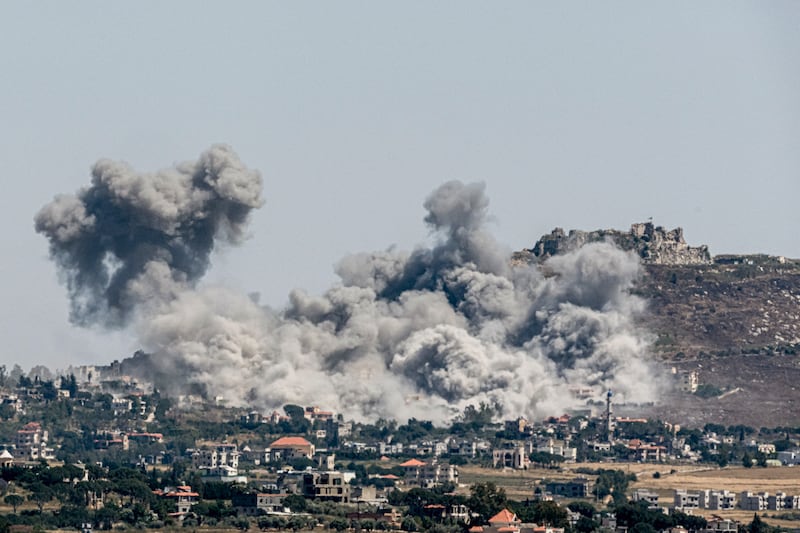
Last week, Nabatieh and its surrounding villages were effectively a no-go zone. The main road leading there from the west was deserted, apart from a few ambulances and journalists’ vehicles marked with “Press” signs, which sped along, swerving to avoid burnt-out cars and motorbikes.
By Monday, with the announcement of a peace agreement between the US and Iran, displaced people began rushing back, hoping this ceasefire would last longer than the ones that came before it.
In Nabatieh, the previous April 16th ceasefire agreed by Israel and Lebanon meant little, apart from an initial rush of people coming to check on their homes.
Many remain too frightened to return now, said paramedic Ali Rida Hammoud. While air strikes stopped overnight, he said artillery fire and drone strikes continued, and the Israeli army appeared to be advancing in at least one area nearby. The Israeli military was approached for comment.
The last fortnight saw the city’s “hardest days”, said Mohammad Suleiman (42), chief of the Nabatieh Ambulance Service. Just 13 paramedics in his organisation remained, down from around 45 before most of the remaining civilians had been evacuated.

The paramedics’ base is outside Najdeh Hospital, which remained open for emergency cases throughout the war. The road to the emergency room was littered with glass – the remnants of strikes nearby.
Sadek Alaik, an emergency doctor and general surgeon, said he had been in the hospital since March 2nd, apart from a quick trip out to see his daughter.
“It’s our duty to stay here,” he said. “I’m from here, this is my country, my people.”
His own area, Yahmour, was occupied, he said, and his house “completely destroyed”. If peace comes, he said he might be able to stay in his sister’s home. “For us, the most important [thing] is the ceasefire: stop killing, stop massacres.”
Alaik has been treating “everything”, from head, chest, inhalation and abdominal injuries, to “mutilated extremities”.
At the beginning of the war, he said, there was a huge civilian toll. Many refused to leave home because they had nowhere to go, he said. “Move to live on the street? It’s not a good thing.”
Chafi Fouany, the hospital’s medical director, said they were aware of how difficult it would be to reopen the facility if it ever closed down. All deliveries, including fuel to power the generators that run the hospital, need to be approved through a mechanism which involves alerts being given to the Israeli military, making future operations uncertain.
In their headquarters nearby, one of the paramedics pointed towards an ashen mark on the road below, where a car was targeted by a drone strike. A man on a motorbike suddenly appeared on the same road – a “suicide mission”, one of the observers suggested. Soon afterwards, there was another explosion: the motorbike was hit by a drone and the driver was killed. The paramedics went out to retrieve his body.
Suleiman is the one who gives the final okay to his crews to deploy to the site of an air strike. His team are volunteers, he said, aided by donations. In peace time, they have other jobs – an engineer, a dentist, an IT worker. Three have been killed in the past three months, putting them among 133 medics killed in total, according to Lebanon’s health ministry.

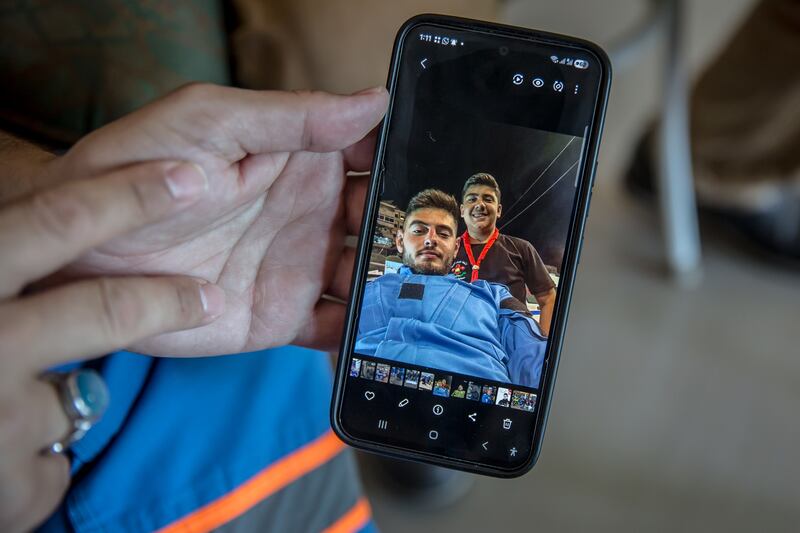
The dead include Suleiman’s teenage son Joud, who was targeted in March with a fellow paramedic, Ali Jaber. The pair had been distributing food to civilians who remained in the city, he said. They were on a clearly-marked motorbike – Suleiman pulls out a picture of them smiling on it – before the attack.
Joud had wanted to help people since he was six years old, his father said. His dream was to be a civil defence member and he refused to leave Nabatieh when the war began. “He told me, ‘if you want to go back to Beirut, go, [and] I will stay here with the team’,” said Suleiman. “It’s God’s will,” he added.
Suleiman went straight back to work after the funeral. “This is from in our soul what we are doing, this is our doctrine.”
As he spoke, a warplane flew overhead.
“We’re expecting a strike,” he said.
Soon one came, then two, three, four. The warplanes continued rumbling. A drone was audible overhead.
The paramedics in Nabatieh said they were on a humanitarian mission, independent from Hizbullah, whom some don’t agree with for “political” reasons.
Hammoud, a 31-year-old software engineer from the village of Houmine el Faouqa, has been volunteering as a paramedic for three years. He stayed for 96 days without seeing his family, he said. In that time, he saw many people killed, including a displaced man going to fetch money from his home and an old lady watering her plants. People distributing aid – food and medicine – were killed and the distributions halted, he says.
Israel has denied targeting civilians, saying its war is against Iranian-backed Hizbullah alone. From what Hammoud said he has seen, “any civilian car is considered a threat”.
Hammoud said they have been gathering evidence of the attacks on civilians. “We have everything on our GoPro film but no one cares.”
They film inside their ambulances too, he said, collecting evidence they can use to counter Israeli claims that ambulances are being used for military purposes.
He says they consider their work as paramedics “as a duty towards our people . . . every Lebanese [person], we consider them our family.”
Now they are waiting to see if the new ceasefire will hold, or if it will be a ceasefire in name only.
Between the April 16th ceasefire agreement coming into force and June 11th, the World Health Organisation says more than 1,200 people were killed in Lebanon and almost 3,640 injured, 348 of whom ended up in intensive care. After Monday’s announcement, Nabatieh feels less like a no-go zone, but safety is far from guaranteed, Hammoud said. “We still don’t have clear information.”
[ Global Briefing: Deal will not restore pre-war status quo in Strait of HormuzOpens in new window ]


