The funeral of the former Iranian supreme leader has begun as the gates of the sprawling Grand Mosalla mosque in central Tehran let in thousands of mourners who had been waiting through the night to enter the grounds.
Iran is staging mass funeral processions for Ali Khamenei – whose 37-year reign was brought to an end in February by the first air strike of the war launched by the US and Israel.
By 5.30am on Saturday, the streets surrounding the mosque were already full as Iranians, some travelling for hours and many carrying flags, made their way to an event designed to emphasise the country’s sense of loss at the killing of the supreme leader and desire for revenge against the west.
Khamenei was assassinated by Israeli jet planes, and the giant raised stage showing his coffin also found room for other members of his family killed in the raid, including his 14-month-old granddaughter.
By 8am, the open air mosque contained more than 10,000 people, segregated with men to the right and women to the left.
The scale of the six-day funeral has been conceived to relay political and religious messages of resistance to the rest of the world. As many as 30 million people may attend. At the request of Iraqi politicians, Khamenei’s body will also be carried through the Iraqi Shia cities of Karbala and Najaf.
As religious songs and music used in the martyrs ceremony blared out, even in the areas reserved for the media, grown men sat cross-legged, sobbing uncontrollably for long periods. Metres away, reporters tended to their Instagram accounts, with selfies showing the mass of mourners behind them.
[ Iran readies ‘funeral of the century’ for slain supreme leaderOpens in new window ]

Officials, eager to avoid the crushes that have marred previous funerals in Iran, urged mourners not to remain in the mosque for too long to ensure the crowd did not build to dangerously high numbers.
In the surrounding streets, banners stretched across the road proclaiming Khamenei’s martyrdom and his indelible place in Iranian history. The yellow flags of Hizbullah were visible at the funeral, while the flag of Iran was festooned around mourners shoulders as if they were on the way to a football match.
Hundreds of mokebs (food stations) offered free boiled eggs, halim soup with cinnamon, lemonade, tea and endless plastic bottles of water. Alms for the poor could given as gifts by credit cards at desks. At one stand, school students offered passersby the chance to be photographed alongside a picture of the new supreme leader – the son of Ali Khamenei.
Mojtaba Khamenei was severely injured in the same US-Israeli strike on a government residence in Tehran a little after 8am local time on 28 February that killed many of his family.
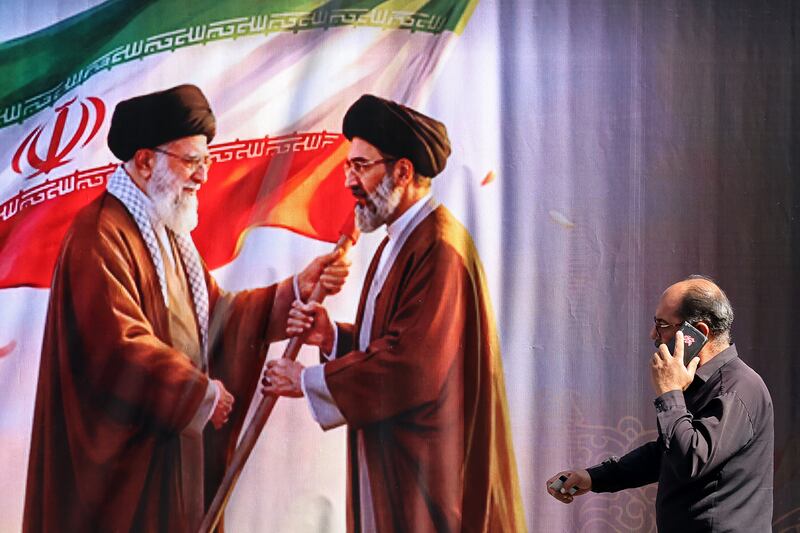
The extent of his injuries is unknown and he has so far issued only written statements, including one that distanced himself from the ceasefire negotiations but sanctioned their continuation.
Since his selection by the Assembly of Experts in March, the younger Khamenei has neither been seen nor heard in public. Israel last week again threatened to kill him, while earlier this week, he failed to attend his wife’s funeral.
On the streets around the mosque, music blared from competing sound systems. Men handed out posters reading: “We are the revenge seekers of Ali Khamenei.”
British and American journalists have officially been advised not to speak to the mourners, but in reality most are delighted to talk – if only to convey the contrast between the US president, Donald Trump, variously described as a megalomaniac and a yellow dog, and their own martyred, learned leader.
One white turbaned cleric, Ali Ajorlu, standing outside the mosque, explained: “There is a brush with which we clean toilets. It grows filthy in time with what the body has processed and rejected. Then there is the clean water of renewal from a spring. That is how I compare the two men.”
The crowds filling the mosque represented a certain section of the Iranian population, with all the women wearing the chador, a large, full-body cloak that drapes from the head to the ground, while in the shops or on motorcycles or in restaurants more than half the women in Tehran do not wear the hijab or scarf.
It will be for the government to calculate the truth of their claim that the US attack has reunified a nation in part divided by Khamenei’s conservative and often unbendingly religious 37-year rule. More than half of Iran’s population have only known one supreme leader, and the government is determined that the funeral, delayed by the conflict with the US and Israel, serve as a display of defiance and raw power. – Guardian