There is a high chance that dozens of workers may be found alive after a week trapped in an underground chamber at a hydropower plant following deadly flash floods, a Nepal Electricity Authority official said on Wednesday.
“In Rasuwagadhi, we think 46 people are trapped in a room-like structure in the tunnel,” Amshu Kiran Shahi, a board member of the Nepal Electricity Authority, told Reuters.
“We are very confident that they must be alive after one week because ... they have food and water over there in the building.”
So far, Nepali authorities have rescued 279 people from hydropower projects swamped by the unprecedented deluge of ice, rock, mud and debris, triggered by a glacial collapse near the country’s border with China.
READ MORE


But at least 639 more were still missing, some of whom are believed to be trapped in tunnels linked to the hydropower projects, where Nepali, Indian and Chinese rescue teams are digging to find survivors.
The Rasuwagadhi Hydroelectric Project, a 111-megawatt facility located in the hard-hit Rasuwa district, lies in a mountain valley 5km (away from Nepal’s border with China.
“This is the only project where it’s possible to walk through the tunnel. The army tried doing that three days ago, but they didn’t find the room,” Shahi said. “We are going in again.”
Rescuers are also looking for survivors believed to be trapped inside tunnels at other locations, where powerhouses have spaces and rooms for people to stay, according to Nepal’s army spokesman Raja Ram Basnet.
At the Upper Trishuli 3A facility, another project hit by the floods, it took rescue workers almost six days to find the tunnels because of thick mud, Shahi said.
“We are expecting (survivors) in there because we are told there is a dry space inside. We are trying to break into the tunnel now,” he said.
“We are using every technology available in Nepal right now, and we are taking help from the Indians, Chinese, Koreans. We have experts from Australia too.”
The disaster created at least 2.2 million tonnes of debris, according to a preliminary estimate by the United Nations Development Programme (UNDP), including parts of buildings, rocks, and sediment, the equivalent of six Empire State buildings.
At least 1,114 people have been killed and nearly 4,000 remain unaccounted for, with officials fearing many are buried under debris left by the floods that tore through towns and valleys near the Chinese border.
Across the border in Tibet, China’s official toll has held steady since Sunday at 16 dead and 546 missing.
“The hope of finding survivors is decreasing,” Phanindra Paudel, a senior official at the government’s National Emergency Operation Center, said. “We pray and are hopeful. Hope is hope!”
Rescuers are trying to find survivors believed to be trapped inside the tunnels of several hydroelectric plants, whose powerhouses have spaces and rooms for people to stay, an army spokesperson said.
Authorities said 279 people had been rescued from the ruins of hydropower projects but at least 639 more were still missing, some of whom are believed to be trapped in tunnels.
Specialised rescue teams from India, China and the United States were involved in the tunnel rescue attempts, authorities said.
“The plan today is to get on a helicopter and go to the hydro tunnels where they believe there’s still life,” Ferrin Cole, a member of the US crisis response team that is in Nepal, told ANI news agency.
“We have high-technology listening equipment to listen for sounds of life. And then the safety teams to go in and check.”
“Looking at the nature of the disaster and the area which has been hit by the flood, as days go by there are less chances of human survivors,” Binoj Basnet, a retired senior army general who oversaw the search-and-rescue operation during the 2015 earthquake in which about 9,000 people were killed, said.
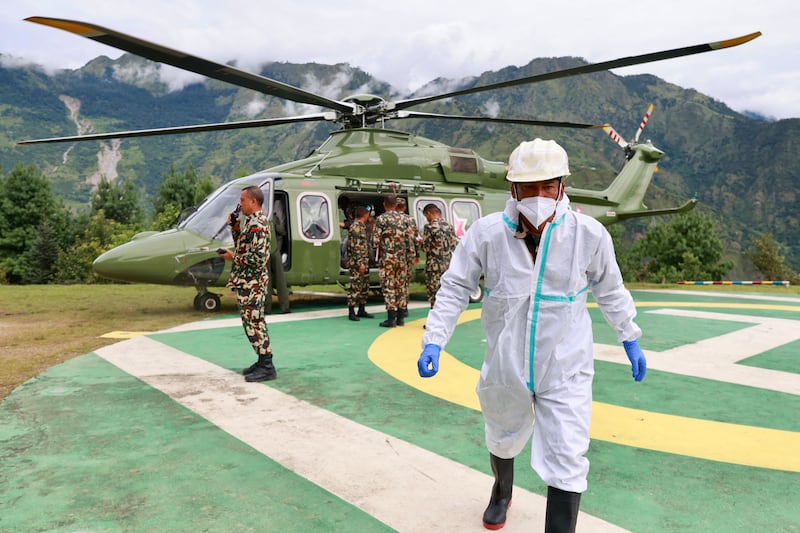
Prime minister Balendra Shah said the focus would shift from search, rescue and relief operations towards rehabilitation and reconstruction.
“The government is now focusing on rehabilitation while working to protect the lives of people in the affected areas and providing necessary medical treatment and psychological counselling,” Shah said in a late-night post on social media on Tuesday.
The disaster left at least 2.2 million tons of debris, according to a preliminary estimate by the United Nations Development Programme, including parts of buildings, rocks, and sediment, the equivalent of six Empire State buildings.
“The amount of debris shows the scale of the destruction and the challenge communities face as they clear homes, roads and public spaces and begin to rebuild,” it said.
Residents in affected areas walked around the remains of what were once bustling villages and towns, trying to salvage whatever they could of their belongings.
“My husband and I were able to escape safely. But we could not pick up anything,” Shanta Sunar (45), a small shopkeeper and survivor from Nuwakot, said.
“We have lost whatever we had. But we are lucky nothing happened to us.”
UN spokesperson Stephane Dujarric said aid agencies were “very concerned” about the growing public health risk from overcrowded shelters, contaminated water and damaged health facilities, particularly for women and children during the monsoon season.
About 3,900 people remain unaccounted for and nearly 3,500 people are living in 27 displacement sites across the hardest-hit districts of Nuwakot and Rasuwa, Dujarric told a UN press briefing on Tuesday.
Shah said his government had stepped up surveillance and response measures to prevent possible outbreaks of disease in flood-affected areas.
The Himalayan region faces severe risks from future glacial floods, a senior UN official said on Tuesday, a sentiment that Shah echoed in his post.
“Questions about why the ice and rock collapsed and how such a large volume of water was generated must be answered by the global community,” Shah said.
China has linked the flood to climate change as well. – Reuters