

If football is a game of opinions, The Irish Times landed an ideal fixture to shadow a League of Ireland referee.
Nobody can say Rob Hennessy did not expect the unexpected.
“Monday night games tend to bring their own level of strangeness,” says Hennessy when we meet in the lobby of an airport hotel at 5pm.
It is March 9th, less than three hours before Shelbourne versus Shamrock Rovers at Tolka Park. The Dublin derby will finish 2-2, with five yellow cards, a controversial goal and the awarding of a penalty only hinting at the official’s perspective of proceedings.
READ MORE


The 35-year-old Limerick native is joined by his assistant referees from recent European adventures, Dermot Broughton and Emmet Dynan, and fourth official Daniel Murphy. They seem relaxed with a journalist tagging along for the night.
“The benefits of having the same assistants is they know my triggers,” says Hennessy. “If I go quiet in a match, they know my concentration is somewhere else and to bring me back. They know the tone of my voice talking to players to say: ‘Rob, relax, or ‘move on’. It adds to the performance.”

To put the game in context, Rovers and Shels have won every Premier Division title in the 2020s. Shels – then managed by Damien Duff – took advantage of Rovers’ longest ever European run to clinch the 2024 title on the final day of the season in Derry.
It proved a blip. Normal service resumed in 2025. This year, under Stephen Bradley’s steady guidance, the Hoops are well placed to secure a sixth title in seven seasons.
Let’s go directly to the game’s flash point in the 13th minute, when John Martin gives Shelbourne a 2-0 lead. Kameron Ledwidge’s cross appears to go out of play mid-flight before curling back onto the field, into the path of Harry Wood. Hennessy appears to signal for a goal kick but doesn’t blow his whistle.
Four Rovers players stop and turn to the referee, including goalkeeper Ed McGinty, who seems to stop playing for a second. Wood drills the ball back across the goalmouth, where it reaches Martin unmarked for a tap-in.
Afterwards, Bradley says the non-decision cost Rovers three points: “The referee is horrendous for the second goal. He points to the goal kick and then allows it to play on. Our players stop. It is a tap-in. Ridiculous stuff, honestly. Crazy from one of the best refs in the country. That’s awful.”
In stark contrast, Shelbourne manager Joey O’Brien offers a reminder of the most basic coaching principle: “Under-10s stuff. Play to the whistle.”
Dylan Watts is the first Rovers player over to Hennessy as the “captains only” policy introduced last season is temporarily abandoned. Sporadic chats continue until John McGovern makes it 2-1 and Watts equalises from the spot in the 33rd minute.
“There is an assumption, by me, as with the players, that the ball is going out of play,” says Hennessy at around 10.30pm that night. “I move to signal but there is immediate comms from Dermot: ‘The ball is still in play, the ball is still in play’.”
Dermot Broughton – notably easy-going in our interaction pre-match – is a garda based in Cork.
“Dermot is the one in the correct position to make that judgment,” adds Hennessy. “Not me. Not any of the players. And he is very clear in comms so play continues.

“Obviously a goal came from it. You don’t want to have anything in a lead-up to a goal that can give somebody something to point at and say, ‘if we had this maybe we wouldn’t have the goal’.
“Look, in terms of impact, I don’t see it being…”
Cars motoring down Richmond Road drown out his voice. It’s been a long day. A throaty full house, along with players, staff and the media have dispersed as we stroll past Tolka’s away end. The officials are always last to leave as they stall for a debrief.
“It is something, when I go back and watch the match, that I will reflect on,” he continues. “It is something you don’t want to see happening because it takes away from, I suppose, the credibility of any decision when there is something like that. It is just unfortunate.”
Despite his criticism, Bradley had also said: “The officials tonight are good ones. At least you can talk to Rob.”
Most of the controversy was confined to the opening half, when all four goals were scored and five yellow cards were handed out.
Three of the bookings came in a hectic exchange as Kerr McInroy caught Watts in a challenge and Roberto Lopes sprinted half the pitch to offer an opinion. Word subsequently came from Murphy, the fourth official, to caution Bradley.
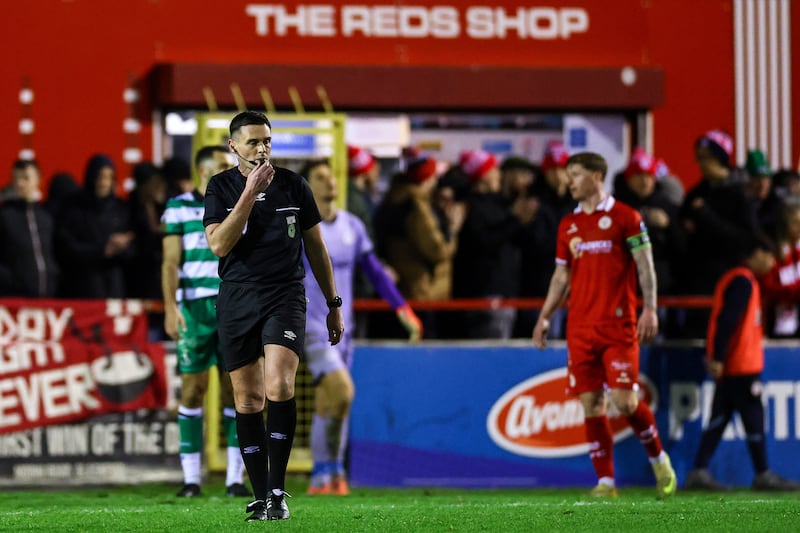
Hennessy had agreed to speak with The Irish Times at half-time. However, it was clear he had enough on his plate and the officials’ dressingroom door remained shut. But he did speak freely on a slow walk back to his car.
You weren’t wrong about the strangeness of Monday nights...
“It was a bit mad,” he says. “There was a spell of five minutes when a lot seemed to happen. You had the goal when there were appeals for ball in play, ball out of play. The penalty was very clear. No issue with that.”
Even O’Brien agreed that Wessel Speel, the Shelbourne goalkeeper, made a clumsy foul on McGovern who was moving wide of the goal.
“It was a strange first-half," Hennessy continues. “There were three yellows in the space of one minute. Tackle (McInroy), Roberto Lopes for running a distance and dissent, and then a yellow card for Stephen Bradley for dissent towards the assistants.
“Things like that in a match can change the mood. So, you go from a game with not that much temperature in it to, all of a sudden, three cards in one instant. That changes what you are thinking as a referee and you begin to manage things a bit differently, because things have changed.”
We relay the views of Bradley and O’Brien while noting the Rovers manager deemed Shels’ second goal “horrendous” and “ridiculous”. We balance this with Bradley adding that Hennessy is one of the “best refs in the country”.
As good a back-handed compliment as any official can expect to hear?
“I tend to be quite critical of myself. I’ll watch it back. Five cards in the first half and none in the second, you are wondering what happened. Did we manage things differently or was it the players’ attitude? Did they just want to play football?

“The big decisions in the match were correct. We can talk about how we got to them, but the outcome was correct. From that point of view, you go away content but there is always room for improvement.”
Earlier, we discussed VAR.
“I struggled a lot as a young referee, I’d replay a mistake over and over again and miss the next decision. I found in games when we have VAR, it has been really helpful. You give a penalty, VAR says that is incorrect and you can just move on.”
Should it be used in the League of Ireland? “It has positives and negatives.”
Not many people have the stomach for his job. There was a smattering of abuse from a section of Shelbourne fans as Hennessy entered the tunnel at half-time. It was pointed and personal.
“We are all very aware at this level that you are going to get shouts from the crowd. And sometimes that emotion boils over into abuse. That is part of the job. We obviously don’t want to see it and it is more the trickle-down effect for grassroots referees who have to deal with it on their own.”
Hennessy’s job in the FAI, as the national amateur referee development lead, is to recruit and keep people officiating at lower levels of the game. This is a challenging undertaking in an environment where, sadly, abuse and even assaults happen.
“It is sanitised for me out on the pitch where I am protected by stewards and a wall. But a lot of grassroot referees don’t have that. What people need to reflect on is what we see at the highest level is repeated at grassroots.”
He confirms Irish football has lost “loads” of good referees due to unacceptable levels of hostile treatment.
Communication does flow between the FAI referees’ manager Eddie Foley, coaches and players, with Lopes and Bohemians midfielder Dawson Devoy even attending the referees’ pre-season seminar to offer different interpretations of big moments from 2025.
This is Hennessy’s 14th season whistling around the league. His career has taken off on two tracks, inside the association since 2019 and with regular Uefa appointments this season, including the recent friendly between Wales and Northern Ireland in Cardiff. The sky is the limit – including the possibility of officiating at a World Cup in the future.
“I’ve just been promoted to category one and there is another level above that with Uefa, which is elite. The goal is to do enough to get promoted and see where that takes us.”


