Dropping Dublin make it Louth and clear
Dublin’s win over Louth on Saturday evening was in the distinctly unusual circumstances of the Dubs being borderline underdogs against the provincial champions.
Rather than take inspiration from their status, Louth went back into their shells. “That’s the first time we’ve come up against a Division 1 team this year – the physicality, the strength and the power ...” said manager Gavin Devlin of his team’s disappointing Leinster title defence.
It was an interesting point on a weekend when two of the teams deemed unlucky not to have gained promotion – or at least, who went close to it – from Division 2 went in quite fancied against the counties relegated from Division 1, but the latter, Dublin and Monaghan, pulled off significant wins against Louth and Derry.
Not that the promoted sides had uniformly positive championship follow-ups. Cork have yet to play in next weekend’s Munster final against All-Ireland champions Kerry but Meath became the first casualties of Westmeath’s impressive run to a first Leinster final in 10 years.
READ MORE


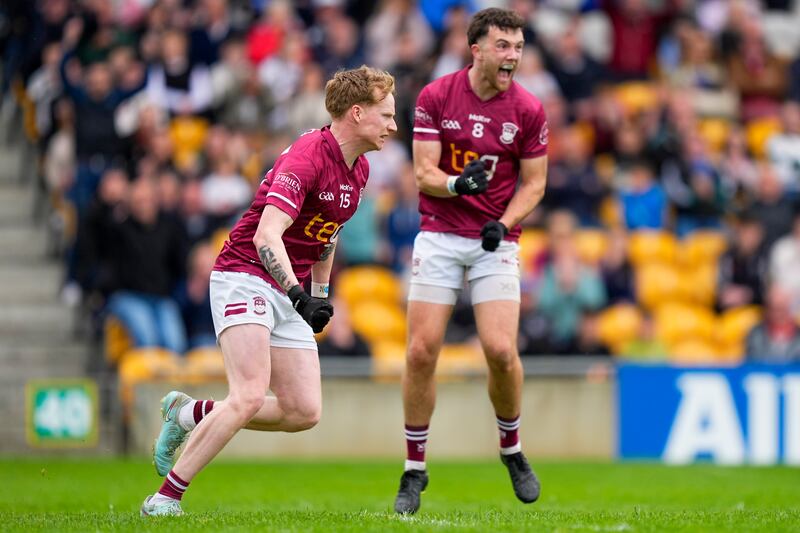
Twice in the past four years, teams promoted from Division 2 have won the All-Ireland – Dublin in 2023 and Armagh, a year later. In 2022, Galway were defeated finalists.
It had been 24 years since Dublin had beaten the defending Leinster champions – a seven-point win over Meath in the 2002 provincial semi-final.
For as comprehensive a win by Dublin over the title holders, we have to go back 71 years to the famous day Kevin Heffernan played the roving full-forward role in the 1955 Leinster final against then All-Ireland champions Meath to such effect that he scored two goals in the team’s 5-12 to 0-7 win. – Seán Moran
Limerick sharpshooting
Heavy scoring has been a recurring pattern of John Kiely’s 10 seasons as Limerick manager. They have consistently bludgeoned teams with white flags and the assumption always was that 30 points was their target, goals and points combined.
On Sunday in Ennis, they reached that threshold with six minutes of normal time remaining. Their final tally of 36 points (2-30) was their joint fourth-highest total in 54 championship matches under Kiely; they also hit 0-36 against Clare in 2020.

Above those scores on the list (excluding games that went to extra-time) are a couple of hauls of 40+ points: 3-32 against Cork in the 2021 All-Ireland final and 3-31 against Waterford a year later. The other entry in the top five is 5-22 against Carlow in a preliminary quarter-final in 2018.
Limerick’s belief that they won’t lose if they reach the 30-point mark is borne out by the stats. They have hit or exceeded that total in 23 championship matches under Kiely and won 22 of them. The outlier was the spectacular round-robin game against Cork in 2024 when they racked up 35 points (3-26) and lost by two points.
The other thing that Kiely always talks about is efficiency, but for a team that gets away so many shots there is always going to be volatility in that metric. In Cork last week they had 40 shots at a conversion rate of 60 per cent; in Ennis on Sunday, they had just one shot more, 41, but their efficiency rate was an outstanding 78 per cent. That made a material difference. – Denis Walsh
Monaghan reap rewards of knowing the rules
It’s always been a vague notion in this corner to hit up Monaghan forward David Garland for a piece sometime. Not about his playing career, or at least not entirely. No, it’s more about the fact that in his spare time – or what passes for spare time as an intercounty footballer – Garland is a budding referee.
Scroll through the juvenile referee list for the Dublin county board and he’s right there: David Garland, UCD. Go back further in fact and Garland has occasionally been an umpire for Martin McNally, the Monaghan referee. Has done an All-Ireland minor final, no less – the 2016 one where David Clifford ran riot for Kerry. (Okay, one of the ones where David Clifford ran riot for Kerry).
All of which is to say, Monaghan weren’t just lucky to have him in his scoring capacity on Saturday night against Derry. He came on and kicked a point during the Monaghan comeback but his biggest contribution was at the end of normal time.
When everything was chaos and referee Noel Mooney was walking off having declared the game was over, the fact that most people’s eyes were on Rory Beggan meant they probably didn’t notice Garland at all. But in fact, as the big goalie was ranting and raving at Mooney about the fact that Monaghan were entitled to take one last sideline ball, Garland was quietly catching Mooney’s eye and talking calmly to him.
Watch it back and you can see Mooney going from arguing with Beggan to actually listening to what Garland has to say, stopping short and turning around to point back over to the sideline, giving Monaghan one last lifeline.
Jack McCarron might have pulled off a miracle shot to send the game to extra-time and Beggan might have been man of the match. But when the decibel level was through the roof and everything was in flux, it did Monaghan no harm at all to have a referee in the number 13 jersey. – Malachy Clerkin
Big ball, big scores
In the foothills of Kerry’s march to the double last year, their place in the league final was secured by a last-day victory in Salthill. Afterwards, speaking about the new, high-scoring game that was unfolding under the FRC proposals, manager Jack O’Connor was asked how he felt about it all.
“Do you like the helter-skelter games, Jack?”
“I don’t, because they’re very bad for my heart. I mean, it’s very exciting,” he said. “You can see where the scores have been racked up. I don’t know, how did we finish? 3-21, was it? 3-24? 3-24, is it? It’s a hurling score, right?”
That day brought Kerry’s total over two matches – including Armagh eight days previously – to 5-45. The standout context to this was the fact that in those two matches O’Connor’s team kicked not a single two-pointer. They did go on to kick plenty in the championship.
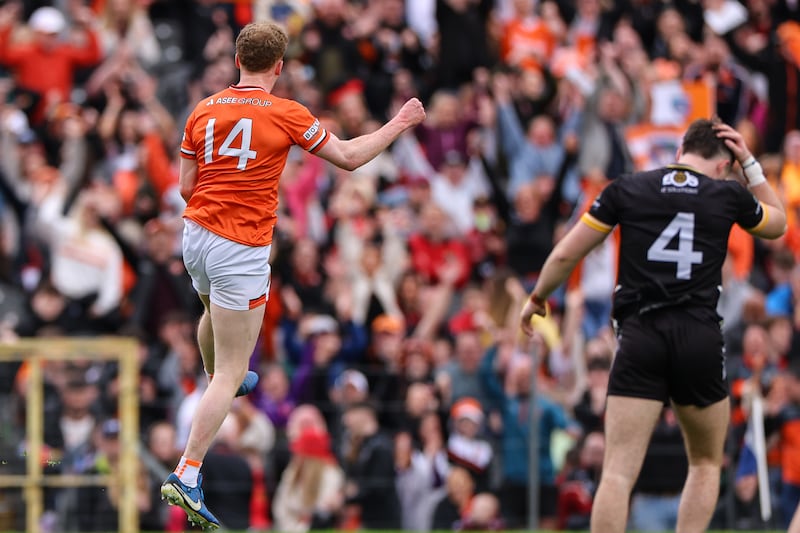
As to the hurling comparison, this weekend, Limerick were back on the high road, shooting 2-30 against Clare. Conor McManus observed it was mad to think that Armagh had scored 1-3 more up in Clones against Down than the Limerick hurlers close to full power.
Even more extraordinarily, Armagh, who put up 2-32 against Fermanagh in the quarter-final, are now averaging 40 points a match. In Ed Donnelly’s useful – and much quoted – programme notes in Munster, Sunday’s By the Numbers pointed out that Cork’s 4-30 (42) against Tipperary two years ago was the highest score in the championship. This weekend, Armagh equalled that with 3-33.
Who says you can never watch football after a hurling match? – Seán Moran
Little reward for Division 3 champs
It is becoming increasingly evident that the prize for winning the Division 3 title is losing its sparkle. One of the pillars supporting the launch of the Tailteann Cup was a general acceptance that Division 3 promotion would probably gain you entry to the All-Ireland series, but if that alone didn’t suffice, winning the division would surely see a team make the cut. It added some real significance to the battle for the Division 3 top spot.
But as Down have now found out, the third-tier league champions are guaranteed nowt. This is the fifth year of the Tailteann Cup. In three of those five seasons, the Division 3 league champion has been frozen out of the All-Ireland series – Cavan (2023), Offaly (2025) and Down (2026).
Conor Laverty, to his credit, did not adopt a toys out of the pram approach following his side’s defeat to Armagh on Sunday – a result that consigned the 2024 Tailteann Cup winners to play in that competition again this summer.

“We all knew, they are the rules. So there is no point complaining about that, that’s just where it is,” said the Down manager.
“We’d probably felt we had done our part in Division 3, to win it, and it was still in our own hands coming here today. It’s not where we wanted to be, it’s not where the group wanted to be, but we’ll have to dust ourselves (off) now, reassess things and have a long hard think about the next part of the jigsaw and what manner we approach the Tailteann Cup.
“Fair play to Westmeath, they didn’t get out of Division 3, but for their performances over the last couple of weeks, you have to give them credit for that as well.”
Effectively, it has once again shown the imbalance that exists on account of a provincial final appearance superseding league standings. Teams cannot change their province, but they can work on improving their league position.
Perhaps there is merit in the GAA reassessing the structure and adding a stipulation that Division 3 champions would be guaranteed a spot in the All-Ireland series that same season. – Gordon Manning