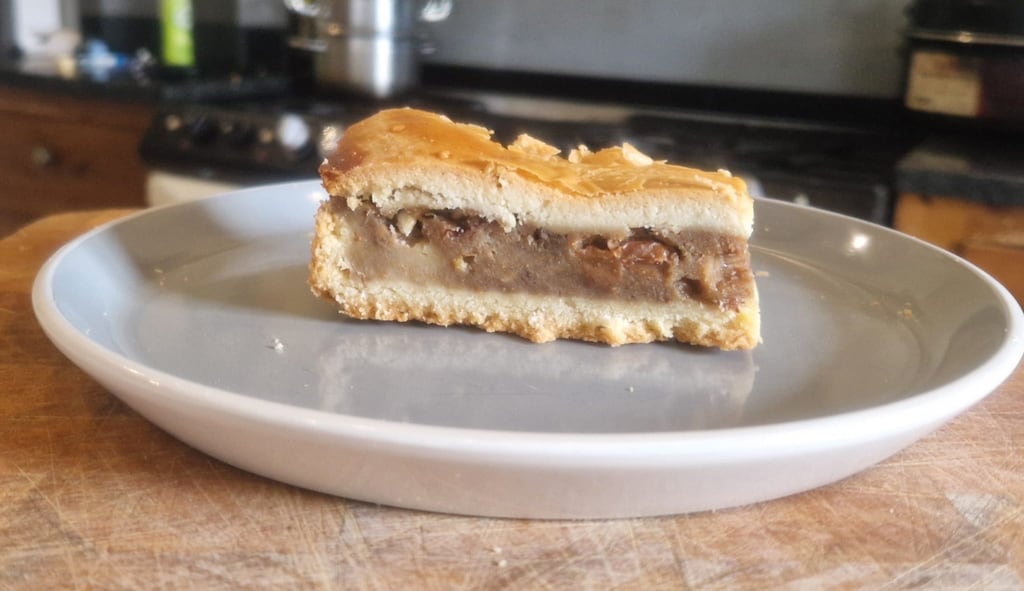
The recent publication of Cormac Moore and Alan Tate’s history of Lemon’s sweets calls to mind another Irish treat of long standing: Chester cake. Stodgy and pastry-clad, traditionally comprising stale bread and cake, fruit and cold tea, it’s a concoction to which I have long been partial.
Chester cake was a feature of the Irish confectionery scene as early as 1838, judging from an incident that took place on Dublin’s Parliament Street in February that year. Harriet Butler, an elderly milliner and dressmaker from Ranelagh, bought three buns on the premises of “fancy baker” Andrew Feeny.
Feeny didn’t serve her, but nonetheless accused her of eating a Chester cake and not paying for it, which she vigorously denied. (She later said that “nothing could induce her to eat” Chester cake.) Feeny subjected her to physical and verbal abuse and kicked her out into the street when she appealed for witnesses among her fellow customers.
Nothing would now be known of the incident if Miss Butler hadn’t taken Andrew Feeny to court. Feeny called his brother James as witness, who was adamant that he had seen the lady take the Chester cake. One juror asked James Feeny if there were any chance he might have confused a piece of Chester cake with a bun. “Not in the least,” the witness said, perhaps indignant at this implied ignorance of sweetmeats.
READ MORE


However, defence counsel eventually conceded that James Feeny might indeed have made such a mistake, and the hitherto intransigent Andrew Feeny apologised and was fined one shilling and costs.
The cake Miss Butler was accused of pilfering is, of course, better known in Dublin as gur cake. This curious name is found in the title of Éamonn Mac Thomáis’s famous memoir, Gur Cake and Coal Blocks – but where does it originate?
Like so many etymological questions, this one can get a bit circular. Gur cake was eaten by gurriers. A gurrier was a child who went “on the gur”, ie played truant – but what was gur? Which came first, the cake or the truancy?
TP Dolan’s Dictionary of Hiberno-English (third edition) is unsure. Writing in the Evening Herald in 1986, Dominic Behan equates gurrier with the Scots Gaelic goraide, meaning “one who plots or hatches battles, or, in the tongue of the stranger – a warmonger”.
A 1909 anecdote from Hulme, Manchester, gives us another moniker for a piece of Chester cake: “a dosser’s wedge”. That the derogatory terms gurrier and dosser have connotations of poverty is no accident. Chester cake was something to fill you up cheaply. A decent slice of it and you were good for the afternoon.
Dubliners may be justifiably proud of their gur cake and Mancunians of their dosser’s wedge (is this latter term still in use?), but first prize in the naming stakes must go their Cork counterparts: according to Seán Beecher’s Dictionary of Cork Slang (1983), the cake is known by Leesiders as “donkey’s gudge”. Not very appetising sounding, but infinitely preferable to the timid “fruit slice” label you see some places. Give me a slab of donkey’s gudge any day.
The Oxford English Dictionary, incidentally, has gudge as a verb, meaning “to eat ravenously or too much, to be gluttonous”, which could fit. But then so could one of the definitions I found on the Dictionaries of the Scots Language website, which gives it as a noun, “anything short and thick” – and the cake does tend to be thick.
Eat too much of it and you’re in danger of becoming a gudget. Don’t say I didn’t warn you. How the donkey got involved is anyone’s guess.
A lady to whom I got talking on the Dublin-Westport train informed me it’s also known as tipsy cake. Subsequent research shows, however, that tipsy cake is much lighter on the filling and – as the name suggests – heavier on the alcohol. Any Chester cake I’ve eaten has been strictly teetotal.
Hence my surprise when I found a recipe from a cafe on Fownes Street, Dublin, (per a copy of the Evening Herald from December 1991) for “Dublin gur cake with Guinness”, which puts a twist on the classic recipe by adding a small bottle of the black stuff. Not for me, thanks. I’ll stick with cold tea.
Whatever you like to call it, there are still places to buy Chester cake if you know where to look. You’ll find it in Londis in Heuston Station, Dublin, just the ticket if you missed your breakfast to catch the train.
Danes Bakery on Limerick’s Upper William Street, an establishment renowned in the city for its elaborate wedding cakes, sells squares of Chester cake topped with icing – or at least they did when I visited several years ago.
My favourite, however, is from Barron’s Bakery in Cappoquin, Co Waterford. Sweet but not excessively so, with dry pastry providing a pleasing contrast to the moist filling, I’m willing to hazard that even Harriet Butler would have approved.


