

In my copy of The Methuen Book of Poems for Every Day, the May 12th entry is WB Yeats’s Easter 1916. So far so good. It’s nice to see English publishers taking an interest in Irish history, historically a neglected subject over there.
But then come the footnotes, where events that happened “on this day” are noted. And of May 12th, the book says this: “The Easter Rising conspirators were hanged in 1916.”
Oh dear. If any Methuen editors are reading, there are two problems with your footnote: (1) the Easter Rising conspirators were not hanged on May 12th; and (2) they were not hanged. Well, except for poor Roger Casement, who being uniquely convicted of treason, was so dispatched on August 3rd.
The other 15 were shot on various dates in early May. Only two, James Connolly and Seán MacDiarmada, died on the 12th. All changed, changed utterly, by Methuen. A terrible infelicity is born.
READ MORE


The publishers can take some comfort from Yeats’s follow-up poem, Sixteen Dead Men, in which he warned of the power their martyrdom conferred. That begins: “Oh but we talked at large before/The sixteen men were shot/But who can talk of give and take/What should be and what not/While those dead men are loitering there/To stir the boiling pot?”
Poor Casement again, having his death rewritten because the truth would have interfered with a rhyming scheme. For pedants and republicans, that may be almost as annoying as Methuen’s footnote. But at least Yeats had a poetic licence. They only had a publishing one.
Indicted on a definite article
One of the men who was shot, not hanged, on 12th May 1916 was caught up in another conflict recently, 110 years on. This time the crossfire was only on social media and arose from a short story-cum-playlet being presented at the annual festival in his honour.
The event promised “the first performance of James Connolly’s The Agitator’s Wife”, a long-lost text “discovered in 2019 [and] believed to be written by Connolly in 1894”. But this billing was disputed by historian Conor McCabe, who took to X to say: “This is not by James Connolly. The @ConnollyFest is hosting the wrong play.”
[ ‘He never said that’: Frank McNally is tired of hearing a phantom WB Yeats quoteOpens in new window ]
It has been said famously that Roger Casement was “hanged on a comma”, thanks to ambiguous punctuation in a 14th century English law. But it seems that, in this case, the Connolly Festival was indicted on a definite article.
There are, confusingly, two story/playlets that have been speculated as being Connolly’s: An Agitator’s Wife (which had been plausibly traced to him) and The Agitator’s Wife (which until recently had not). The former may be a reworking of the latter. In any case, the festival presented both.
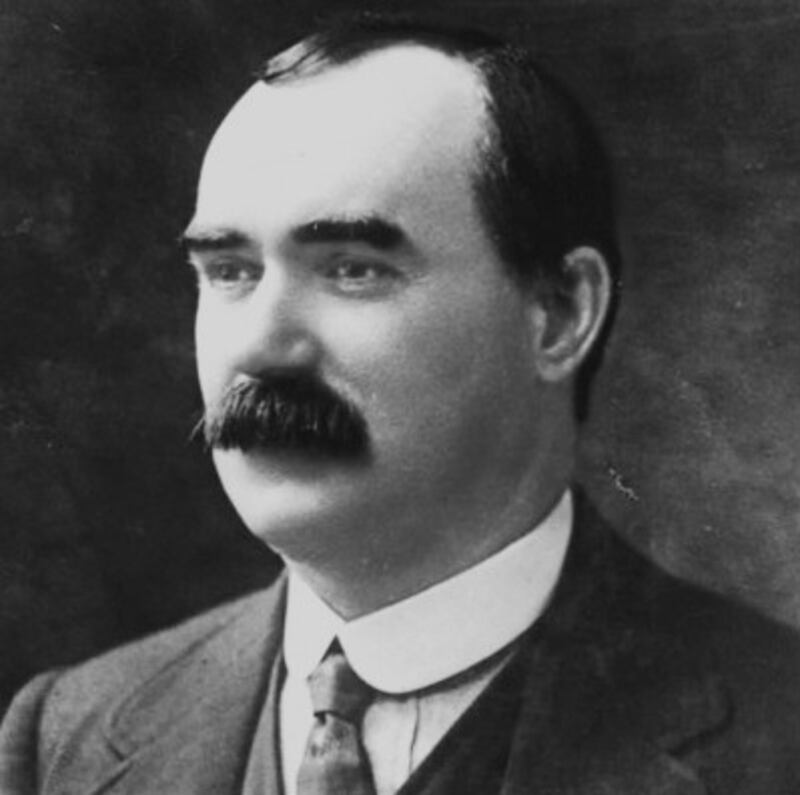
McCabe, who later deleted his X post, included An Agitator’s Wife in his 2024 anthology, The Lost & Early writings of James Connolly. And the text has a certain resonance with Yeats’s line about a woman (Countess Markievicz) spending “her nights in argument until her voice grew shrill”.
Except that the main character in An Agitator’s Wife is the oppressed spouse of a would-be revolutionary, berating him for being a useless husband. Here she is, sarcastically responding to his suggestion that she has wakened the baby:
“Me wakened the baby! Oh no, but it was the sound of your voice that wakened the baby, for it is very seldom, indeed, the poor darling hears [it] ... Hush-a-bye-baby, there’s a darling. Don’t be frightened. It’s only the man who comes here to take his meals and change his clothes. He won’t hurt you, oh no; he would not intrude for all the world. He is so bashful that he never comes here if he can avoid it. Hush-sh-sh, hush-a-bye. That, baby, is only your father, your respected parent, your affectionate sire; that, baby, is the socialist agitator, the apostle of the new righteousness, who tells people that ‘society in the future must be founded on a right perception of love and duty, and then neglects his own wife and children, and stays out till twelve at night attending meetings ...’”
James Connolly’s statue
We used to have moving statues. Today, in Dublin at least, we have talking ones. Ten of the city’s best-known sculptures now have QR codes attached, swiping which with your phone brings the figure to life, as voiced by actors and scripted by writers.
Oscar Wilde, for example, is channelled by Andrew Scott, with words by John Banville. And James Connolly, down at Beresford Place, can talk too, as written and voiced by Brendan O’Carroll.
Alas, the state of Eamonn O’Doherty’s Connolly statue has attracted despairing comment of late. Conor McCabe posted a picture on Instagram showing the backdrop daubed with graffiti. Donal Fallon tweeted that it was now also a receptacle for “needles” and “human waste”. Others pointed out that the attached bench is sometimes used by rough sleepers.
I’m not sure what the statue’s QR code has to say, because I haven’t heard it. Unfortunately, as a commentary on the state of things, the monument itself may have become more eloquent.


