

While British king Charles III launched a charm offensive in Washington this week, the Northern politics blog Slugger O’Toole, less diplomatically, reminded readers of a 19th-century army officer, Robert Ross (1766–1814).
Dublin-born but with roots in Co Down, Ross is today best known for leading a British invasion force that in 1814 captured the US capital and set fire to many of its public buildings, including the White House.
In fairness, he has been described as a “reluctant arsonist” who had to be persuaded to burn the place by his superiors. And in any case, he didn’t long outlive the act. Three weeks later, he was killed by an American sniper.
His body was preserved in Jamaican rum, en route to burial. His memory is preserved in granite, still, via a 30m high obelisk in Rostrevor, on the northern shores of Carlingford Lough, strikingly similar in shape to Dublin’s Wellington Monument.
READ MORE


Something not mentioned by Slugger is that Ross met his nemesis at a place now known as Dundalk. No, not the one just across the water from Rostrevor. This Dundalk is a suburb of Maryland and so named (decades after the skirmish in which Ross fell) by a Louth man who set up a bell foundry there.
Both Dundalks are notoriously republican, in their own ways. The rust-belt Maryland version voted heavily for Donald Trump. The drumlin-belt Louth one famously repelled a 20th century British invasion – by Ian Paisley and hundreds of DUP supporters in 1986 – with the help of some not-so-reluctant arsonists, who dropped crates of petrol bombs from upstairs windows along the route.
Erected 200 years ago in 1826, the Rostrevor obelisk also stands in what is now a predominantly nationalist area. That its site was overgrown for many years may have saved it the fate of Nelson’s Pillar and other monuments in the last century. In more forgiving times, after the Good Friday Agreement, it was restored by the local council. But it is probably just as well, thanks in one case to the Cooley Mountains, you can’t see the monument from either of the Dundalks, even on a clear day.
***
As reported by The Irish News, meanwhile, the latest front in the North’s ongoing political squabble is the sport of sheepdog trials. In which – yes – a “bitter dogfight” is said to have erupted over which flags should fly at the All-Ireland governing body’s events.
Of course, it’s not dogs fighting: it’s humans, as usual. Which said, it does seem telling that the four-legged friends at the centre of this sport, invariably are “border collies”. No doubt some are cross-border collies too. And you wouldn’t want to meet one of those without his hyphen.
***
Speaking of small but important grammatical issues, I note while the same Charles was credited with the lifting of US tariffs on British “whisky” this week, it was “whiskey” Donald Trump referred to in his social media announcement.
This is hardly a legal loophole Ireland can exploit, alas. Nevertheless, whiskey is the Irish and American spelling. E-less whisky is the Scots.
The two versions used to be interchangeable, even in Ireland. But as I understand it, at a time when Irish whisk(e)y was the world leader and Scotch the poor relation, the big Dublin distilleries deliberately adopted the now-standard Irish spelling to differentiate from supposedly inferior spirits. If so, it was a rare case of an e-additive being used to make a consumer product seem more attractive.
***
That news story about a giant oarfish turning up in Clare is indeed, as we reported on Thursday, ominous. Rarely seen by humans, the species is known in Japanese folklore as a “messenger from the sea god’s palace”, its perceived prophecies of doom often followed by earthquakes and tsunamis.
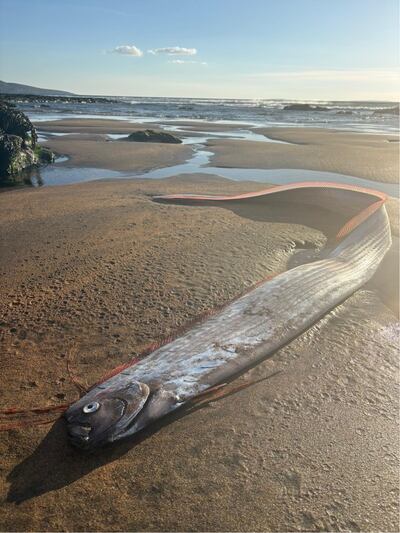
Capable of growing up to 8m (the one in Clare was a mere 2.5), the ribbon-shaped creature said to be the “longest bony fish” on Earth. So perhaps it adds to the bad omen that it washed up on a beach in Fanore, which at an estimated seven miles of ribbon development, claims to be “Europe’s longest village”.
Either way, in a famously musical county, the creature could yet become the subject of a (similarly long) ballad, sean-nós style. “The Oarfish of Fanore”, detailing its possible portents in 36 verses, already has a ring to it.
As Father Ted anoraks will know, Fanore was also the setting for an episode of that series subtitled “Hell”, wherein the three priests went on a caravan holiday.
But the oarfish could have appeared in worse places, I suppose, even in Clare. Imagine the furore if it had washed up 50km down the coast at Doombeg – sorry, Doonbeg – where the Irish Golf Open will take place in September, with the potential attendance of US president Trump.


