

One of the social networks of Irish nationalism, circa 1904, revolved around a shop called An Stad, located at No.1b North Frederick Street, Dublin, opposite what is now the northeast corner of Parnell Square.
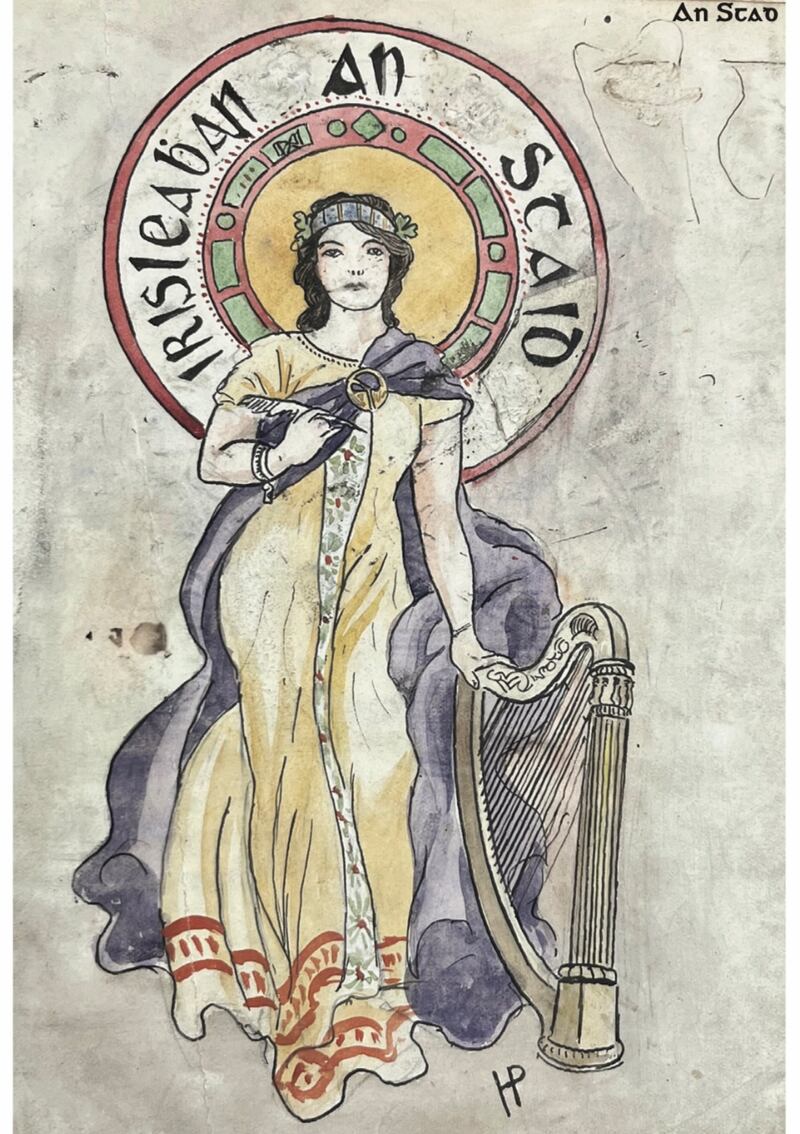
It even had its own social media, in the form of series of visitors’ books, to which the shop’s gaeilgeoir manager, Donegal man Cathal McGarvey, invited all-comers to contribute words or sketches “in any language other than English”.
The shop’s primary commodity was tobacco. But McGarvey – a poet and entertainer in his own right, perhaps best known today for having written The Star of the County Down – also presided over an assembly of conversationalists and wits.
Many now-famous names visited the venue, including Oliver St John Gogarty, who lived 15 doors away, and GAA founder Michael Cusack. Arthur Griffith dropped in every night. While producing his own weekly newspaper, United Irishman, he mined An Stad for material.
READ MORE


Hence Turlough Crowe’s essay on the visitor books in the latest issue of Cut & Paste, a journal devoted to the study of Griffith and his contemporaries. As Crowe writes, the shop lasted only five years, from 1900 to 1905. But that was a pivotal time in Irish politics and culture, not least because it also coincided with the early adulthood of James Joyce, another occasional caller.
Joyce mentions An Stad, disguised as “Cooney’s”, in his aborted memoir Stephen Hero. It’s also a backdrop, unnamed, in A Portrait of the Artist, where he writes: “Met Davin at the cigar shop opposite Findlater’s Church.”
More importantly, An Stad may be where Joyce first met Cusack. According to a 1953 Bureau of Military History statement by the artist Harry C Phibbs, the GAA founder introduced himself to Joyce there as “Citizen Cusack”, under which title he would be comically immortalised in Ulysses.
Another writer to drop into An Stad in those years was William Bulfin, whose travelogue Rambles in Eirinn included a visit with an unnamed companion to a “tower” in south Dublin in September 1904, where a trio of also unnamed young Bohemians were holding court and “outraging the seoníní”.
We now know this was the Martello tower and that the trio were Joyce, Gogarty and Samuel Chenevix Trench, whose stay there would be backdated to June in the opening scene of Ulysses. We also know, thanks to one of Crowe’s previous contributions to Cut & Paste, that Bulfin’s companion was Griffith.
Yet another regular in An Stad, Crowe says, was “Lord Ashbourne”. This, presumably, refers to William Gibson, the second Baron Ashbourne, a cultural nationalist, and not to his father, who was Lord Chancellor of Ireland until retirement.
Mad Willie, as some called the younger lord, was notable for wearing a kilt, in the sporran of which he was rumoured to keep a pet turtle. But today he is probably less famous than his sister Violet who, as mentioned here last week, almost assassinated Mussolini in 1926 before spending the rest of her life in a psychiatric hospital.
In his memoir, Tumbling in the Hay, Gogarty devoted a chapter to An Stad, joking that although many of its regulars were in theory devoted to such manly sports as hurling, in practice they preferred to sit around and smoke. Everyone was committed to “the cause”, he wrote, or affected to be anyway.
“So there was a united front at the Stad. Even if we had a misgiving about the wholeheartedness of our neighbour we could all believe in Arthur Griffith. And for anyone who preferred the athletic side of the Gael to the political side – for Arthur was short-sighted and wore pince-nez, which the ancient Gaels did not – there was always Michael Cusack,” Gogarty wrote
The shop closed in 1905, although some its spirit was inherited in later years by a hotel of the same name, elsewhere on Frederick Street, which became a popular haunt for republicans.
It was also succeeded by a nearby and similarly named business at 75a Great Britain – now Parnell – Street. That site was in time taken over by a certain Tom Clarke, who ran his own tobacconist and newsagent’s shop there until Easter 1916.
The four An Stad visitor books remained in McGarvey’s ownership for some years. But in the 1940s, they resurfaced “in a book barrow on the Dublin quays”, where a Gaelic scholar saved them for posterity.
Today, Crowe writes, the books are in the care “of people who fully appreciate that they are custodians of a work of great historical and literary interest … a unique daily record of the lives of ordinary Gaelic nationalists between 1900-1905.”
Cut & Paste takes its name from another of Griffith’s publications, Scissors and Paste (1914), in which he circumvented wartime censorship by reproducing and subverting newspaper articles already passed by the censor.
The latest issue of C & P, by contrast, includes original essays by Colum Kenny, Felix Larkin, Brian Maye and many others. Costing €7, it can be bought in hard copy or as a download from printwellbooks.com.


