Less than 20 years ago, in the general election of 2007, Fianna Fáil got 15,398 first preferences in Dublin Central – 44 per cent of the vote. On Friday, in the same constituency, Fianna Fáil got 1,049 first preferences – 4 per cent of the vote. This is a decline of 93 per cent.
The shocking thing, however, is that there is no shock. Nobody on the ground expected anything different. The pathetic attempts of the Supreme Being of 2007, Bertie Ahern, to suck up to anti-immigrant voters were symptoms of desperation and ideological bankruptcy. The mighty are fallen so low that they scrabble in the dirt.
Yet, if we stand back a little, we should be astounded. This is arguably the world’s most successful democratic political machine of the last century. For more than half of that century of existence, Fianna Fáil has held the office of taoiseach (albeit not called by that name until 1937). And, just in case we haven’t noticed, it still does.
I’m sure some political anorak (maybe Bertie himself) can answer this question: has any serving prime minister’s party in a stable democracy ever got less than 5 per cent of the vote in a national parliamentary election? I can’t think of any.
READ MORE


We must, of course, enter the caveats. This was a byelection with a depressingly low turnout. Most of those entitled to vote couldn’t be bothered. But the Dublin Central debacle doesn’t feel like a freak event either.
In Galway West, Fianna Fáil got nearly 9 per cent of the vote: much better than Dublin Central but not out of line with the larger trend. In 2007, Fianna Fáil got 37 per cent in Galway West. The decline is 80 per cent. Good luck with claiming that as good news because it’s not 93 per cent.
All of this feels like the trope in the old cartoons where the coyote runs off the cliff and keeps going for a while. He freezes in mid-air, looks down and realises that there is no ground under his feet.
It feels like we’re in that strange hiatus now. Fianna Fáil has no ground beneath its feet. Its base has eroded. The urban working class that voted for the party because it built them reasonably decent houses now sees its frontmen as shills for a new landlord ascendancy. The rural voters who once saw it as the beating heart of the real Ireland are increasingly alienated and disgruntled.
Most importantly, the social glue has melted. Fianna Fáil’s hegemony was founded on its determination to stick to the Catholic hierarchy. Once it came in from the post-Civil War cold, it learned very quickly that the route to power lay through episcopal palaces. Whatever the bishops wanted – no divorce, no contraception, no abortion, full control of health and education, a blind eye to systemic institutional abuse – the bishops got. This alliance lasted right up to the heyday of Ahern as taoiseach.
The tacit deal gave the party, in return, a rock-solid social and ideological base. The church had immense prestige and overwhelming authority and it lent them to Fianna Fáil as its representatives on Earth.
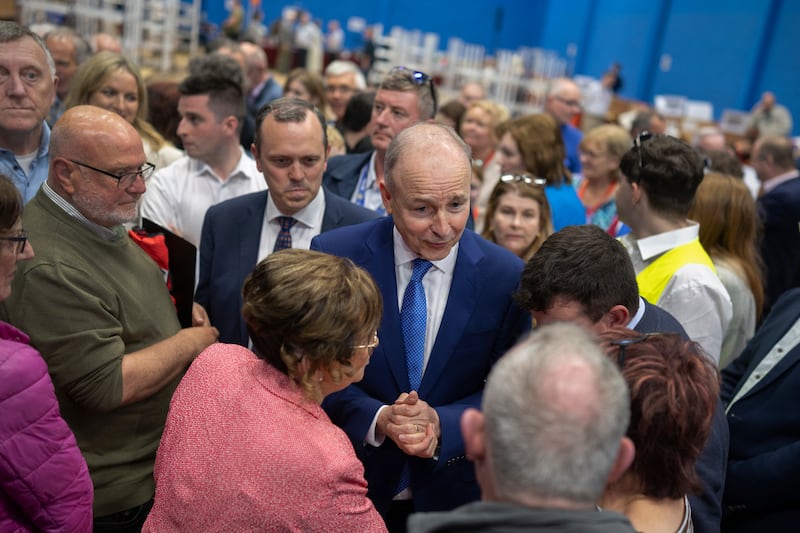
All of that’s gone: the hierarchy has no spare authority to lend to anyone. What’s left is the ghost of a machine. The system, the organisation, the confraternity of local belonging, still has a vestigial existence. It can get a vote out.
Or can it? Certainly not in Dublin Central where the unfortunate Fianna Fáil candidate often seemed to be dancing alone. The Green Party has been on the floor: devastated and almost annihilated in the 2024 general election. On Friday, it got out three times the number of voters that Fianna Fáil managed to entice to the polls. That’s grotesque, unbelievable, bizarre and unprecedented.
If the machine is so rusted that it would struggle to be sold for scrap, what’s left? A fear of frightening the multinational geese and their golden eggs. A general sense that Micheál Martin is a decent sort. A muscle memory of the way power used to work in this State.
But really, what’s keeping this thing in the air long after it’s gone over the cliff is the lack of a coherent alternative. Sinn Féin’s job as the main Opposition party is to form the core of that alternative, to present for the electorate a credible proposition for a progressive government.
That credibility is not being built. If anything, it is evaporating. The party has important things to say on some vital issues – housing and healthcare in particular – but its big underlying propositions are twofold.
One is that there will be Border polls in 2030 that will usher in a united Ireland, in which all will be for the best in the best of all possible worlds. The other, is that in the meantime, everybody who demands anything must get it because American multinational capital is the gift that will keep on giving. It’s a strange brew of nationalism and hyper-globalism: ourselves alone with our transatlantic benefactors.
The byelections sent a clear message: too few voters are imbibing this concoction to make Sinn Féin a credible alternative government. If it does not grasp this reality, it will continue to founder.
[ Almost €280,000 spent by political parties during byelectionsOpens in new window ]
And while it does so, we are left with a kind of gothic politics. The undead rule. A century-old party that cannot get a tenth of the vote in Dublin or Galway, that can’t find compelling candidates or tell a half-convincing story about how it is shaping the future of Irish society nonetheless retains power.
This is dangerous. A somnolent governing party might be okay if Irish society were not in flux. Its systems of authority and social control are not just gone but bitterly discredited. Its self-image as a nation of emigrants has been turned upside down by large-scale immigration. Its system for reproducing a middle class through home ownership has fallen apart. The old is undead and the new is struggling to be born. Mind that gap.