My intention for this week’s column was to write something positive, something hopeful, to find a topic that might admit of something other than the cynicism, foreboding and despair that have increasingly come to characterise our world. And the prime candidate is Nasa’s Artemis II mission, the first manned lunar flight since the last of the Apollo missions, Apollo 17, in 1972.
Artemis II, which took the four crew members of the Orion spacecraft on a fly-by around the moon, could in one sense be seen as a mere reboot of a once-beloved blockbuster franchise fallen into disrepair. But it is also, in its own right, a historic moment – not least because the crew, in circling around the far side of the moon, have now officially travelled the farthest from Earth any humans have ever gone.
There are other records, too. Commander Reid Wiseman is, at 50, the oldest human to travel beyond low earth orbit. The pilot, Victor Glover, is the first black man to travel to the moon and the first to leave low earth orbit. Mission specialist, Christina Koch, is the first woman. Canadian Jeremy Hansen is the first non-American. There is something surprising, and even a little uplifting, in the knowledge that humanity – and let’s give the devil his due here, the US government – is still capable of pulling off such a tremendous human and technological feat.
And then there are the photographs that have been sent back to Earth by the crew aboard the Orion. There are haunting depictions of the dark side of the moon, vast and alien and entirely devoid of life. Looking at these, I was put in mind of Buzz Aldrin’s impromptu description of the lunar surface he had just stepped on to as a “magnificent desolation” – a phrase that has always struck me as more memorable and more authentically poetic than his colleague Neil Armstrong’s somewhat corny (and in any case flubbed) line about small steps and giant leaps, famously delivered to the world moments previously.
READ MORE


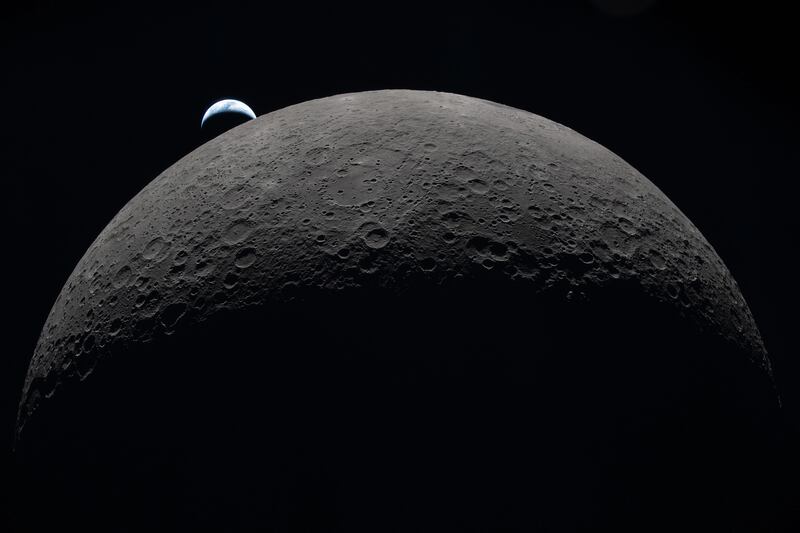
More striking than the photographs of the lunar surface, though, are those taken by the crew members of their own planet. A haunting image of the Earth setting, half in shadow, behind the curved horizon of the moon. Another of the Earth in all its vivid beauty, cradled by a crescent of light from an unseen and eclipsed Sun. Most moving of all, for me, is the photograph taken from inside the Orion’s cabin in which Wiseman, the mission commander, rests his shadowed head against the cabin window, gazing out on a view of the Earth, almost entirely blue save for the partly clouded continent of Australia.
There is something solemn about the photograph, even slightly melancholy. Though perhaps I’m projecting here, imagining as I am that Wiseman can only be thinking – as sagely as his own name somewhat heavy-handedly suggests – about the present disorder under heaven, about the foolish malignancy of the men leading his own country, and the cowardice of the leaders of so many others.

In truth, that is probably not what he’s thinking about at all, or only part of what he’s thinking about. It’s quite likely, in fact, that he’s thinking about his wife Carroll, who died of cancer in 2020, and of the two daughters they had together, Katie and Ellie, who are alive and looking up at him from that beautiful and afflicted planet.
According to a recent report in the Sunday Times, when Carroll was diagnosed with cancer, Reid was in his 40s and working in a senior management role at Nasa. He wanted to leave Nasa and move across the country with her so that she could receive cancer treatment close to her own family; she refused, however, to let him leave his career and his dream of becoming – relatively late in life – an active astronaut.
Which brings me to a video clip that seems to me the most affecting of all the recorded moments from the Orion over the days of its voyage. Visually, it’s fairly unremarkable, at least compared with those spectacular photographs of the lunar surface, and of the Earth at a distance. In the video, the camera is fixed on the cramped interior of the cabin, with its tangles of wires and its four semi-weightless astronaut occupants, practically on top of each other in their confinement. Having spent much of that day hovering over the moon’s surface, observing its craters and land formations, the crew are on a call with mission control.
Jeremy Hansen, the Canadian mission specialist, is speaking into a hand-held microphone, as Wiseman sits silently beside him. “There is a feature in a really neat place on the moon,” he says. “It is on the near-side/far-side boundary. And so at certain times of the moon’s transit around Earth, we will be able to see this from Earth.” Then he pauses, and when he begins to speak again, his voice has a slight but unmistakable quiver. “And so, we lost a loved one. Her name was Carroll, the spouse of Reid, the mother of Katie and Ellie. It’s a bright spot on the moon, and we would like to call it Carroll.” As he speaks, you can hear the emotion in his voice, and you can see Wiseman – who is presumably not up to delivering this message himself, and for whom Hansen is therefore speaking – wiping tears from his eyes, and reaching out to clasp his fellow astronaut’s shoulder.
I watched this video for the first time on Thursday night, after an evening of clicking through news stories and social media posts about the US president’s explicitly genocidal threats against Iran, and experiencing a helpless anger and anxiety at the sorrowful state of the world. Despite – or perhaps because of – the impossibility of entirely separating the Artemis II mission from that late-imperial derangement, embedded as it is within the context of a broader effort to shore up weakening American hegemony, I found the clip profoundly affecting. I watched it again, and then again, and I’ve watched it countless times more while writing this.
And every time I watch it, I am moved nearly to the point of tears by the way Wiseman reaches out to hug a colleague who has delivered on his behalf this message of love for his wife who has died; by how he literally floats towards him, and by how the other two astronauts then instinctively float towards them to join the hug.
If you’re looking to remind yourself that there is still good in the world, and that as long as people exist there always will be, I advise you to watch it yourself. And it’s a reminder, too, that in the most straightforward and simple of speech there is often a kind of poetry. “It’s a bright spot on the moon, and we would like to call it Carroll.” How lovely and devastating a thing is that to hear a man say? Just as over the horizon of the moon what comes most clearly into view is the Earth, what is revealed by death is the beauty of life.